
Karl Marx Monument
Karl Marx Monument is a monumental sculpture in Chemnitz showing a stylized head of Karl Marx. It stands 7.1 meters high, or more than 13 meters including the base, and weighs around forty tons. The work was realized from a design by Soviet artist Lew Kerbel and inaugurated in 1971. Located in the city center on Brückenstraße near the junction with Straße der Nationen, it is Chemnitz’s best-known landmark. The monument is the second-largest portrait bust in the world, after a Lenin head in Ulan-Ude. Behind it is a wall bearing the slogan “Workers of the world, unite!” in four languages.
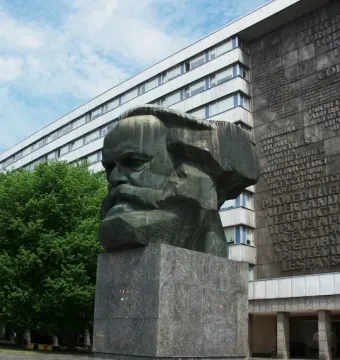
July 2022 © Aagnverglaser · CC BY-SA 3.0 de
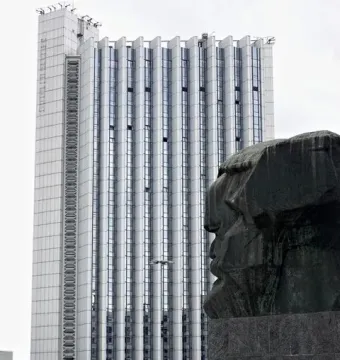
April 2022 © Lusi Lindwurm · CC BY-SA 4.0
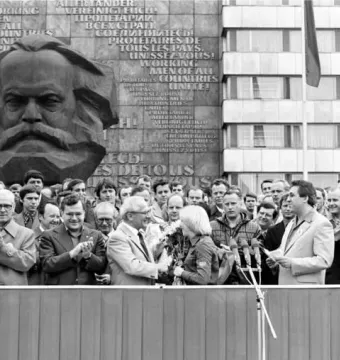
© Wolfgang Thieme · CC BY-SA 3.0 de
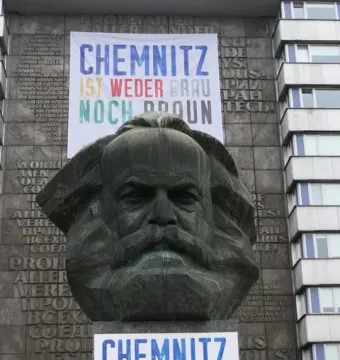
September 2018 © Dr. Bernd Gross · CC BY-SA 3.0 de
Identification | |
| Title | Karl Marx Monument |
| Subject | Karl Marx |
| Depicted form | Stylized head of Karl Marx |
| Original German name | Karl-Marx-Monument |
| Type | Monument / sculpture |
| Alternative names | Karl-Marx-Kopf; Nischel; Bashka; dor Nischl |
Historical context | |
| Commissioned after | Chemnitz and its district were renamed Karl-Marx-Stadt on 10 May 1953 |
| Purpose of commission | To honor Karl Marx and symbolize the city’s socialist transformation |
| Commissioning authority | Government of the GDR |
| Commissioning year context | 1968 was the 70th anniversary of Karl Marx’s death; the GDR also marked a Karl Marx Year in 1953, 1968, and 1983 |
Creator | |
| Designer / sculptor | Lew Kerbel (Lev Kerbel), Soviet artist and sculptor |
Discovery and provenance | |
| Place of manufacture | Leningrad, at the Monument Skulptura art foundry |
| Selection process | The client chose one of 17 sketches proposed by Kerbel |
Materials | |
| Pedestal material origin | Southern Ukraine |
| Pedestal material | Korninskij granite slabs |
| Main material | Bronze |
Technique | |
| Construction method | Cast in bronze, then divided into 95 parts and welded together |
| Assembly contractor | VEB Germania |
| Assembly issue | Soviet welding technology was considered unsuitable, so the work was transferred to VEB Germania |
Physical characteristics | |
| Height | 7.1 m |
| Total height with pedestal | more than 13 m |
| Weight | about 40 tonnes |
| Base | The monument stands on two pedestals and includes a base platform |
Appearance | |
| Stylistic description | Stylized portrait head |
| Reason for design | A full-body design was rejected because the viewer would have seen Marx’s shoes at eye level |
Iconography and meaning | |
| Inscription location | On the wall behind the monument |
| Inscription | “Workers of all countries, unite!” |
| Inscription languages | German, English, French, and Russian |
| Inscription source | The Communist Manifesto |
Location and ownership | |
| Current location | Brückenstraße, central Chemnitz, Saxony, Germany |
| Original unveiling location | Karl-Marx-Allee, now Brückenstraße, in Karl-Marx-Stadt |
| Nearby setting | Near the junction with Straße der Nationen, with the city concert hall, Hotel Merkur, and Galerie nearby |
| Background wall | Part of the former District Council building area known as the Parteisäge; the wall is now behind the monument and the State Office for Taxes and Finances is located there |
| Local nickname | Nischel |
| Nickname meaning | A local dialect word for head or skull |
| Area nickname | The area around the monument was called Schädelstätte, also rendered as Nischelgasse or Skull Alley |
History and restoration | |
| Demolition debate | The proposed demolition caused heated debate when the city reverted from Karl-Marx-Stadt to Chemnitz |
| Media and cultural uses | Appeared on a GDR 35-pfennig stamp; used in the 2013 Seeed music video 'Deine Zeit' |
| Use during GDR holidays | Backdrop for parades and mass events |
| Restoration | Sockel renovation from late 2011 to 4 April 2012 to repair water and moisture damage |
| Unveiling attendance | about 250,000 people |
| Post-unification status | Remained in Chemnitz after German reunification despite debate over demolition |
| Attendees at unveiling | Erich Honecker and Robert-Jean Longuet, Karl Marx’s great-great-grandson |
| Unveiling date | 9 October 1971 |
| Completion date | 1971 |
Significance | |
| City landmark status | Best-known and most famous monument in Chemnitz |
| Size ranking | Second-largest portrait bust in the world, after the Lenin head in Ulan-Ude |
| Historical significance | Symbol of the city of Karl-Marx-Stadt and of socialism |
| Local motto | Until 2007 the city slogan 'Stadt mit Köpfchen' (“city with brains”) referred to the monument |
| Related events | Focal point of media coverage during the 2018 unrest in Chemnitz |