
Enceladus Fountain
The Enceladus Fountain in the park of Versailles is named after a giant from Greek mythology and was built around 1676 as a decorative fountain feature. Seen from the palace, it lies to the right of the main path, the Kings’ Alley, near the Great Canal. At its center, the defeated giant tries to rise from a mass of boulders. On days with major water displays, a jet of water can burst from his mouth to a height of about 25 meters.
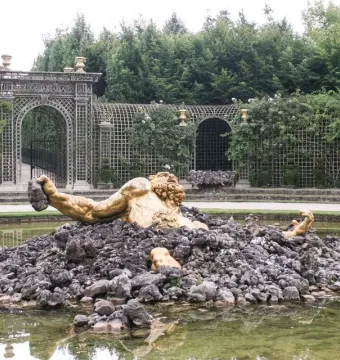
July 2008 © Szilas · CC0
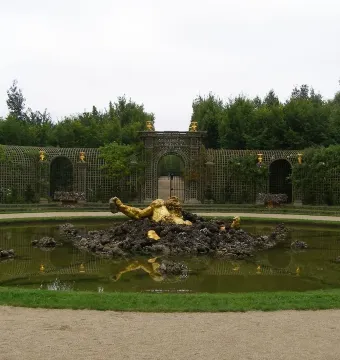
November 2012 © Provence13 · CC BY-SA 3.0
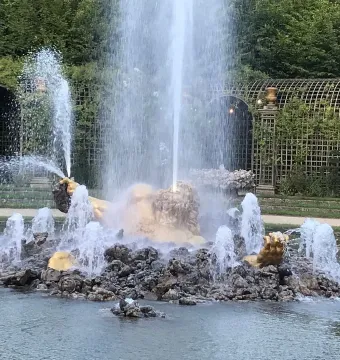
July 2020 © CvZ · CC BY-SA 4.0
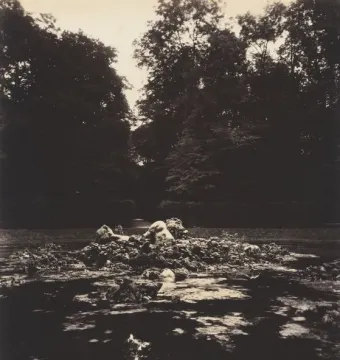
© Eugène Atget · Public domain
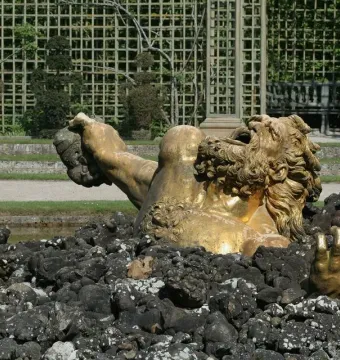
April 2011 © Coyau · CC BY-SA 3.0
Identification | |
| Title | Enceladus Fountain |
| Type | fountain |
| Alternative name | Fountain of Enceladus |
Historical context | |
| Date of creation | c. 1676 |
| Named after | a giant from Greek mythology |
| Original design context | part of a bosquet (grove) designed by André Le Nôtre |
Creator | |
| Later modification | modified and simplified by Jules Hardouin-Mansart |
History and restoration | |
| Restoration characterization | spectacular but costly to maintain |
| Louis XVI intervention referenced | replanting undertaken by Louis XVI in 1774-1776 |
| Preferred restoration reference state | the late 18th-century state, corresponding to the replanting carried out by Louis XVI in 1774-1776 |
| Historical states involved in the restoration decision | 17th, 18th, 19th, and 21st centuries |
| Restoration context | restoration of the Gardens of Versailles requested by Jean-Pierre Babelon, director of the domain, after a storm |
| Restoration result | restored to its original state |
| Restoration direction | under the direction of Pierre-André Lablaude, chief architect of historic monuments |
| Restoration date | 1998 |
| Reason for modification | Le Nôtre's decoration was considered outdated and expensive to maintain |
| Date of modification | in the 1700s |
Physical characteristics | |
| Depiction | the defeated giant trying to rise up from among boulders |
| Water feature | during large water displays, a jet about 25 meters high can spray from the mouth |
Location and ownership | |
| Location | Gardens of Versailles, Park of Versailles Palace, France, on the right side of the main path (King's Avenue) as seen from the palace, near the Grand Canal |