
Saint Louis of Toulouse
Saint Louis of Toulouse is a gilded bronze sculpture of Louis of Toulouse by Donatello, with a marble niche all'antica on the facade of Orsanmichele. It was executed in 1423–1425 and originally commissioned by the Parte Guelfa for their external niche at the centre of the east facade, facing via de' Calzaiuoli. Their patron saint, canonized in 1317, was chosen for his symbolic renunciation of worldly power, which suited Guelph support for the papacy. The sculpture is now in the refectory of the Museo di Santa Croce in Florence.
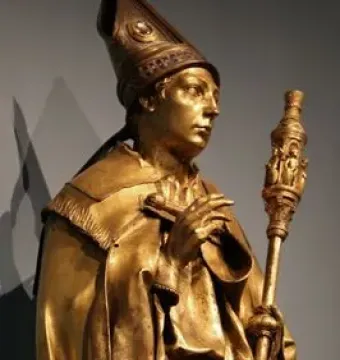
April 2022 © Francesco Bini · CC BY-SA 4.0
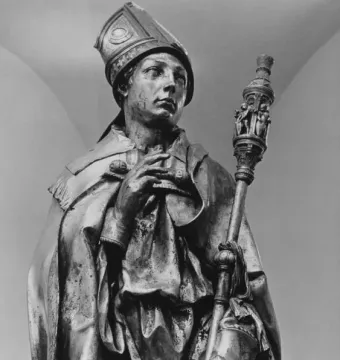
© David Finn · CC BY-SA 4.0
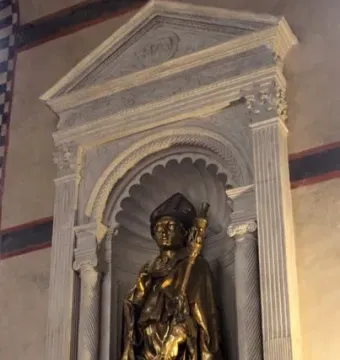
July 2015 © Miguel Hermoso Cuesta · CC BY-SA 4.0
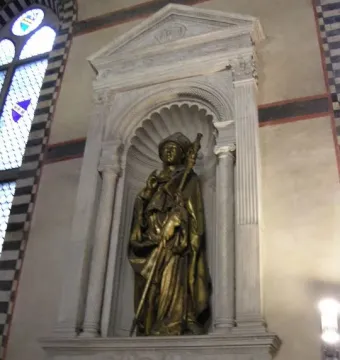
February 2009 © sailko · CC BY 2.5
April 2022 © Francesco Bini · CC BY-SA 4.0
Identification | |
| Title | Saint Louis of Toulouse |
| Type | gilded bronze statue |
| Subject | Louis of Toulouse (Saint Louis of Toulouse, Louis of Anjou) |
| Italian title | San Ludovico di Tolosa |
Creator | |
| Artist | Donatello |
Historical context | |
| Date | 1423–1425 |
| Commissioned by | the Parte Guelfa |
| Patron saint connection | the Parte Guelfa's patron saint, canonized in 1317 |
Discovery and provenance | |
| Later location | the Basilica of Santa Croce, Florence |
| Temporary return | briefly placed back in its original niche on via de' Calzaiuoli in 1943 during wartime protection |
| Post-19th-century location | the refectory of the Museo di Santa Croce, Florence |
| Placement at Santa Croce | a niche above the central portal of the facade |
| Removal date | 1459 |
| Reason for removal | the tabernacle was sold to the Tribunale della Mercanzia, which later installed Verrocchio's Group of the Incredulity of Saint Thomas there |
| Designer of the niche | Donatello, according to Vasari; Michelozzo also took part in creating the niche according to Vasari |
| Original setting | a marble tabernacle in an all'antica niche |
| Original location | an external niche at the centre of the east facade of Orsanmichele facing via de' Calzaiuoli, Florence |
Physical characteristics | |
| Height | 2.26 m |
| Width at widest point | about 0.75 m |
| Width at bottom | 0.85 m |
| Size | above life-size |
| Form | a hollow-shell statue |
| Condition | the hollow shell is open on the back; it tilts forward and requires additional, non-original support |
Materials | |
| Material | bronze, gilded |
Technique | |
| Casting technique | bronze casting using the revived lost-wax method |
| Construction | made in multiple separate pieces and later assembled |
Appearance | |
| Depiction | shown as a young bishop |
| Gesture | blessing with the right hand |
| Attributes | finely chiseled mitre, pastoral staff, bishop's gloves, friar's habit, and a heavy cope |
| Relative scale | significantly larger than the earlier works in the Orsanmichele niches |
| Fit in niche | fit more tightly into the tabernacle |
Iconography and meaning | |
| Iconographic meaning | the saint renounced his crown for religious life, symbolizing the Guelphs' support for the papacy against the Holy Roman Emperor |
| Political symbolism | associated with the Guelphs' support for the papal party in the Investiture Controversy and later conflicts |
History and restoration | |
| Post-war identification | after the war it was confirmed as Donatello's work for the Guelphs |
| War-time storage | placed in secure storage in 1943 for wartime protection |
| 19th-century transfer | with the construction of the 19th-century facade, the work was moved into storage and then to the museum |
| Relocation to Santa Croce | moved there because Santa Croce was visited by their patron saint Louis of Anjou |
| Original placement context | commissioned by the Parte Guelfa for Orsanmichele, with political pressure later forcing them to give up that representational space |
Significance | |
| Earliest known bronze sculpture by Donatello | yes |
| Earliest known sculpture of this size by Donatello | yes |
| Historical significance | the first large-scale work cast with the revived lost-wax technique in the modern era; an above life-sized bronze statue had not been produced since late antiquity, and bronze-casting knowledge was almost lost in Tuscany |
| Art-historical importance | marked Donatello's debut in bronze casting and began a new relationship of emancipation between sculpture and its niche, in contrast to Gothic sculpture |
| Critical reception | opinions range from benevolent acceptance to dismissal as a failed work |
| Vasari's judgment | Vasari described it as a rough figure and the least successful work Donatello ever made |
| Alternative interpretation | some scholars argue that Donatello expressed the conflict between ascetic conversion and the later return to power in the saint's life |
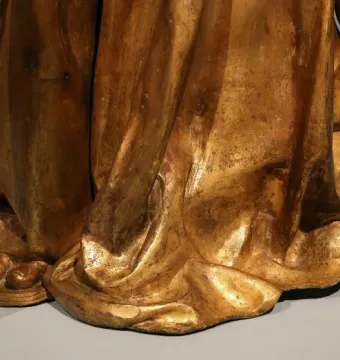
| Perceived defects | the mantle seems to crush the slender body, the mitre is excessively large, and the face is idealized |
| Possible intentional effect | Donatello may have deliberately shown the young saint overshadowed by cumbersome episcopal vestments he would have preferred not to wear |