
Fisenne Altarpiece
The Fisenne Altarpiece, also known as the Passion Altarpiece, is a winged polyptych made in the Netherlands around 1510. It belongs to the Antwerp altarpiece type, combining sculptural and painted elements, and is carved from polychromed and gilded oak. The work measures 2.04 meters high and 2.48 meters wide. Originally located in the chapel of Saint-Remi Church in Fisenne, Belgium, it is now one of the central exhibits at the Gaspar Museum in Arlon, where it has been on display since September 2004. When closed, it forms an inverted T-shape; when open, it shows New Testament scenes, including the Passion of Christ and the Seven Sacraments.
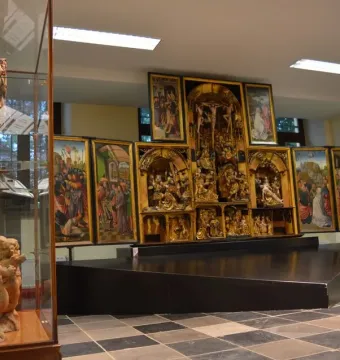
June 2019 © Valnovembre · CC BY-SA 4.0
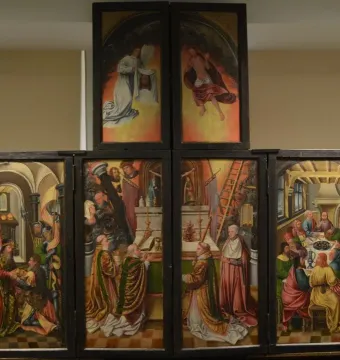
June 2016 © D'Hoest Nicolas · CC BY-SA 4.0
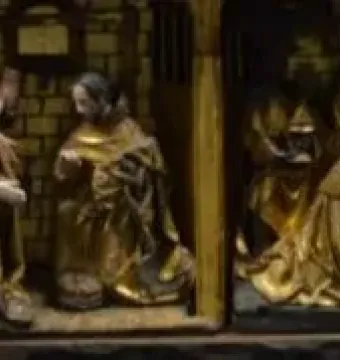
July 2016 © D'Hoest Nicolas · CC BY-SA 4.0
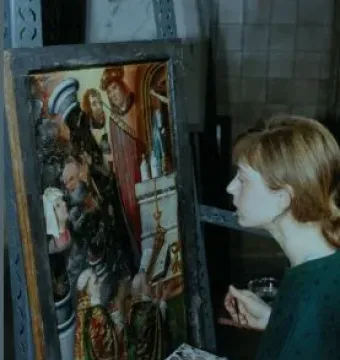
July 2016 © D'Hoest Nicolas · CC BY-SA 4.0
June 2016 © D'Hoest Nicolas · CC BY-SA 4.0
Identification | |
| Title | Reredos of Fisenne |
| Type | reredos / altarpiece / retable |
| Subtype | Antwerp altarpiece type; winged polyptych with movable wings |
| Alternative names | Fisenne Altarpiece; Altarpiece of the Passion; Reredos of the Passion; Fisenne altar; Le retable de Fisenne |
Historical context | |
| Date of creation | circa 1510 / early 16th century |
| Place of production | Antwerp workshops, Antwerp, Netherlands |
| Artistic context | An Antwerp altarpiece, within the line of Antwerp altarpieces; Antwerp works were regarded as models and a pinnacle of 16th-century craftsmanship, and the city's prestige influenced the design and monumentality of the work |
Creator | |
| Makers | Unknown; made by multiple artisans including carvers, painters, and gilders |
| Workshop context | Production was enabled by the status of the Antwerp Guild of Saint Luke |
Materials | |
| Primary material | oak |
| Surface treatment | polychromed and gilded |
| Imported material | high-quality wood imported from the Baltic region |
Discovery and provenance | |
| Sale arrangement | After several years of negotiations, the governor of Luxembourg Province agreed to carry out the repairs in exchange for the altarpiece |
| Subsequent movement | After acquisition, the altarpiece was moved several times |
| Acquisition | The governor of Luxembourg Province obtained the altarpiece |
| Commissioned for | Church of Saint-Rémi in Fisenne, Belgium |
| Reason for sale | To fund repairs to the church roof and vaults |
| Renaming of original site | The Church of Saint-Rémi became the Saint-Remi Chapel in 1713 |
| Original location | Saint-Rémi Church / Saint-Rémi Chapel, Fisenne, Belgium |
Location and ownership | |
| Current location | Musée Gaspar in Arlon, Belgium |
| Public display since | September 2004 |
| Current status | One of the museum's central exhibits / key pieces; still on display |
Physical characteristics | |
| Predella | Lost / absent |
| Structure | Two shutters, each made of two hinged panels, flanking a central case divided into two registers |
| Architectural style | Includes architectural elements reminiscent of Gothic architecture |
| Width | 2.48 m |
| Overall form | In the closed state, it has the shape of an inverted capital T |
| Height | 2.04 m |
| Niche depth | 24 cm |
Appearance | |
| Central crucifixion panel | Crucifixion |
| Surviving sacraments | Holy Orders, Eucharist, and Penance |
| Outer molding | Contains the Seven Sacraments |
| Function of shutters | They accentuate a theatrical effect of presence for the viewer |
| Central upper register | Combined with the painted panels on the shutters to evoke episodes of the Passion of Christ |
| Central lower register | Scenes from the childhood of Christ |
| Closed form imagery | Scenes from the Old Testament |
| Open form imagery | Scenes from the New Testament |
Technique | |
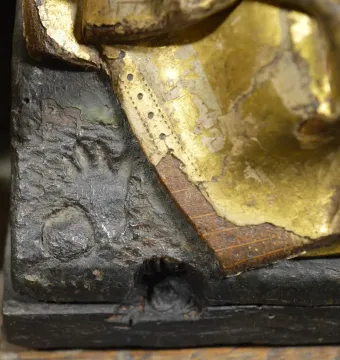
| Workshop marks | 18 open-hand guild marks made by inspectors of the Antwerp Guild of Saint Luke |
| Meaning of marks | They reproduce part of the city coat of arms and function as a quality label identifying Antwerp as the production center |
History and restoration | |
| Condition before restoration | Visibly deteriorated by time; state of preservation was very concerning until 1993 |
| Restoration in 1941 | Restored by the Royal Institute for Cultural Heritage (IRPA) |
| Restoration in 1993 | The paintings in the panels were completely restored in Antwerp by Atelier Artikon for an exhibition on Antwerp altarpieces; missing areas were reconstructed to improve readability, using a very similar altarpiece as a model |
| Preserved original polychromy | The surviving polychromy on the sculptures is original, from the beginning of the 16th century |
Significance | |
| Artistic significance | Considered a true masterpiece; the survival of original polychromy on the sculptures is rare and remarkable |
Category | |
| Categories | altars; 16th-century works; Art of Antwerp; Arlon |
Other | |
| Related publications | Guillaume Emilie and Zeippen Laetitia, Le retable de Fisenne. Joyau des collections du Musée Gaspar, vol. 1, Arlon, series "Les incontournables du Musée Gaspar", August 2016 (forthcoming at the time of the source); Marjan Buyle and Christine Vanthillo, Retables flamands et brabançons dans les monuments belges, Brussels, Ministerie van de Vlaamse Gemeenschap, series "M & L cahier, 4", 1999, 256 pages, ISBN 90-403-0104-2; Brigitte de Patoul and Roger Van Schoute (eds.), Les Primitifs flamands et leur temps, Tournai, La Renaissance du Livre, 2000, 656 pages, 33 cm, ISBN 2-8041-2013-9 |
| Event | Heritage Days (journées du patrimoine), weekend of the 10th, theme: religious and philosophical heritage; the reredos of Fisenne is featured in guided tours |