
Porta bronzea
Porta bronzea is the bronze entrance gate of Castel Nuovo in Naples, cast between 1465 and 1475. It commemorates King Ferdinand I of Naples and his victory in the 1459–1463 war against rebellious barons and the claimant Jean de Anjou. Probably inspired by Ghiberti’s Gates of Paradise and Filarete’s door for St. Peter’s Basilica, it was designed as the entrance to the triumphal arch of Castel Nuovo. The gate is made up of four panels, each measuring 130 x 120 cm, with two semicircular lunettes above them. Its reliefs depict episodes from the war, framed by classical friezes and accompanied by Latin couplets.
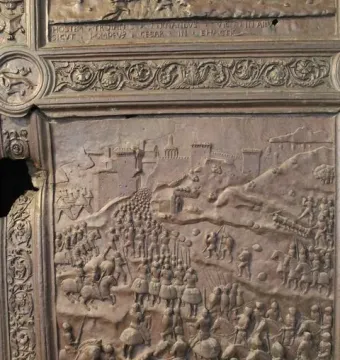
October 2014 © Richard Nevell · CC BY-SA 2.0
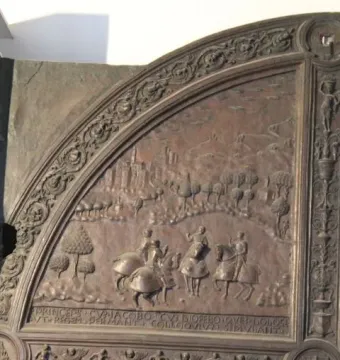
October 2014 © Richard Nevell · CC BY-SA 2.0
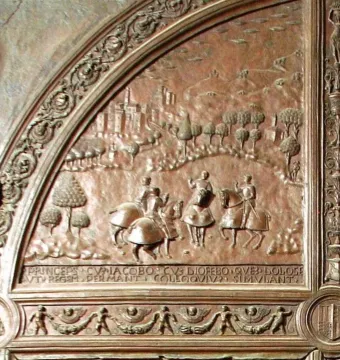
April 2021 © Guglielmo Monaco (XV secolo). · Public domain
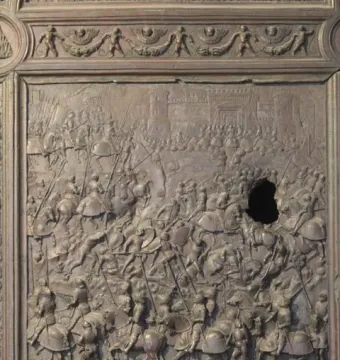
October 2014 © Richard Nevell · CC BY-SA 2.0
September 2011 © Marie-Lan Nguyen · CC BY 2.5
Identification | |
| Title | Porta bronzea |
| Type | Bronze door |
Location and ownership | |
| Location | Triumphal arch of Castel Nuovo, Naples |
Historical context | |
| Date | Cast between 1465 and 1475 |
| Commissioned by | Ferrante d'Aragona |
| Purpose | To commemorate Ferdinand I of Naples's victory over Giovanni d'Angiò and the rebel barons in the war of 1459–1464 |
| Historical period depicted | The war of 1459–1464 between Ferdinand I of Naples and the rebellious barons and French claimant Jean de Anjou |
| Political context | After the death of Alfonso the Magnanimous, Ferdinand became king and faced a rebellion by Neapolitan feudal lords and an invasion by a French claimant |
Creator | |
| Attribution | Attributed to Guglielmo Monaco; some scholars instead suggest up to three artists, possibly including Pietro da Milano |
| Probable text author | Giovanni Pontano |
Physical characteristics | |
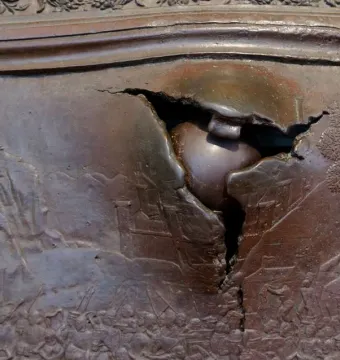
| Damage | A cannonball is embedded in the lower-left quadrant; other damage is present, and some small bronze pieces are missing, probably due to theft |
| Geographic sequence | Teano, Troia, Accadia |
| Panel order | The panels are not arranged chronologically; they are ordered geographically from north to south, and are read top to bottom from the right leaf to the left leaf |
| Decoration | Low-relief war scenes with Renaissance motifs, framed by classical friezes |
| Inscription | Latin distichs |
| Panel size | 130 × 120 cm |
| Structure | Six narrative panels, arranged in two leaves with two semicircular lunettes above |
| Material | Bronze |
Iconography and meaning | |
| Depicted subject | The victory of King Ferdinand I of Naples |
| Narrative content | Three key events of the war are shown in six panels, with two panels for each event |
History and restoration | |
| Late damage date | Late 15th century |
| Alternative damage explanation | Some authors attributed the damage to the 1503 attack on Castel Nuovo by Gonzalo Fernández de Córdoba during the Naples War of 1501–1504 |
| Assessment of alternative damage explanation | This theory is considered improbable because the cannonball appears to have struck from inside the gate and is smaller than the usual caliber for such a confrontation |
| Historical fate | After Charles VIII conquered Naples in 1495, the gate was dismantled and shipped toward France |
| Damage hypothesis | The gate was probably on the deck of the French ship when a cannonball struck it during a battle with the Genoese fleet, becoming embedded in the door |
| Subsequent fate | The Genoese reportedly sent it back to Naples in 1495, and it was reinstalled in its place |
Significance | |
| Inspiration | Ghiberti's Paradise Gate in Florence and Filarete's door for St. Peter's Basilica in Rome |