
Monument to Alexander Tamanyan
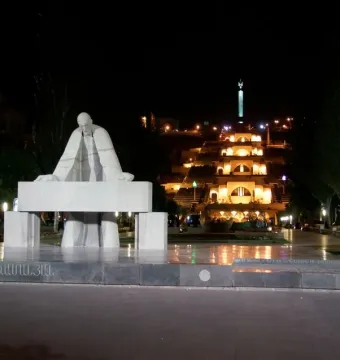
Monument to Alexander Tamanyan is set on the axis of the opera theatre designed by Tamanyan, at the start of the boulevard named after him. The five-metre basalt figure is rendered in monumental forms and stands on a granite pedestal. The architect is shown leaning on a long rectangular stone block resting on two smaller blocks, a symbolic composition explained as linking old and new architecture and helping create the city’s modern architecture. The pedestal bears the architect’s name and an Armenian national ornament. In its right corner is a plan of Yerevan, together with a line by Yeghishe Charents: “He must have seen a sunny city.” The pedestal rests on a basalt platform with wide steps.
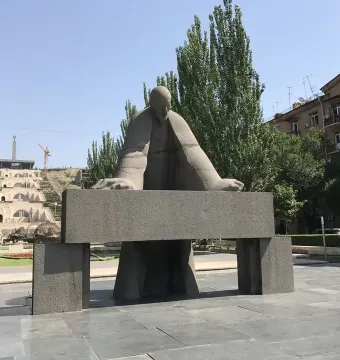
July 2017 © Benoît Prieur · CC0
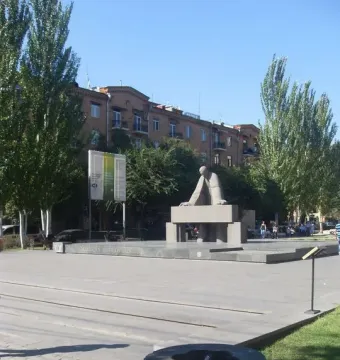
September 2013 © 23artashes · CC BY-SA 3.0
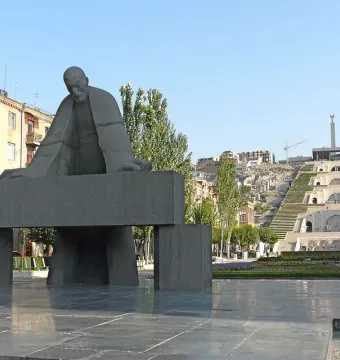
September 2008 © Rita Willaert · CC BY 2.0
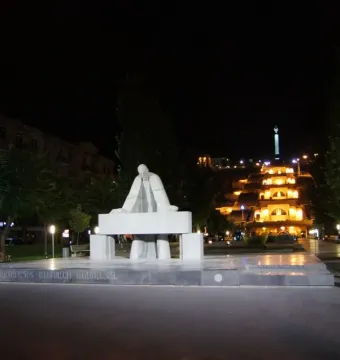
October 2013 © Sebastian Wallroth · CC BY 3.0
June 2014 © Vyacheslav Argenberg · CC BY 4.0
Identification | |
| Title | Monument to Alexander Tamanyan |
| Depicted person | Alexander Tamanyan |
| Subject occupation | Architect |
Location and ownership | |
| Location | On the axis of the opera theatre designed by Tamanyan, at the beginning of the boulevard street named after him, in Yerevan |
Physical characteristics | |
| Height | 5 meters |
| Composition | A long rectangular stone block stands on two small blocks, with two pillars supporting the platform on which Tamanyan rests |
| Pose | Tamanyan is shown leaning on a long rectangular stone block |
| Base | The pedestal rests on a basalt platform with wide steps |
| Style | Monumental forms |
Materials | |
| Base/plinth material | Basalt |
| Pedestal material | Granite |
| Figure material | Basalt |
| Materials | Basalt and granite |
Appearance | |
| Urban setting | It fits organically into the surrounding development/buildings |
Iconography and meaning | |
| Symbolism | The left stone represents old architecture and the right stone represents new architecture; the architect bridges these periods and creates the newest architecture for the capital |
| Symbolism of pillars | They represent the past and the future |
| Interpretation | Tamanyan's work symbolizes a bridge between the past and the future |
History and restoration | |
| Pedestal inscription | Tamanyan's name is carved on the granite pedestal |
| Pedestal decoration | A national Armenian ornament is carved on the pedestal |
| Pedestal decoration | A plan of Yerevan is drawn in the right corner of the pedestal |
| Pedestal inscription | A verse by Yeghishe Charents is engraved on the pedestal: 'He saw, perhaps, the sunny city' |