
Apoxyomenos Pio-Clementino
Apoxyomenos Pio-Clementino, known as the Vatican Apoxyomenos, is a marble statue housed in the Vatican Museums, specifically the Pio-Clementino Museum. It is generally considered a copy of a lost ancient Greek bronze statue made by Lysippos, although some authors have questioned whether this copy truly resembles Lysippos’s original work. The sculpture belongs to a conventional theme in ancient Greek votive sculpture and shows an athlete in the familiar act of scraping sweat and dust from his body with a small curved tool called a strigil.
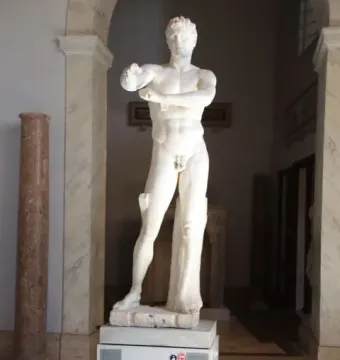
August 2019 © Gary Todd · Public domain
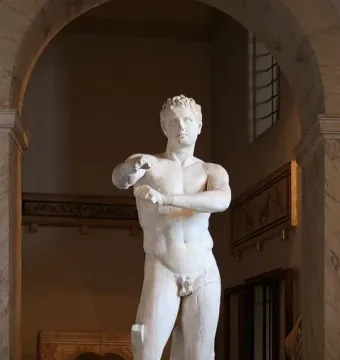
© Jean-Pol GRANDMONT · CC BY-SA 3.0
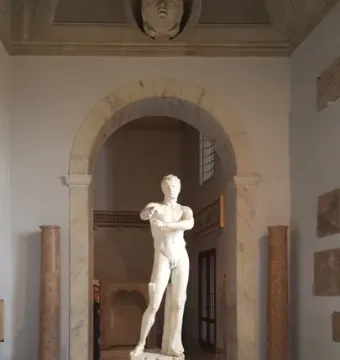
April 2017 © Jamie Heath · CC BY-SA 2.0
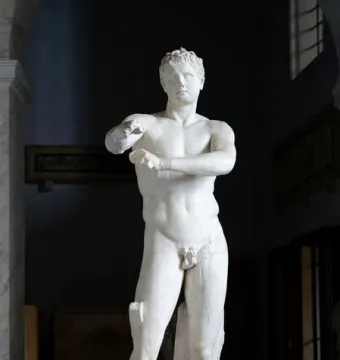
September 2015 © Alvesgaspar · CC BY-SA 4.0
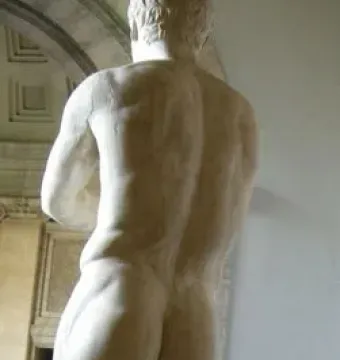
April 2010 © sailko · CC BY-SA 3.0
Identification | |
| Title | Apoxyomenos Pio-Clementino |
| Alternative name | Vatican Apoxyomenos |
| Original-language name | El Apoxiómeno del Vaticano |
| Sculpture type | Apoxyomenos |
| Object type | Statue |
Historical context | |
| Subject meaning | "the one who scrapes himself" |
| Art historical context | One of the conventional themes of ancient Greek votive sculpture |
| Apoxyomenos of Croatia similarity | Its appearance is close to the Apoxyomenos of Ephesus and to the head in the Kimbell Art Museum, Fort Worth, Texas |
| Related type note | A different Apoxyomenos type is represented by two Roman bronzes |
| Date of original statue | 4th century BC, probably around 330–320 BC |
| Original statue status | Lost |
| Related works | Apoxyomenos of Ephesus; Apoxyomenos of Croatia |
| Comparative reference | The same elongated canon also appears in the fighters of the frieze of the Mausoleum at Halicarnassus |
| Type popularity | The strigil-wielding athlete type was common in ancient statuary and already famous in antiquity |
Creator | |
| Apoxyomenos of Croatia attribution | Paolo Moreno attributes it to Daedalus of Sicyon |
| Original artist attribution | Lysippus |
| Attribution status | Most art historians consider it a copy of a lost ancient Greek bronze statue by Lysippus; some authors question whether it is actually similar to Lysippus’ statue |
Materials | |
| Restoration material detail | A fig leaf was used in the restoration to cover the athlete's genitals |
| Related type material | Bronze |
| Copy material | Pentelic marble |
| Original statue material | Bronze |
| Apoxyomenos of Ephesus material | Bronze |
Discovery and provenance | |
| Discovery location | Trastevere, Rome |
| Apoxyomenos of Ephesus identification | Roman copy |
| Related variant | A torso on the facade of building M in Side, Pamphylia, probably a library, was identified as a variant in 1973 |
| Related fragment | A much smaller torso discovered in Fiesole, Tuscany, was linked to the Apoxyomenos, but its authenticity is disputed |
| Discovery date | 1849 |
| Apoxyomenos of Ephesus discovery | Discovered in 1898 in Ephesus |
| Apoxyomenos of Croatia discovery | Discovered in 1996 in the Adriatic Sea, Croatia, by Belgian diver René Wouters |
| Related replica | A very badly damaged torso of unknown origin in the National Roman Museum was recognized in 1967 as a replica; its pose is reversed |
| Imperial history | Emperor Tiberius admired the statue so much that he had it removed to his rooms; after public outrage, it was returned |
| Ancient dedication | According to Pliny, the statue was dedicated by Marcus Vipsanius Agrippa in front of the baths that bore his name |
| Ancient description | Pliny mentions an athlete cleaning himself with a strigil (destringens se) |
| Ancient literary source | Pliny the Elder, Natural History |
| Identification history | Initially identified by Luigi Canina in 1849 as a copy of Polykleitos; in 1850 August Braun recognized it as a copy of a Lysippan bronze type |
| Inventory number | Inv. 1185 |
| Discovery context | Found by workers in the ruins of what was then believed to be Roman baths |
Physical characteristics | |
| Apoxyomenos of Croatia height | 1.92 m |
| Apoxyomenos of Croatia condition | Practically complete; missing only the little finger of the left hand |
| Apoxyomenos of Croatia preservation | Exceptional state of preservation |
| Apoxyomenos of Croatia base | Still has its ancient plinth |
| Musculature | Less strongly rendered than in Polyclitus |
| Head position | Slightly tilted and looking straight ahead |
| Action depicted | He scrapes the back of his right forearm with a strigil held in his left hand |
| Pose | A nude young athlete standing in contrapposto, with his weight on the left leg, the right leg slightly advanced and bent, the hips turned left, and the shoulders turned in the opposite direction |
| Support | A tree trunk supports the left leg; another support, now broken, formerly bore the weight of the outstretched right arm |
| Composition | Not purely frontal; the outstretched right arm creates a twisting movement that is best perceived from the sides |
| Body proportions | More elongated and slender than the Polyclitan canon, with a small head |
| Size | Slightly larger than life-size |
| Head proportion | The head measures one-eighth of the body, compared with one-seventh in the Polyclitan canon |
| Torso treatment | The torso is partly concealed by the position of the arms |
| Head treatment | The head is treated like a portrait, with disheveled hair, a marked forehead, and sunken eyes |
| Condition of restorations | Later restorations have been removed |
| Display hypothesis | The statue may have been set on a raised base |
| Height | 2.05 metres |
History and restoration | |
| Restorer | Pietro Tenerani |
| Restoration work | He completed the missing fingers of the right hand, reconstructed the missing strigil of the left hand, completed the tip of the nose, and covered the athlete's genitals with a fig leaf |
| Literary reception | Cited by Jacob Burckhardt in his 1865 Cicerone (guide to Rome) |
| Apoxyomenos of Croatia recovery and restoration | Raised in 1999 and restored in 2005 |
| Copies and reproductions | Numerous casts have been made |
Location and ownership | |
| Current location | Pio-Clementino Museum, Vatican Museums |
| Apoxyomenos of Croatia current location | Apoxyomenos Museum, Mali Lošinj, Croatia (since 2016) |
| Current location detail | Vatican Museums, specifically the Pio-Clementino Museum |
| Apoxyomenos of Ephesus current location | Kunsthistorisches Museum, Vienna (Inv. 3168) |
Significance | |
| Status among surviving examples | Only complete marble example of this type known |