
Equestrian Statue of José de San Martín
The Equestrian Statue of José de San Martín is part of the Monument to General San Martín and the Armies of Independence, located in Plaza General San Martín in Buenos Aires. It is a bronze equestrian monument set on a polished red granite base. The monument honors the Argentine national hero and four key moments linked to American independence: Departure for war, the Battle, Victory, and The return of the victor. The rider on horseback was the first equestrian monument in Argentina, inaugurated on 13 July 1862 and created by the French sculptor Louis-Joseph Daumas. The bronze groups around the base were made by the German sculptor Gustavo Eberlein and inaugurated in 1910.
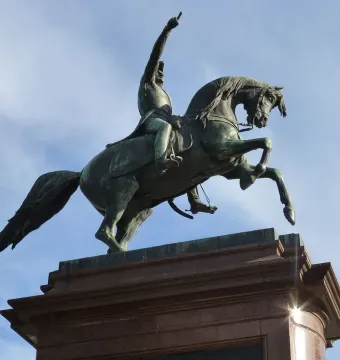
September 2012 © Galio · CC BY-SA 3.0
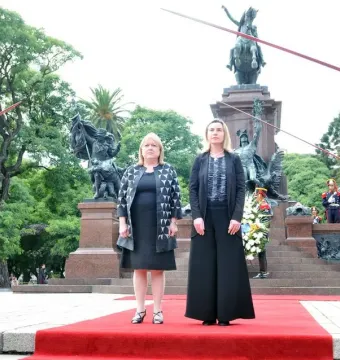
March 2016 © Cancillería Argentina · CC BY 2.0
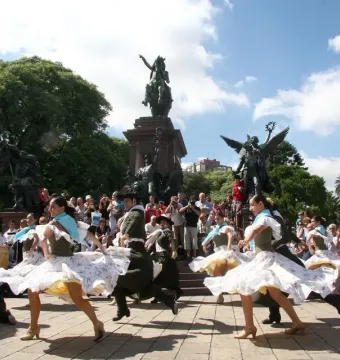
March 2010 © Gobierno de la Ciudad de Buenos Aires · CC BY 2.0
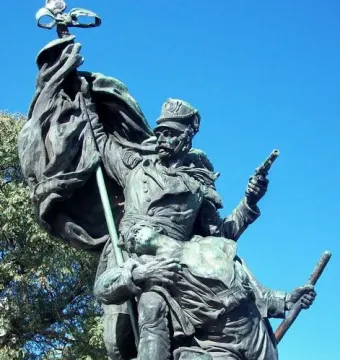
August 2008 © Gustav Eberlein · Public domain
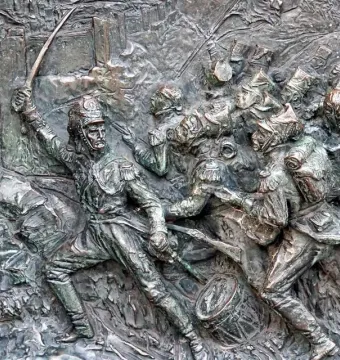
October 2019 © Dennis G. Jarvis · CC BY-SA 2.0
Identification | |
| Title | Equestrian statue of José de San Martín |
| Monument name | Monumento al General San Martín y a los Ejércitos de la Independencia |
| Type | Equestrian statue |
| Depicted figure | José de San Martín |
Historical context | |
| Honoree significance | General and Argentine national hero; liberator of Argentina and hero of American independence |
| Commissioned by | Government of Chile |
| Original intended location | Santiago, Chile |
| Original model completed | 1860 |
| Original commission year | 1860 |
| Original title | Monument to José de San Martín in Buenos Aires |
| First equestrian monument in Argentina | Yes |
Creator | |
| Sculptor | Louis-Joseph Daumas |
| Sculptor specialization | French sculptor specialized in equestrian figures |
| Redesign sculptor | Gustav Eberlein |
| Redesign sculptor's nationality | German |
Discovery and provenance | |
| Arrival in Buenos Aires | 13 April 1862, disassembled |
| Copy made for Buenos Aires | Daumas made a copy for Buenos Aires |
| Argentine commission members | Joaquín Cazón (president), Constant Santa María (vice president), Santiago Albarracín (treasurer), Leonardo Pereira (secretary), Hilarión Medrano, and Manuel Aguirre |
| Commission decision | To place the monument in the Retiro neighborhood and request Daumas to make a replica of the statue intended for Chile |
Location and ownership | |
| Current location | Plaza General San Martín, Buenos Aires, Argentina |
| Original installation location | A square in the Retiro district, Buenos Aires, Argentina |
| Site history | The square stands on the site of the former Campo de Marte, where General San Martín organized the squadron of the Granaderos a Caballo |
| Location country | Argentina |
Physical characteristics | |
| Facial appearance | Shaven, with short sideburns |
| Current condition | The monument has suffered vandalism and thefts |
| Design modification from the Chilean version | The horse's tail does not rest on the plinth in the Buenos Aires version |
| Pose | Serene attitude, with the right arm extended and pointing the way |
| Current orientation | Facing west toward the Andes |
| Depicted age | About thirty to forty years old |
| Structural characteristic | One of the rare equestrian sculptures with two points of support |
| Original orientation | Facing east |
| Base | White marble base, later replaced by polished red granite pedestal |
| Overall form | Equestrian monument |
Materials | |
| Added groups and reliefs material | Bronze |
| Base material | Polished red granite |
| Main material | Bronze |
Technique | |
| Model for pose | Théodore Géricault's 1819 lithographic portrait |
| Figure source | Daumas based the figure on a portrait of the flag that Mercedes, San Martín's daughter, had in France |
Appearance | |
| Clothing and accessories | His clothing, curved saber, and horse were faithfully based on the real ones preserved by his family after his death |
Iconography and meaning | |
| Illustrated elements in captions | The God Mars, The Battle, The Victory, and The Battle of Salta |
| Historical inaccuracy in the Salta relief | The relief does not match the historical event: after the Battle of Salta, Belgrano embraced Pío Tristán in front of the formed troops, not on horseback as shown |
| Contested inclusion | The inclusion of the Capture of Montevideo was questioned because it was carried out by Carlos María de Alvear, who at that time was an enemy of San Martín |
| Misnamed relief history | The Battle of Salta relief was originally called the Battle of Tacuarí, but the Centennial Commission accepted Eduardo Schiaffino's objection to that name |
| Relief subjects | The Battle of San Lorenzo, the Battle of Chacabuco, the Battle of Maipú, the Crossing of the Andes, the Proclamation of the Independence of Peru, the Battle of Salta, and the Capture of Montevideo |
| Front figure | The god Mars holding the Condor with his left leg, representing Victory |
| Symbolism of additional figures | They symbolize four periods of the Argentine War of Independence: departure for war, decisive battle, triumphant victory, and return home |
| Additional figures added | Four figures were added in 1910 |
| Commemorated themes | Departure for war, decisive battle, triumphal victory, and return home |
History and restoration | |
| Extent of correction | Because most fragments had already been cast, only part of the inaccuracies could be corrected |
| Items stolen in 2021 | Bronze pieces such as swords, laurel wreaths, and helmets |
| Security measures | The monument was enclosed behind 50 iron-fence sections, each 3.3 m high and 2 m long; stolen pieces were replaced with theft-resistant material simulating bronze, such as cement mixed with resin; additional security measures included fences and cameras |
| Reason the Salta relief error was not corrected | There was no time to correct it before the inauguration, so no changes were made then or since |
| Later commentary | Eduardo Schiaffino commented on the work in La Nación on 9 May 1926 |
| Newspaper criticism | La Prensa reported on 22 April 1910 that the historical representation was inaccurate |
| Controversy | The Eberlein work generated controversy because of historically inaccurate representations in the bas-relief depicting the Battle of Tucumán and Belgrano's surrender |
| Attendees at rededication | President José Figueroa Alcorta of Argentina, the President of Chile, veterans Enrique Martínez, Tomás Guido, and Lucio V. Mansilla, delegations from neighboring countries, and army battalions |
| Official rededication date | 27 May 1910 |
| Chilean version completed | 1860 |
| Inspection findings | The figures, fauna, and flora did not reflect South American realities, and the soldiers were dressed in Napoleonic uniforms |
| Inspection by Ernesto de la Cárcova | Ernesto de la Cárcova visited Eberlein's studio in January 1910 and reviewed the work in Germany |
| Inspection date | January 1910 |
| Reason for redesign | To make the monument more pompous, one year after the centenary of the May Revolution |
| Later redesign date | 1909 |
| Chilean version inaugurated | 5 April 1863 |
| Comparison with Chilean monument | The Argentine statue was inaugurated several months before the Chilean one |
| Decree ceremony instructions | Upon unveiling, the statue was to be greeted with music, bugle calls, cheers, and a 21-gun salute; afterward, the troops would return to their barracks and a sentry would be stationed at the foot of the statue |
| Government decree date | 11 July 1862 |
| First inauguration date | 13 July 1862 |
Significance | |
| Historical significance | The first equestrian statue in South America located in Argentina |