
Armed Aphrodite
Armed Aphrodite is a first-century AD Roman marble, lifesize sculpture depicting Aphrodite Areia, the warlike aspect of the Greek goddess Aphrodite, known to the Romans as Venus. It is modeled after a lost fourth-century BC Greek original by Polykleitos the Younger and once adorned the sanctuary of Asclepius in Epidaurus. The sculpture was unearthed during excavations at the ancient site in 1886. It is now in the collection of the National Archaeological Museum of Greece in Athens, accession number 262. The statue is missing its right forearm, lower legs, and feet, and its face shows significant wear.
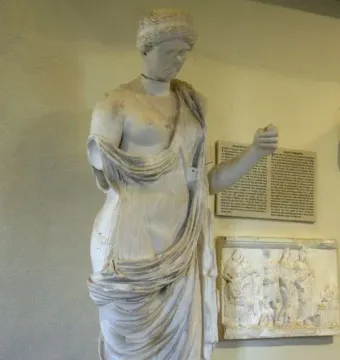
July 2009 © Zde · CC BY-SA 4.0
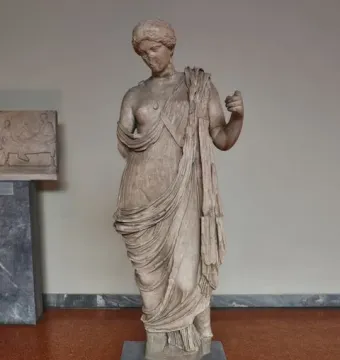
July 2018 © George E. Koronaios · CC BY-SA 4.0
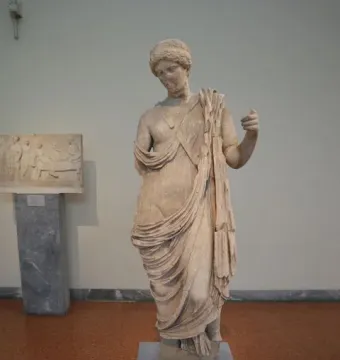
April 2018 © George E. Koronaios · CC BY-SA 4.0
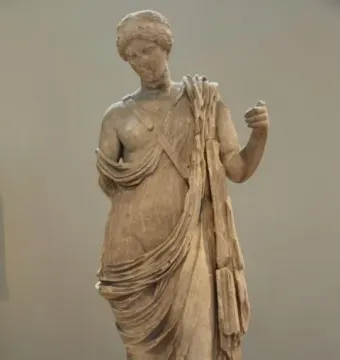
July 2016 © Gary Todd · CC0
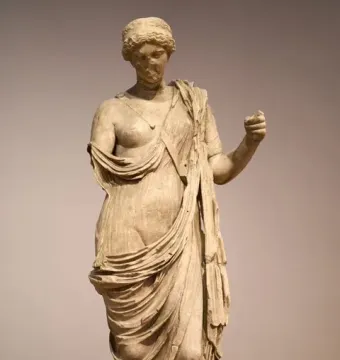
January 2023 © George E. Koronaios · CC BY-SA 4.0
Identification | |
| Title | Armed Aphrodite |
| Type | Roman marble statue |
| Culture | Roman |
| Title in Spanish | Afrodita armada |
Historical context | |
| Date | First century AD |
| Original model date | 4th century BC |
Creator | |
| Attributed artist of original model | Polykleitos the Younger |
Discovery and provenance | |
| Model | A lost Greek original of the 4th century BC |
| Originality hypothesis | Possibly an original Greek work from the Hellenistic period rather than a Roman copy |
| Reattached parts | The left arm and head were found separately and reattached to the sculpture |
| Discovery context | Unearthed during excavations at the sanctuary of Asclepius; found with several other sculptures |
| Discovery location | Ancient Epidaurus |
| Discovery date | 1886 |
| Original setting | Sanctuary of Asclepius, Epidaurus |
Physical characteristics | |
| Height | 1.51 m |
| Size | Lifesize |
| Condition | Heavily damaged; the face is badly worn, and the right forearm, lower legs, feet, and nose are missing |
Materials | |
| Material | Parian marble |
Appearance | |
| Hair | Delicate wavy hair tied with a ribbon and arranged at the back of the head in a ponytail wrapped in a hairnet |
| Right hand object | Unknown |
| Sword | She held a sword in her left hand |
| Sword strap | A sword scabbard strap crosses diagonally over the semi-nude chest |
| Clothing | Very thin, almost transparent chiton |
| Left arm garment arrangement | The chiton wraps around the left arm and falls freely at her side |
| Clothing effect | The chiton clings to the torso, emphasizing the curves of the body, especially the pubic triangle and navel |
| Head position | Head turned left and tilted downward |
| Pose | Standing with weight on the right leg and the left leg relaxed |
| Right shoulder | The chiton has slipped off the right shoulder, exposing the right breast |
Iconography and meaning | |
| Relationship to Ares | Her lover |
| Locations where this representation was found | Sparta, Argos, Cythera, and Taras (modern Taranto) |
| Associated worship | Sometimes worshipped as a war goddess |
| Cult and religious context | Ancient Greek cult and religion |
| Depiction | Shown as a war goddess, in full armor like Ares |
| Related deity | Ares |
| Usual association of deity | More commonly worshipped as a goddess of beauty and love |
| Epithet meaning | "Aphrodite the Warlike" |
| Depicted figure | Aphrodite Areia, the warlike aspect of Aphrodite (Venus to the Romans) |
Location and ownership | |
| Current location | National Archaeological Museum of Athens, Greece |
| Inventory number | 262 |
History and restoration | |
| Display status | Displayed at the National Archaeological Museum of Athens ever since its transfer to Athens |