
Napir-Asu
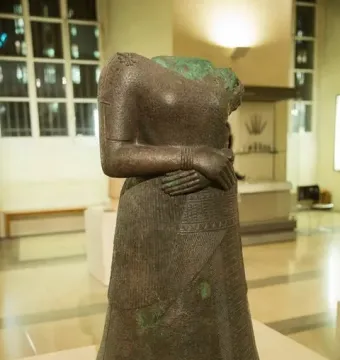
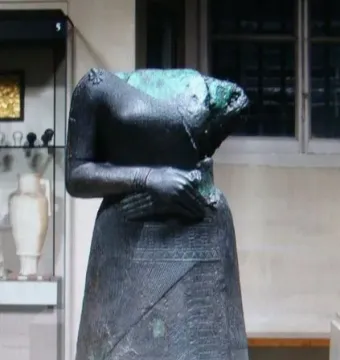
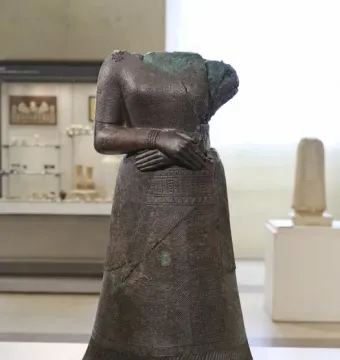
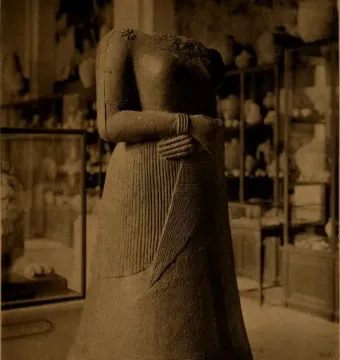
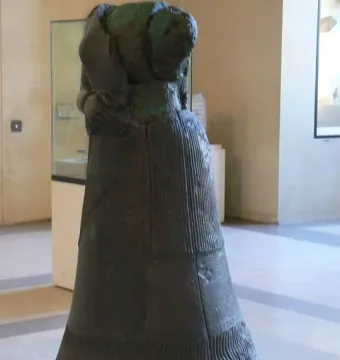
Napir-Asu is a major work of Elamite art now in the Louvre in Paris. The nearly life-size statue, 1.29 m tall, was found in 1903 by Jacques de Morgan in Susa, the capital of Elam, in the temple of the Sumerian goddess Ninḫursanga. It shows the standing queen in a long, wide robe, with hands crossed over the stomach in a prayer pose. The head and most of the left arm are lost. The figure is decorated with patterned garments and arm rings, and carries an Elamite inscription with a curse against anyone who damages the statue or its text. It was cast in bronze and copper using the lost-wax process, and was likely once adorned with silver and gold leaf.
January 2016 © Ninara · CC BY 2.0
February 2013 © Nahankhaneh · CC BY-SA 3.0
May 2025 © Shonagon · CC0
1900 © Geffroy, Gustave, 1855-1926 · No restrictions
June 2007 © user:Rmashhadi · Public domain
Identification | |
| Title | Napir-Asu |
| Type | Elamite statue |
Historical context | |
| Date | Second half of the 14th century BC |
| Art historical significance | One of the main works of Elamite art |
| Artistic context | From a flourishing period of Elamite bronze working |
Creator | |
| Depicted person | Napir-Asu, wife of Untaš-Napiriša |
| Depicted person's spouse | Untaš-Napiriša |
| Spouse's reign | c. 1275–1240 BC |
Discovery and provenance | |
| Discovery place | Ruins of the temple of Ninhursag in Susa, the capital of Elam |
| Discoverer | Jacques de Morgan |
| Find context | Found in the temple of the Sumerian/Mesopotamian goddess Ninḫursanga |
| Possible father of Napir-Asu | Probably the Babylonian king Burna-buriaš II |
| Interpretive note on find context | The statue's discovery in a temple of a Mesopotamian rather than an Elamite deity may be explained by the hypothesis that Napir-Asu's father was Burna-buriaš II |
| Discovery date | 1903 |
Physical characteristics | |
| Clothing | Long, wide bell-shaped garment with short sleeves; skirt wrapped around the body |
| Decoration | Upper garment with a pattern of circles with dots resembling eyes; skirt with geometric patterns and a fringed lower part |
| Jewelry | Four bracelets on the right arm |
| Scale | About life-size |
| Pose | Standing figure with hands crossed over the abdomen in a praying posture |
| Condition | Head missing; left arm mostly lost |
| Weight | 1750 kg |
| Height | 1.29 m |
Materials | |
| Material | Bronze and copper |
| Core material | Bronze |
| Core composition | 11% tin |
| Outer material | Copper |
| Outer composition | 1% tin |
| Original surface treatment | Probably covered with gold or silver leaf/sheet |
Technique | |
| Casting technique | Lost-wax casting in a mold |
| Inscription technique | Inscription engraved after casting |
Iconography and meaning | |
| Inscription | Elamite inscription with a curse against anyone who damages the statue or its inscription |
| Deities named in inscription | Napiriša, Kiriša, Inšušinak, and Beltiya ('my lady') |
Location and ownership | |
| Current location | Louvre, Paris |