
Six Steeds of Zhao Mausoleum
The Six Steeds of Zhao Mausoleum are a group of six high-quality limestone bas-reliefs created during China’s Tang dynasty (618–907). Each relief measures 2 meters wide and 1.7 meters high and depicts a different warhorse. For more than 1,200 years, they stood along the north gate of Tang Taizong’s mausoleum, north of Xi’an, China. The six horses were personally selected by Emperor Taizong to represent his battlefield successes and rise to power, and each was given a name. In the 1910s, the reliefs were removed from Zhaoling; two are now at the University of Pennsylvania Museum of Archaeology and Anthropology, and four are in the Beilin Museum in Xi’an. They are considered important artistic treasures of China.
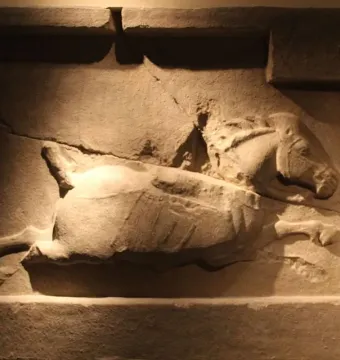
September 2011 © Gary Todd · CC0
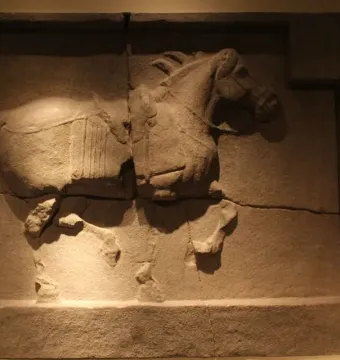
September 2011 © Gary Todd · CC0
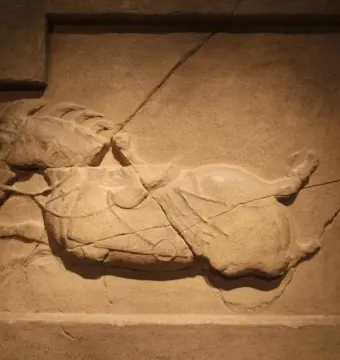
September 2011 © Gary Todd · CC0
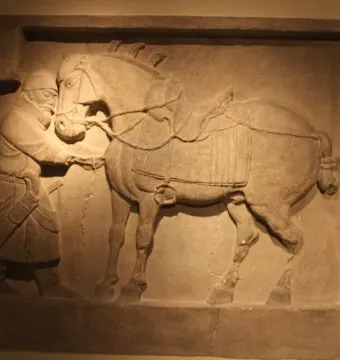
September 2011 © Gary Todd · CC0
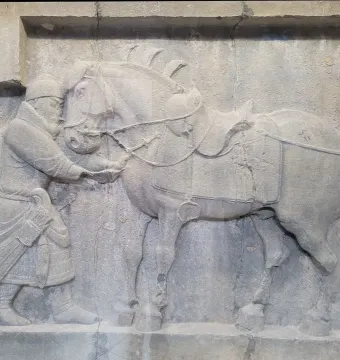
© SnowFire · CC BY 4.0
Identification | |
| Title | Six Steeds of Zhao Mausoleum |
| Chinese name | Zhāolíngliùjùn |
| Type | Set of six Tang stone bas-reliefs |
Historical context | |
| Date | Tang dynasty (618–907); commissioned in 636 and completed in 649 |
| Commissioned by | Emperor Taizong of Tang (Li Shimin) |
| Burial site | Zhaoling (the mausoleum of Emperor Taizong of Tang) in Shaanxi, China |
| Original setting duration | Remained at Zhaoling for more than 1,200 years |
| Placement at original site | Placed along the north gate of Zhaoling when Taizong was buried there in 649 |
Creator | |
| Traditional designer | Yan Liben; possibly the designer of the whole structure |
Materials | |
| Material | Limestone |
Physical characteristics | |
| Form | Bas-reliefs |
| Number of works | Six |
| Dimensions | Each relief measures about 2.0 m wide and 1.7 m high |
Iconography and meaning | |
| Horse names | The names are transliterations of Turkic or Central Asian terms, suggesting the horses may have been gifts or tributes from the Tujue |
| Historical use of the horses | Ridden by Taizong during the early campaigns to reunify China under the Tang |
| Inscription | Emperor Taizong wrote a personal eulogy for each horse |
| Interpretation | They represent Emperor Taizong's battlefield successes and his conquest of power |
| Depicted horses | Quanmaogua, Shifachi, Baitiwu, Telebiao, Qingzhui, and Saluzi (Autumn Dew) |
| Subject | Six war horses of Emperor Taizong |
Discovery and provenance | |
| Style | Very flat and linear, likely carved after drawings or paintings |
| Removal from original site | Two reliefs were stolen after the Xinhai Revolution in 1912 or 1913; the four remaining reliefs were confiscated by local authorities |
| Recovery and transfer | The two stolen reliefs were seized by Shaanxi authorities and sent to Beijing in 1915 on President Yuan Shikai's orders |
| Sale and export | Two reliefs were sold by C. T. Loo in 1914 and shipped to the United States sometime between 1914 and 1918 |
| Acquisition by Penn Museum | The University of Pennsylvania Museum negotiated purchase from 1918 to 1921; Eldridge R. Johnson bought the reliefs and donated them to the museum |
Location and ownership | |
| Current location of two reliefs | University of Pennsylvania Museum of Archaeology and Anthropology, Philadelphia, United States |
| Current location of four reliefs | Beilin Museum, Xi'an, China |
| Storage after seizure | Shaanxi Provincial Library |
History and restoration | |
| Conservation | In 2010, three experts from China helped reconstruct the two cracked reliefs in Pennsylvania |
| Diplomatic issue | China has pressed the United States to return the reconstructed reliefs |
Significance | |
| Cultural importance | Important Chinese art treasures |
| Art historical status | Regarded as ancient Chinese art treasures |