
Bronze Head of Hypnos from Civitella d'Arna
The Bronze Head of Hypnos from Civitella d'Arna is an ancient bronze sculpture now displayed in the British Museum under bronze catalogue number 267 (Inv. GR 1868.6-6.9). It is a Roman copy from the 1st–2nd century of a late Classical original, thought to date to around 350 BC and attributed to the school of Praxiteles or Skopas. The approximately 21 cm high head was found in Civitella d’Arno near Perugia and purchased in 1866. Only the head survives, and it shows some damage. The god’s face is inclined forward, his lips slightly parted, and his wavy hair is held by a broad headband. Wings appear at both sides, though one survives only as a stump.
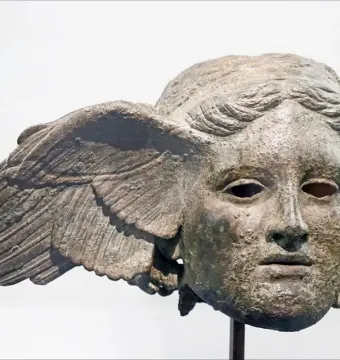
March 2019 © Jean-Pierre Dalbéra · CC BY 2.0
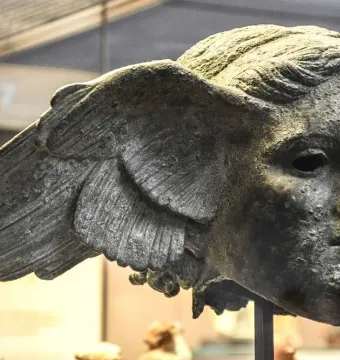
May 2014 © Carole Raddato · CC BY-SA 2.0
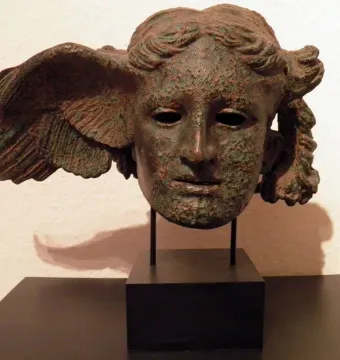
January 2013 © Carole Raddato · CC BY-SA 2.0
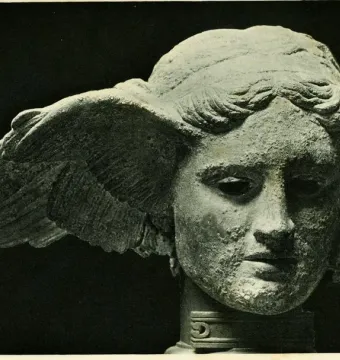
1898 © Murray, A. S. (Alexander Stuart), 1841-1904 · No restrictions
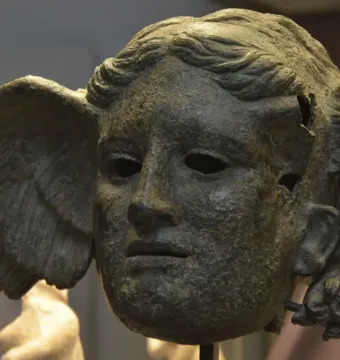
May 2014 © Carole Raddato · CC BY-SA 2.0
Identification | |
| Title | Bronze Head of Hypnos from Civitella d'Arna |
| Subject | Hypnos, god of sleep and father of dreams |
| Object type | Ancient Roman bronze head fragment |
Historical context | |
| Date | Roman copy from the 1st–2nd century of a Late Classical original about 350 BC |
| Original attribution | Attributed to the school of Praxiteles or Skopas |
Creator | |
| Original work attribution | Attributed to the school of Praxiteles or Skopas |
Discovery and provenance | |
| Later ownership | Part of the Castellani Collection |
| Museum acquisition | Purchased by the British Museum in 1868, along with other parts of the Castellani Collection |
| Discovery details | Originally discovered there; the circumstances of the find are largely unknown |
| Discovery date | Early 19th century |
| Findspot | Civitella d'Arna near Perugia, central Italy |
Location and ownership | |
| Current location | British Museum |
| Collection number | Bronze catalogue no. 267 (Inv. GR 1868.6-6.9) |
Physical characteristics | |
| Hair | Wavy, elaborately woven hair parted in the middle, combed to both sides, and tied in a knot at the back |
| Original attributes | The full statue would have held a drinking horn and poppies |
| Wings | Wings on both sides of the head; one survives only as its base, and one emerges from the right temple |
| Headband | Broad headband (tainia) holding the hair together |
| Survival | Only the head survives; the rest of the body is lost |
| Face | Lips slightly open |
| Pose | Head inclined forward; the original full figure would have been walking forwards |
| Height | Approximately 21 cm |
| Condition | The head is damaged |
Materials | |
| Material | Bronze |
Iconography and meaning | |
| Depicted figure | Hypnos, the god of sleep |
| Literary comparison | Homer compared his wings to those of a nightjar |
Significance | |
| Rarity | Sculptural depictions of Hypnos are very rare; only a handful of similar statues are known in Western Europe, though he is frequently shown in Greek vase painting |
| Copying and popularity | Widely copied since its discovery |