
Hercules and Lychas
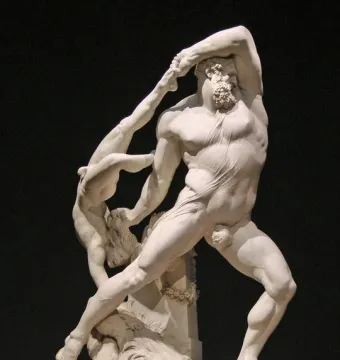
Hercules and Lychas is a marble sculptural group by Antonio Canova, executed between 1795 and 1815 and now housed in the National Gallery of Modern Art in Rome. The work was commissioned in March 1795 by Prince Onorato Gaetani, inspired by Canova’s earlier group of Adonis and Venus. It depicts a scene from ancient poetry: Hercules, driven mad by the pain of a tunic soaked in the poisoned blood of the centaur Nessus, throws the young Lychas into the air after Lychas has delivered the garment on Deianira’s orders. Interrupted several times and left unfinished amid political events in Naples, the sculpture was later acquired by Giovanni Torlonia and finally completed in 1815.
June 2011 © Jean-Pierre Dalbéra · CC BY 2.0
August 2014 © Mm4mm · CC BY-SA 4.0
1812 © Rijksmuseum · CC0
August 2022 © Federigo Federighi · CC BY-SA 4.0
September 2015 © Lalupa · CC BY-SA 4.0
Identification | |
| Title | Hercules and Lychas |
| Original title | Ercole e Lica |
| Type | Sculptural group |
Creator | |
| Artist | Antonio Canova |
Historical context | |
| Date of execution | 1795–1815 |
| Commission date | March 1795 |
| Commissioned by | Prince Onorato Gaetani dei principi d'Aragona |
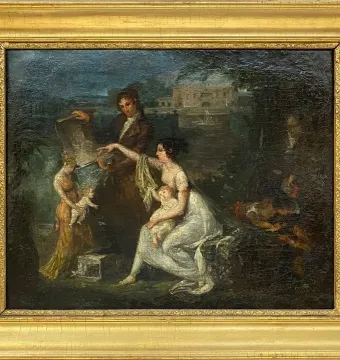
| Commission inspiration | Gaetani admired Canova's earlier group Adonis and Venus, acquired by Marquis Francesco Berio and placed in a specially built temple in the garden of his palace in Naples on Via Toledo |
| Work interruption | Interrupted several times because of the severe political events in Naples following the arrival of the French |
| Later ownership | Purchased by Giovanni Raimondo Torlonia in 1800 |
| Completion date | 1815 |
| Proposal for Verona | In 1799 Canova proposed the work as a monument to celebrate Verona's victory on 5 April 1799 against French troops, with Lychas identified with France; the proposal for Piazza Bra was refused by Emperor Francis II of Austria-Lorraine |
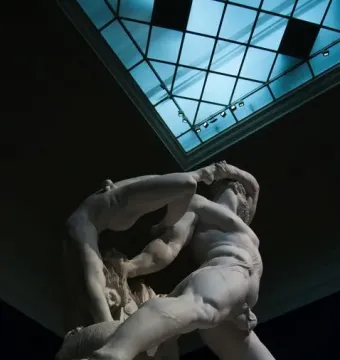
| Initial presentation | Placed by the owner in an exedra of his palace and illuminated with zenithal light |
Materials | |
| Material | Marble |
Appearance | |
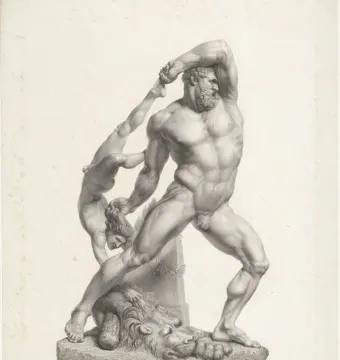
| Composition | Two nude bodies in an arched torsion |
| Hercules depiction | Shown in a moment of maximum muscular tension, angry, with a thick curly beard, and almost completely nude except for a very thin veil that covers the musculature |
| Lychas depiction | Shown screaming, lifted forcefully from the ground, suspended in the air, and struggling in vain to cling to the altar behind Hercules and the lion skin at Hercules' feet |
| Formal character | Marked by absolute geometric precision |
| Emotional effect | Great energetic intensity and a desperate climax in the boy's face and Hercules' expression |
Iconography and meaning | |
| Subject | A scene from Greek mythology in which Hercules, maddened by pain from the poisoned tunic stained with the blood of the centaur Nessus, throws the young herald Lychas into the air; Lychas had unknowingly delivered the tunic to Hercules under Deianira's orders |
| Mythological figures depicted | Hercules, Lychas, Deianira, Nessus |
| Iconographic elements | Altar behind Hercules; lion skin at Hercules' feet |
| Interpretation | The French interpreted the work as an allusion to France overthrowing the monarchy, but Canova did not intend an ideological reference or identify such meaning himself |
Technique | |
| Artistic source of inspiration | Based on a careful study of celebrated ancient marble sculptures, especially the Colossi of the Quirinal, the Hercules Farnese, and the Hellenistic group Laocoön and His Sons in the Vatican Museums; the group of Hector and Troilus (also known as Athamas and Learchus) in the National Archaeological Museum of Naples may also have been studied |
Discovery and provenance | |
| Plaster model location | Gipsoteca Canoviana, Possagno |
Location and ownership | |
| Current location | Galleria Nazionale d'Arte Moderna, Rome |
Significance | |
| Reception | Immediately successful at its first exhibition, but later critics judged the work negatively as academically executed and lacking true emotional participation |