
Jeune fille de Mégare
Jeune fille de Mégare is a marble statue made in 1870 by the French sculptor Louis-Ernest Barrias. It depicts a young girl from the Greek city of Megara seated cross-legged, with bare breasts, holding a spindle in one hand and a distaff in the other. Purchased at the Salon in the year it was created, the sculpture is now conserved at the Musée d'Orsay in Paris.
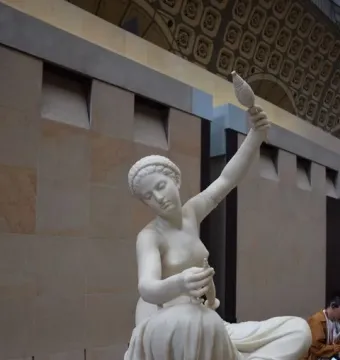
July 2023 © Chatsam · CC BY-SA 3.0
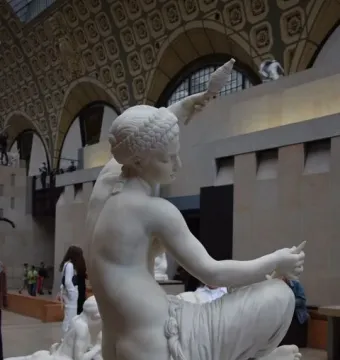
July 2023 © Chatsam · CC BY-SA 3.0
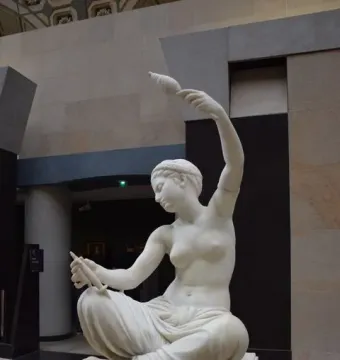
July 2023 © Chatsam · CC BY-SA 3.0
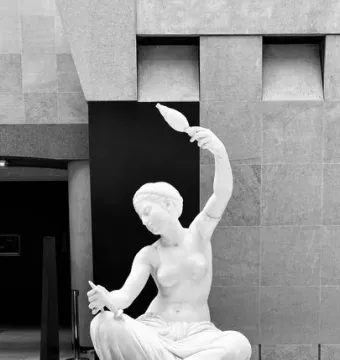
June 2023 © Cnbrb · CC BY-SA 4.0
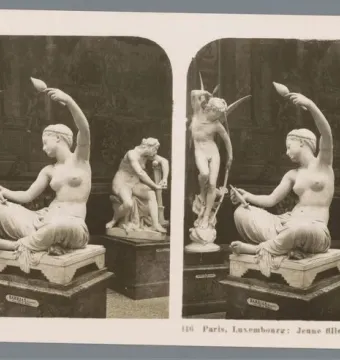
1904 © Rijksmuseum · CC0
Identification | |
| Title | Jeune fille de Mégare |
| Alternative titles | La Ragazza di Megara; Fileuse de Mégare |
| Type | statue |
Creator | |
| Artist | Louis-Ernest Barrias |
| Artist nationality | French |
Historical context | |
| Date | 1867–1870 |
| Place of creation | Rome |
Materials | |
| Material | marble |
| Other version material | plaster |
| Production sequence | First made in plaster, then in marble |
Iconography and meaning | |
| Subject | An ancient Greek spinner, a young woman from Megara |
| Objects held | Two spindles, one in each hand |
Appearance | |
| Arm position | One arm raised while the other rests on her right knee |
| Eyes | Slightly half-closed |
| Base decoration | Geometric decorations |
| Figure | Bare-breasted young woman |
| Pose | Sitting cross-legged on a base |
Discovery and provenance | |
| Exhibition | Exhibited at the Paris Salon in 1870 |
| Acquisition | Bought by the French state for 6,000 francs |
| Destination of versions | Both versions were sent to France |
Location and ownership | |
| Current location | Musée d'Orsay, Paris |
History and restoration | |
| Provenance | Entered the Musée du Luxembourg in 1872; transferred to the Louvre in 1923; transferred to the Musée d'Orsay in 1986 |
Other | |
| Later related sculpture | Spinner of Bou-Saada |
| Influence on later work | The spinner figure was said to have been reused by the artist in Spinner of Bou-Saada |
| Later related sculpture figure | In the later work, the girl is a Middle Eastern woman wearing a long dress |
| Later related sculpture location | It adorns the tomb of the Orientalist painter Gustave-Achille Guillaumet |
Significance | |
| Critical reception | A period magazine said viewers would focus more on the upper body than on the crossed legs, and compared the statue to people without lower limbs |