
The Nubian Woman
The Nubian Woman was exhibited at the 1852 Salon. After being shown alongside its male pendant, Le Nubien, at the 1851 Great Exhibition in London, a version of the bust was purchased by Queen Victoria of the United Kingdom. The French state also acquired a version of the bust and its pendant for the anthropology room of the Jardin des Plantes in Paris. In 1858, versions of these two works entered the collection of the André Malraux Museum of Modern Art in Le Havre, following an exhibition organized by the Society of Friends of the Arts. Other related versions include a bronze Nubienne with gilded earrings, called African Venus, at the Walters Art Museum, and a plaster head, Vénus africaine, at the Musée d’Orsay.
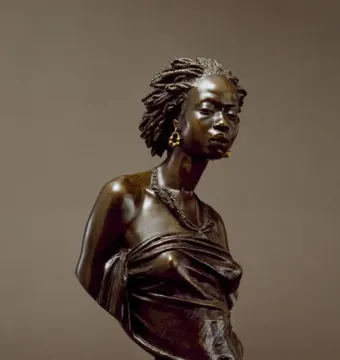
© Charles Henri Joseph Cordier · Public domain
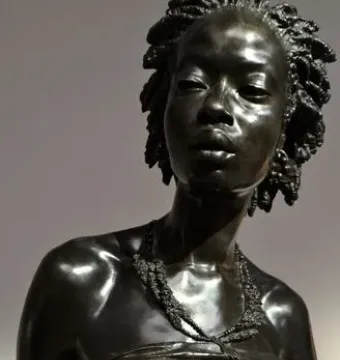
April 2019 © Ibex73 · CC BY-SA 4.0
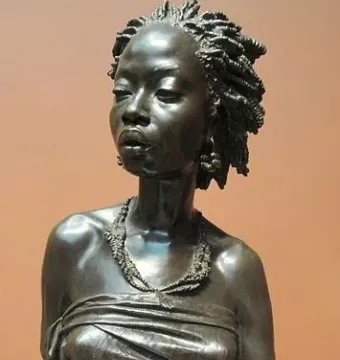
July 2015 © Daderot · CC0
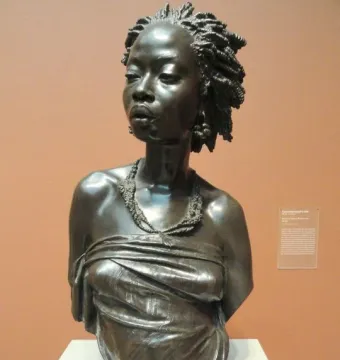
October 2012 © Charles Henri Joseph Cordier · CC0
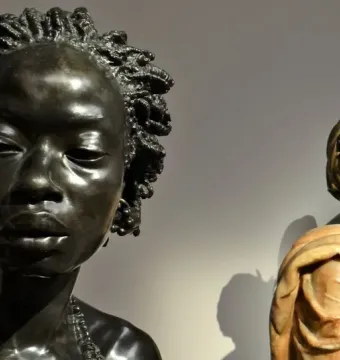
April 2019 © Ibex73 · CC BY-SA 4.0
Identification | |
| Title | The Nubian Woman |
| Artistic category | Anthropological bust |
| Alternative title of other version | African Venus |
| Type | Bust |
Creator | |
| Artist | Cordier |
Iconography and meaning | |
| Depicted subject | A young woman of Nubian, sub-Saharan African type |
| Pose / composition | Upper-body portrait showing the head, shoulders, and chest |
| Hair | Full of curly hair |
| Jewelry | Necklace and earrings |
| Symbolic meaning of jewelry | Indicates freedom obtained |
| Shoulders | Bare |
| Chest covering | Covered by a garment with small decorations |
| Head covering | The woman does not wear a veil over her head |
Historical context | |
| Interpretation / intent | The author's intention was to express the beauty and truth of the ethnicities encountered during his travels |
| Historical timing relative to abolition | The acquisition took place ten years after the abolition of slavery in the French colonies |
| Historical context of Le Havre | In the 18th century Le Havre was a port city from which many Black slaves departed |
| Collection / series character | Part of a true 'ethnographic gallery' made up of anthropological busts |
| Later series subjects | Subsequent works portray inhabitants of places visited by the author, such as the Romana di Trastevere and the Young Woman of Morvan (a Gallic type) |
| Series grouping | The first groups, namely the two Nubians and the two Chinese, portray subjects the author met in Paris |
| Artist's reaction to model | The young sculptor was struck by Seïd Enkess |
| Pendant counterpart subject | The Nubien is a portrait of the former African slave Seïd Enkess |
| Companion piece | Le Nubien (male pendant) |
History and restoration | |
| Historical interpretation of Le Havre acquisition | The city was deliberately confronting its own past |
| Acquisition context in Le Havre | After an exhibition organized by the Society of Friends of the Arts |
| Entered collection at Le Havre | 1858 |
| Intended location of French state purchase | Anthropology room of the Jardin des Plantes, Paris |
| Acquisition by French state | The French state bought a version of the bust together with its pendant |
| Acquisition by Queen Victoria | Queen Victoria bought a version of the bust together with its male counterpart, Le Nubien |
| Exhibited together with pendant | At the 1851 Great Exhibition in London |
| First exhibited | Salon of 1852 |
| Relationship of other related work to the sculpture | It reprises this subject |
Location and ownership | |
| Current location of Le Havre example | Musée d'art moderne André Malraux, Le Havre |
| Other version | Bronze version with gilded earrings |
| Location of other version | Walters Art Museum, Baltimore |
| Other related work | Plaster head called Vénus africaine at the Musée d'Orsay |
Materials | |
| Material of other version | Bronze |
Physical characteristics | |
| Additional feature of other version | Gold hoop earrings (creoles) |