
Baptistry of Callistus
The Baptistry of Callistus, also known as the baptistery of Cividale, is kept in the Christian Museum of Cividale del Friuli. It dates to the so-called Liutprandic Renaissance, around 730–740, and is considered a masterpiece alongside the Altar of King Rachis. The baptistery has an octagonal shape and rises to 354 cm. It is made of white limestone and topped by a ciborium with large semicircular arches supported by Corinthian columns. The arches are decorated with inscriptions and vegetal, animal, and geometric motifs, while the lower section features two carved slabs closely related to the Altar of Duke Rachis. Its symbolic figures, including peacocks, griffins, lions, and lambs, are connected to the sacrament of baptism.
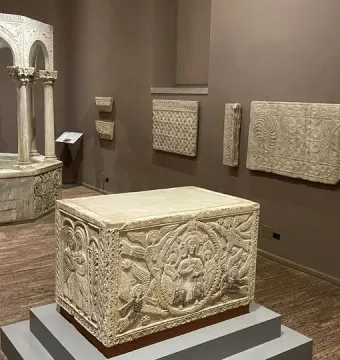
© Christian Diocesan Museum and Treasure of the Cathedral of Cividale del Friuli · CC0
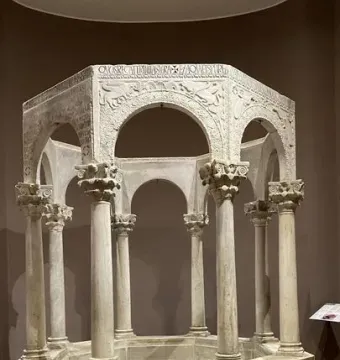
2024 © Christian Diocesan Museum and Treasure of the Cathedral of Cividale del Friuli · CC0
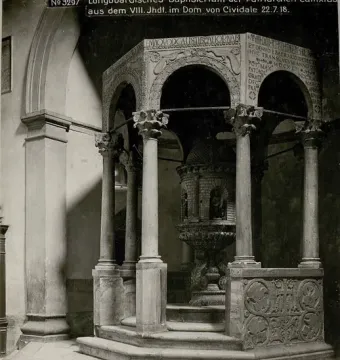
© K.u.k. Kriegspressequartier, Lichtbildstelle - Wien · Public domain
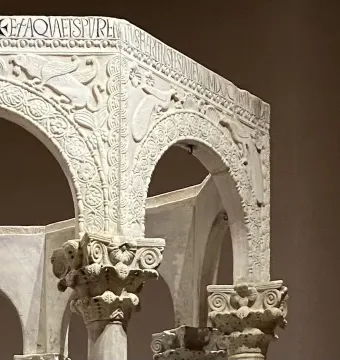
2024 © Christian Diocesan Museum and Treasure of the Cathedral of Cividale del Friuli · CC0
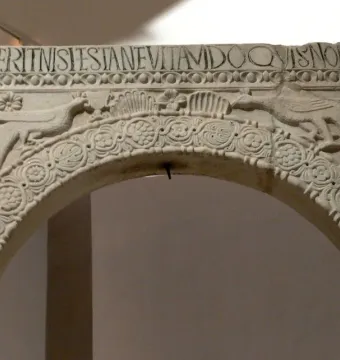
April 2011 © Wolfgang Sauber · CC BY-SA 3.0
Identification | |
| Alternative names | Baptistery of Cividale; baptismal font of Patriarch Callistus; Fonte battesimale del patriarca Callisto |
| Title | Baptistry of Callistus |
Historical context | |
| Date | c. 730–740 |
| Period | Liutprandian Renaissance (Rinascenza liutprandea) |
Creator | |
| Attribution | Possibly carved by the same artist as the Altar of Duke Rachis for the two lower carved slabs |
Discovery and provenance | |
| Original association | Cividale |
Location and ownership | |
| Current location | Museo Cristiano di Cividale del Friuli |
Physical characteristics | |
| Decorative elements | Two carved slabs at the lower part |
| Arch decoration | Inscriptions and vegetal, animal, and geometric motifs on the arches |
| Height | 354 cm |
| Superstructure | Ciborium or canopy of large round arches supported by Corinthian columns |
| Shape | Octagonal |
Materials | |
| Material | White limestone |
Iconography and meaning | |
| Symbolic meaning of shape | The eight-sided form was linked to resurrection; eight was interpreted as seven, meaning eternity, plus one, meaning God |
| Iconography | Figures and symbols related to the sacrament of baptism, including peacocks, griffins, lions, lambs, Christological symbols, and symbols of the Evangelists |
Artistic significance | |
| Significance | Considered a masterpiece of the Liutprandian Renaissance together with the Altar of Duke Rachis |
History and restoration | |
| Stylistic comparison | The lower carved slabs are very similar to those of the Altar of Duke Rachis |