
Arqueta de Sant Cugat
Arqueta de Sant Cugat is a gold reliquary casket from the beginning of the fourteenth century. It is made of a wooden casket covered with embossed silver plates, engraved and partly superimposed, showing scenes from the life and death of the martyr Saint Cugat. The work was made by Joan de Gènova and Arnau Campredon. In the seventeenth century, it was dismantled and rebuilt in a smaller form, reusing the earlier silver plates. It was kept in the monastery of Sant Cugat del Vallès until 1835, when it was moved to the church of Sant Cugat del Rec in Barcelona. It is now in the collection of the Diocesan Museum of Barcelona.
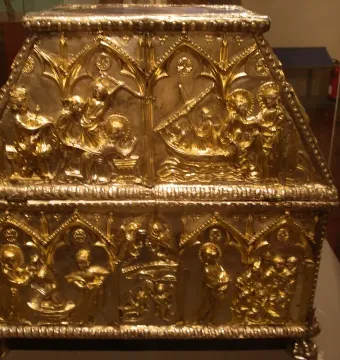
May 2009 © Bocachete · Public domain
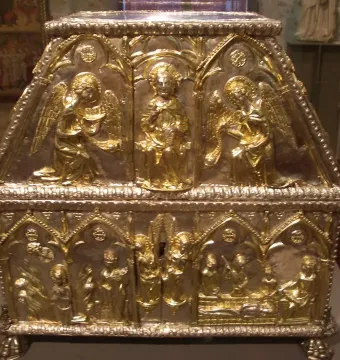
May 2009 © Bocachete · Public domain
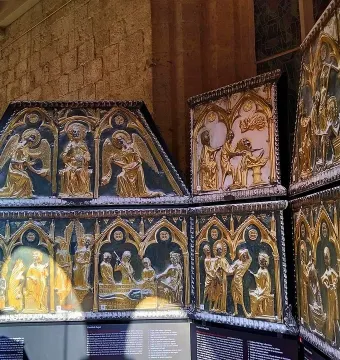
June 2025 © Enric · CC BY-SA 4.0
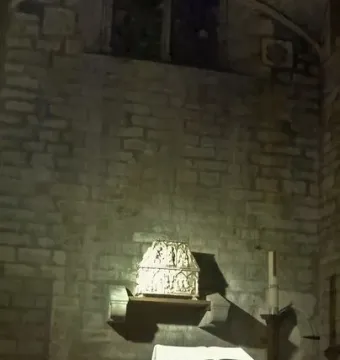
November 2015 © Bocachete · CC BY-SA 4.0
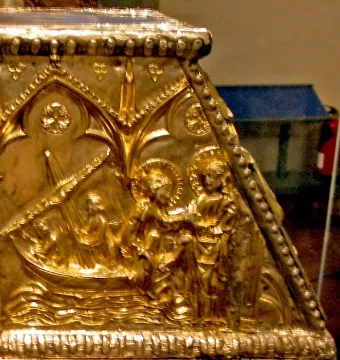
May 2009 © Bocachete · CC BY-SA 3.0
Identification | |
| Title | Arqueta de Sant Cugat |
| Type | reliquary casket |
| Alternative name | casket of Sant Cugat |
Historical context | |
| Date | early 14th century |
| Commission date | 18 September 1303 |
| Commissioner | Abbot Pons Burguet of the Monastery of Sant Cugat (1298–1306) |
| Funding | a legacy from Bonanat Basset intended to finance the casket |
Creator | |
| Artists | Joan de Gènova and Arnau Campredon |
| Joan de Gènova | goldsmith of probable Italian origin, established in Perpignan |
| Arnau Campredon | sculptor and collaborator of Joan de Gènova |
Discovery and provenance | |
| Moved to | Church of Sant Cugat del Rec, Barcelona |
| Current location | Diocesan Museum of Barcelona |
| Inventory number | 679 |
| Relocation reason | ecclesiastical confiscation and closure of the monastery |
| Kept at monastery until | 1835 |
| Original location | Monastery of Sant Cugat del Vallès |
| Commission travel | the monastery paid for the artists' trips to Barcelona |
History and restoration | |
| Later modification | in 1664–1665 the casket was dismantled and rebuilt in a smaller size, reusing silver plates from the earlier casket |
| Later additions | border moldings and feet were later additions |
Physical characteristics | |
| Dimensions | current casket: 63 × 26 × 63 cm; earlier casket: 120 cm wide |
| Plan | rectangular |
| Cover | hinged cover with four sides |
Materials | |
| Materials | gold, partly gilded silver plates, engraved/repoussé/chased silver plates, and wood; later casket reused silver plates from the earlier version |
Technique | |
| Technique | goldsmithing; repoussé, chasing, embossing, casting, soldering, nailing, and joining with tabs |
Appearance | |
| Style | Gothic |
| Stylistic influence | clear Franco-Flemish influence |
| Decoration | serial relief scenes from the life and death of Saint Cugat around the casket, with Christ, angels, demons, and architectural framing on the upper panel |
Iconography and meaning | |
| Subject | the life and martyrdom of Saint Cugat (Saint Cucuphas), including his arrival in Barcino, preaching, arrest, torture, beheading, and burial by Juliana and Semproniana |
| Depicted figures | Christ, Saint Cugat, Saint Feliu, Saints Juliana and Semproniana, Maximian, angels, and demons |
| Narrative setting | Barcino and Castrum Octavianum |
Location and ownership | |
| Associated institution | Monastery of Sant Cugat |
Other | |
| 1916 note | Jeroni Martorell noted the casket as a possible acquisition for the municipal art museum collections |