
Descent from the Cross by Antelami
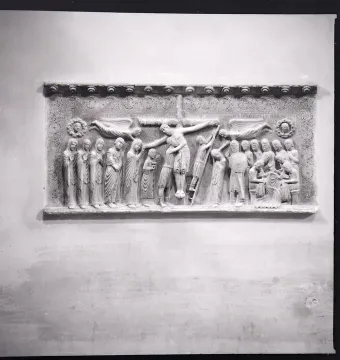
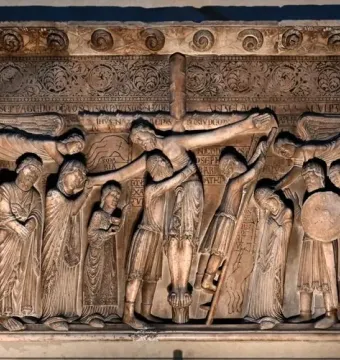
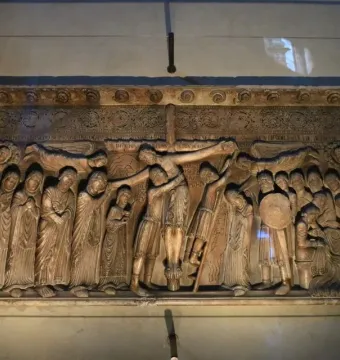
Descent from the Cross by Benedetto Antelami is a marble sculpture dated to 1178, measuring 110 by 230 cm. It is preserved in the right transept of Parma Cathedral in Italy. The high relief depicts the moment Christ’s body is taken down from the cross, based only on the Gospel of John, and combines elements from the Crucifixion and Resurrection traditions. The scene is enclosed in a decorated frame with inscriptions that help explain the figures and events. Among its many symbolic details are personifications of the Sun and Moon, the Ecclesia and Synagoga, the Virgin, the three Marys, Joseph of Arimathea, Nicodemus, soldiers, and the division of Christ’s garments.
© Paolo Monti · CC BY-SA 4.0
September 2022 © Dominik Landwehr · CC BY-SA 4.0
October 2022 © Benjamin Smith · CC BY-SA 4.0
July 2017 © Sailko (scatto) · CC BY-SA 3.0
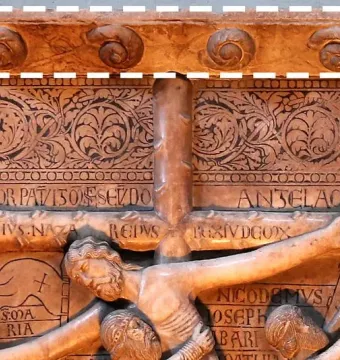
February 2024 © Clop · CC0
Identification | |
| Title | Descent from the Cross |
| Italian title | Deposizione dalla croce |
| Subject | The descent of the body of Jesus Christ from the cross |
Creator | |
| Artist | Benedetto Antelami |
| Artist name in inscription | Benedetto called Antelami |
Historical context | |
| Date | datable to 1178 |
| Inscribed date | 1178 |
| Inscribed month | April (the second month in the medieval calendar, where March was the first month) |
| Completion timing | Probably completed in April 1178, likely coinciding with Holy Week |
Physical characteristics | |
| Type | High relief panel |
| Dimensions | 110 × 230 cm |
Materials | |
| Material | Red Verona marble |
| Cross material | Wood from a green shoot, with remains of broken branches |
| Tunic | Christ's seamless garment |
Technique | |
| Technique | Niello and black vitreous paste decoration; ornamentation carved in two dimensions alongside relief carving |
Appearance | |
| Framing and border | The scene is enclosed by a decorated frame of geometrically entwined vine scrolls, with ornamental clusters and upper rosettes |
| Decorative motifs | Twisted rosettes, vine-scroll garlands, acanthus leaf bracket, and sun and moon personifications as human heads in garlands |
| Figure arrangement | Rigid composition with figures arranged in rhythmic vertical series and overlapping planes |
Iconography and meaning | |
| Depicted moments | From right to left: the soldiers gambling for Jesus' garments, the Deposition, and the three Marys returning in the Resurrection story |
| Narrative structure | The composition combines three different moments of the Passion and Resurrection narrative |
| Titulus crucis | 'IH[ES]VS NAZARENUS REX IVDE[ORV]M' ('Jesus of Nazareth, King of the Jews') |
| Cross symbolism | The cross is shown as a living green trunk, interpreted as the Tree of Life and an allusion to the Resurrection |
| Soldiers and tunic scene | Two beardless and two bearded men seated on stools unfold Christ's seamless tunic and cast lots for it, unsure whether to cut the cloth |
| Soldiers | Five soldiers follow the centurion, and two point at Christ |
| Centurion's speech | 'VERE ISTE FILIVS DEI ERAT' ('Truly this was the Son of God') |
| Centurion | Armed with a sword and a large round shield inscribed 'CENTVRIO' / 'Centurio'; a positive figure placed on the negative side of the work |
| Archangel Raphael | Makes the Synagogue bow her head in defeat; identified by the inscription 'RAPHAEL' |
| Nicodemus | Stands on a ladder and removes the second nail; identified by the inscription 'NICODEMVS' / 'Nicodemus' |
| Synagogue | Personification of the Jewish or Hebrew world, depicted defeated with closed eyes, a broken and overturned standard, and the inscription 'SINAGOGA DEPONIVR' / 'Sinagoga deponitur' |
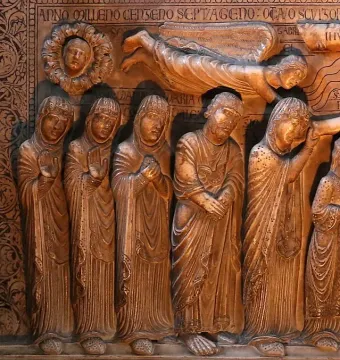
| Three Marys | Mary Magdalene, Mary of James, and Mary Salome appear at the far left; the sun shines on them as part of the Resurrection iconography |
| Mary Salome | Identified by the inscription 'SALOME'; makes a gesture of testimony with an open hand near the chest |
| Mary Magdalene | Identified by the inscription 'MARIA MADALENE' / 'Maria Madalene' |
| Saint John | Shown in a gesture of grief, one hand holding the other; identified by the inscription 'S[ANCTVS] IOH[ANNI]S' / 'Sanctus Iohannis' |
| Ecclesia | Triumphant Ecclesia, wearing a dalmatic and alb, holding the cross banner and a chalice with Christ's blood; inscribed 'ECCL[ESI]A EXALTATVR' / 'Ecclesia exaltatur' |
| Archangel Gabriel | Arrives in flight to assist the Virgin; identified by the inscription 'GABRIEL' |
| Virgin Mary | Lifts Jesus's newly un-nailed hand to her face, or lovingly holds one arm of Jesus; identified by the inscription 'S[ANCHTA]: MARIA' / 'Sancta Maria' |
| Joseph of Arimathea | Supports Christ and kisses his side; identified by the inscription 'IOSEPH AB ARIMATHIA' / 'Ioseph ab Arimathia' |
| Christ | Christ's inert body bends to the left |
| Overall symbolism | The composition contrasts salvation and victory with defeat and unbelief, and sets Resurrection prefiguration against condemnation |
| Iconographic sources | Combines canonical Crucifixion and Resurrection iconography with classical personifications of the sun and moon |
| Biblical source | Based on the Gospel of Matthew |
| Mary of James | Identified by the inscription 'MARIA IACOBI' / 'Maria Jacobi'; makes a gesture of testimony with an open hand near the chest |
Location and ownership | |
| Related surviving elements | Three of the four capitals are in the Galleria Nazionale di Parma, four lion-shaped stilts are in the Diocesan Museum, and the central Maiestas Domini panel is in the Galleria Nazionale di Parma and was later reused as a tomb slab in the church of Carmine |
| Current location | Right transept of the Cathedral of Parma, Italy |
| Part of | One of three surviving panels from a pulpit or ambo from Parma Cathedral |
| Original location | Parma Cathedral, Parma, Italy |
History and restoration | |
| Historical alteration | In 1566, following Counter-Reformation directives after the Council of Trent, the cathedral presbytery was modified and the pulpit was dismantled |
| Later reuse | The Deposition panel was wall-mounted in the right transept, and a stone plug imitating the original decoration was inserted into an upper-edge recess, probably where a lectern once stood |
Significance | |
| Importance | Considered Benedetto Antelami's first major known work and a masterpiece of Romanesque/Gothic sculpture |
| Stylistic significance | Shows a transition from the severe forms of Wiligelmo to freer, more naturalistic forms |
| Artistic period | Transitional between Romanesque art and Gothic art |
| Stylistic influences | Influenced by sculpture from southern France; classical heritage filtered through Byzantine tradition, with Provençal line treatment and Burgundian perforated garment details |
| Modeling and composition | Human bodies are less bulky than in Wiligelmo, the scene is less animated but expressive, and the work uses a rigid structure with an early articulation of spatial depth in Italian sculpture |
| Art-historical notes | Antelami reused the green-growing cross iconography more than twenty years later in the lunette of the West portal of the Baptistery of Parma |
Other | |
| Inscription | The work bears engraved inscriptions giving the artist's name and the date; the couplet text is 'ANNO MILLENO CENTENO SEPTVAGENO OCTAVO SCVLTOR PAT[RA]VIT M[EN]SE SE[C]V[N]DO // ANTELAMI DICTVS SCVLPTOR FVIT HIC BENEDICTVS' |