
Saint Nicholas of Mozhaysk
Saint Nicholas of Mozhaysk, also called Nikola of Mozhaysk, is a Russian variation of the Saint Nicholas tradition. According to legend, during the 14th-century siege of Mozhaysk by Mongols, the city’s residents prayed to Saint Nicholas. He appeared as a huge figure holding a sword in his right hand and the city of Mozhaysk on the palm of his left hand. The Mongols, frightened by the vision, retreated. In gratitude, the citizens erected a wooden monument to Saint Nicholas in the form in which he had appeared. The motif later became popular in Russian icons and high-reliefs.
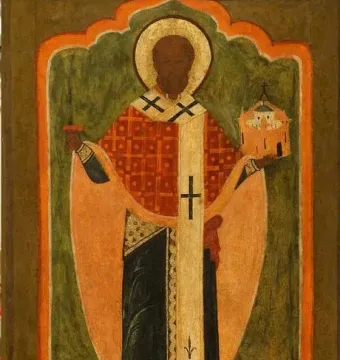
© Unknown authorUnknown author · Public domain
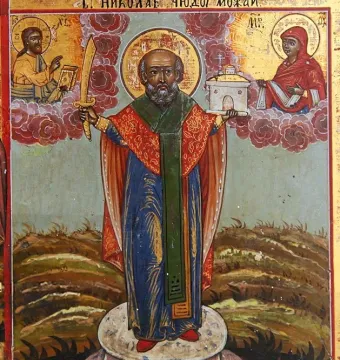
· Public domain
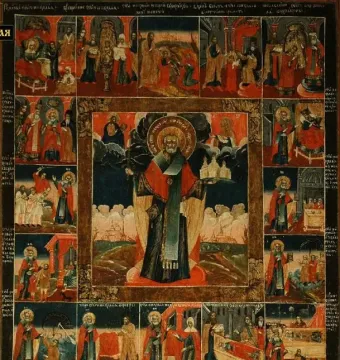
© Unknown authorUnknown author · Public domain
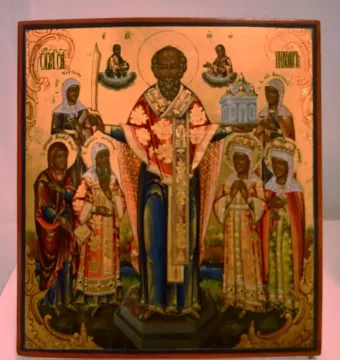
© Gregory Trephonov Pavlikov · Public domain
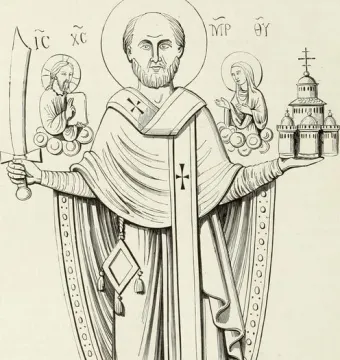
1867 © Internet Archive Book Images · No restrictions
Identification | |
| Title | Saint Nicholas of Mozhaysk |
| Alternative name | Nikola of Mozhaysk |
| Date | 17th century |
| Date | 16th-17th century |
| Inscription/title variant | Saint Nicholas of Mozhaysk and his Life |
| Associated figure | Saint Nicholas of Mozhaysk |
| Date | 1894 |
| Subject | Saint Nicholas the Wonderworker, depicted in a threatening protective pose with a sword in his right hand and a model of Mozhaysk in his left hand |
| Form | High-relief icon |
| Type | Russian variation of the Saint Nikolaus traditions |
Historical context | |
| Historical interpretation | The Mongols retreated after seeing the vision |
| Possible historical basis | Some legends may include events actually experienced in the life of the missionary of Petseri |
| Associated event | The 14th-century siege of Mozhaysk by Mongols |
| Commemorative origin | Citizens reportedly erected a wooden monument to Saint Nicholas after the vision |
| Location associated with the missionary | Petseri, near the Estonia-Russia border |
| Associated legend | Mozhaysk was saved by Saint Nicholas, who appeared above the cathedral in a fierce form, frightened the enemies away, and became the city's patron |
| Description in some texts | A white-bearded man standing on top of the monastery wall who cannot be touched by enemy fire |
| Main role | Protector of crops from the cold |
| Artistic influence | The motif became a popular subject for Russian icons and high-reliefs |
| Popularity | Became most popular as a protective image |
| Favored by | Setu people |
| Offerings | Loaves of bread or cream |
| Depicted as | Warrior-hero |
| Associated blessings | Agriculture and cattle-raising |
Creator | |
| Creator | Unknown |
Discovery and provenance | |
| Fragments preserved in the Tretyakov Gallery | A gold crown from the halo; four fragments of gold basma from the saint's chasuble; 69 fragments of silver-gilt basma with various ornaments; two fragments forming a Deesis in quatrefoils; fragments with images of Saint Nicholas and an unidentified saint |
| Documentation of vestments | N. I. Vlasyev recorded the riza in his notebooks and noted that it was intact and supposedly stored in the Armoury Chamber of the Kremlin |
| Current copy location | A colored copy is currently in the St. Nicholas Cathedral in Mozhaysk |
| Museum holdings | Fragments of the precious ornament from the 16th century are kept in the Tretyakov Gallery |
| Current location | Tretyakov Gallery, where the original carved image has been kept since 1933 |
| First mention in sources | 1495, in a decree of Grand Prince Ivan III to princes S. M. Ryapolovsky and M. Ya. Rusalka |
| Return from Poland | Returned to Mozhaysk in 1618 under the Treaty of Deulino |
| Later early mention | In the spiritual testament of Prince Ivan Borisovich Volotsky, compiled around 1504 |
| Original location | Probably inside the St. Nicholas Cathedral, later the Old St. Nicholas Cathedral, in the Mozhaysk Kremlin |
| Later location history | At the end of the 15th century the image was transferred to the Church of the Exaltation on the stone Nikolsky Gate, later rebuilt as the New St. Nicholas Cathedral |
Physical characteristics | |
| Resulting depiction after 1917 damage | After damage, the left hand and cathedral were missing while the sword in the right hand remained intact |
| Sword and city | The wooden sword and city were gilded |
| Golden ornaments | The crown, pendant, and cross on the chest were made of ducat gold |
| Original decoration | The wooden sculpture was decorated with a silver chased vestment |
| Headgear | A mitre decorated with large pearls, precious stones, and a cross on top |
| Carving | The figure with halo was carved from a single block of wood; separate carved parts include the head, the hand holding the sword, the right epitrachelion sleeve, the left hand with the city, and part of the epitrachelion |
| Dimensions of figure | 182 × 98 cm |
| Dimensions with sword | 200 × 98 cm |
Materials | |
| Materials | Wood |
| Paint | Tempera on an adhesive base without gesso |
| Ornament materials | Silver-chased vestment, ducat gold ornaments, gilded wooden sword and city |
Technique | |
| Floral ornament details | Stem forming a circle with a stylized flower inside; four-pointed crosses with semicircular ends between the circles; crosses with four petals; four-lobed motifs; flower |
| Technique | Carving |
| Ornament types on silver-gilt basma | Floral, lattice, spiral, scale-like, and cross-like ornament |
| Deesis figures | The Savior Not Made by Hands, and half-length images of the Mother of God and John the Baptist |
Appearance | |
| Pose | Standing with a sword raised |
| Description after damage | Wounded Saint Nicholas of Mozhaysk depicted holding the sword in the right hand, with the left hand and cathedral missing |
| Legendary depiction | A huge figure holding a sword in the right hand and the city of Mozhaisk on the palm of the left hand |
| Iconographic attributes | In the legend, Nicholas holds a shining sword in his right hand and a city-shaped object or model of Mozhaysk in his left hand as a sign of protection |
Iconography and meaning | |
| Suggested builders / artistic context | N. N. Voronin and G. K. Wagner noted Serbian features in the decoration of the Old St. Nicholas Cathedral and allowed participation of South Slavic craftsmen |
| Type of image | Protective image |
| Possible origin hypothesis | V. I. Vlasyev suggested in 1925 that one of the main Christian fetishes may have been created by the pre-Christian Baltic tribe of the Golyad, though the hypothesis is uncertain |
| Hypothesized historical connection | Linked by some researchers to the activities of Metropolitan Peter, and by others to Metropolitan Cyprian, both associated with the image's appearance |
| Stylistic influences proposed | Western European Catholic models; Serbian art of the 14th century |
| Legendary interpretation of the sword | In the initial legends, Nikolai appears during wartime; in other stories, the sword is explained as the saint threatening to strike an old woman who did not believe in him |
| Related Serbian reference | A likeness to an icon of Saint Nicholas installed by the Serbian king Stefan Uroš III near the saint's relics in Bari |
Location and ownership | |
| Moscow Kremlin / military context | The sculpture was associated with the fortress church and gate complex during the history of the Mozhaysk Kremlin |
| Gate location history | The image was associated with the fortress church and gate complex during the history of the Mozhaysk Kremlin |
| Location installed | On the wall of Nikolskaya Tower above the Nikolsky Gate to the Moscow Kremlin |
| Historical location | Nikolskaya Tower, Moscow Kremlin |
| Location | Mozhaysk, Russia |
History and restoration | |
| Damage in 1917 | The icon was damaged by artillery fire during the October Revolution |
| Restoration | Uncovered and restored in 2010 |
| Closure and transfer | In 1933 the St. Nicholas Cathedral was closed and the carved icon was taken to the Tretyakov Gallery |
| Removal of vestments | In April-May 1922 the riza and mitre were removed from the icon |
| Treatment during the Soviet period | Plastered over |
| Specific damage in 1917 | The left hand with the Mozhaisk cathedral was destroyed; the right hand with the sword remained intact |
| Destruction and survival in 1812 | The unfinished New St. Nicholas Cathedral was heavily damaged during the War of 1812, but the wooden sculpture and stored church vessels survived |
| Tower destruction in 1812 | The top of the tower was completely destroyed |
| Damage in 1812 | The icon was slightly damaged when Nikolskaya Tower was exploded by retreating French during the French invasion of Russia |
| Later reconstruction | A major rebuilding of the church on the fortress gate began in 1779 but was interrupted because of theft of church funds |
| Rebuilding history | The Nikolsky Tower with the gate church was rebuilt in 1683–1685 by order of Patriarch Joachim |
| Historical setting of original cathedral | Likely associated with the stone St. Nicholas Cathedral built in the late 14th century on the site of the wooden Mozhaysk Kremlin |
| Dating by A. I. Nekrasov | 1320s |
| Dating by G. Ya. Mokeev | 1409 for the surviving image; the original may have appeared in the 13th century, together with the fortress and gate |
| Dating by V. I. Gorokhov | Allowed either 1401 or the 13th century |
| Alternative proposed dates | 1401; 13th century; 1409; 1320s |
| Approximate date of creation | Usually dated to the late 14th century |
| Possible outdoor exposure | Restoration suggested the wooden surface may have been exposed at times to rain and temperature changes, so it may have stood directly above the gate arch for some period rather than inside the gate church |
Significance | |
| Modern monument | A monument by V. M. Klykov was installed on the Trade Square of Mozhaysk in 1998 |
Other | |
| Context | Kremlin icon of Saint Nicholas of Mozhaisk after the October Revolution in 1917 |
| Historical note | After the French retreat, the Nikolskaya Tower had its top destroyed, but the icon survived |