
Porta della Mandorla
Porta della Mandorla is the left side portal on the north facade of Florence Cathedral, facing today’s Via Ricasoli. It was created between 1391 and 1423 by several sculptors, including Giovanni d'Ambrogio, Donatello, and especially Nanni di Banco. The portal takes its name from the depiction in the tympanum of the Assumption of the Virgin within an almond-shaped nimbus. Its carved vegetal spirals on the jambs also include robust figures modeled in the manner of antiquity. The sculptures are important in art history because they belong to the transition from the late Gothic period to the early Renaissance, and they include some of the earliest rigorously classicist works in Florence.
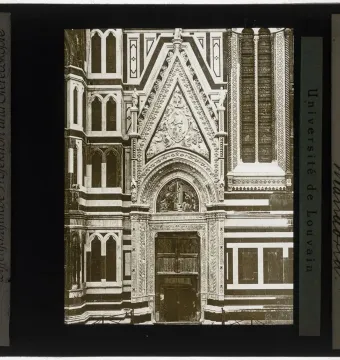
© Donatello (Italian sculptor, ca. 1386-1466) (artist) · Public domain
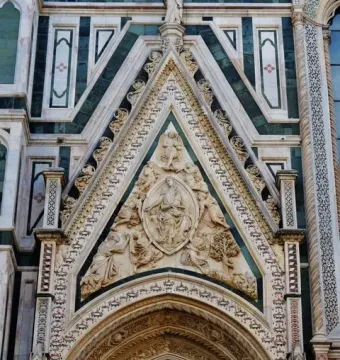
April 2023 © Zairon · CC BY 4.0
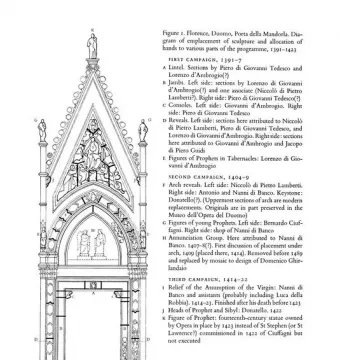
April 2023 © Gennadii Saus i Segura · CC BY-SA 4.0
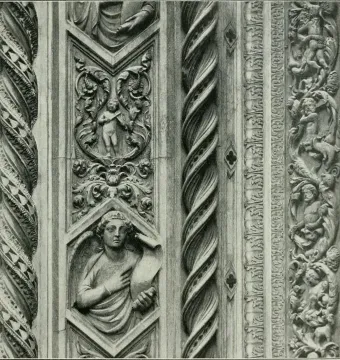
1907 © Internet Archive Book Images · No restrictions
June 2019 © George M. Groutas · CC BY 2.0
Identification | |
| Title | Porta della Mandorla |
| Alternative name | La porte de la Mandorle |
| Name origin | Named after the Assumption of the Virgin shown in a mandorla-shaped halo in the upper relief |
| Type | Side portal of a cathedral |
Location and ownership | |
| Building | Cathedral of Santa Maria del Fiore (Florence Cathedral, Duomo di Firenze) |
| Location on building | Left side portal of the north facade, facing Via Ricasoli, near Via dei Servi |
| City | Florence |
| Country | Italy |
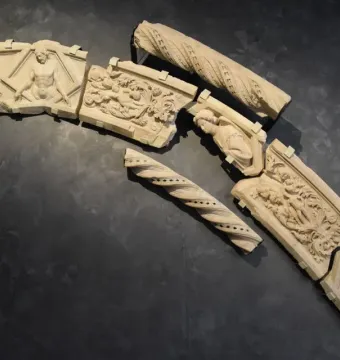
| Preserved original elements | Several removed elements, including parts of the archivolt and former lateral prophet statues, are now in the Museo dell'Opera del Duomo |
Historical context | |
| Date of creation | 1391–1423 |
| Historical context | Created during the transition from the last phases of Gothic art to the earliest Renaissance in Florence |
Creator | |
| Annunciation mosaic artists | Davide Ghirlandaio with the collaboration of Domenico Ghirlandaio |
| Assumption relief artist | Nanni di Banco |
| Nude figures attribution | Variously attributed to Nanni di Banco, Giovanni d'Ambrogio, the young Jacopo della Quercia, or an unknown master |
| Other sculptors involved | Jacopo di Piero Guidi, Piero di Giovanni Tedesco, Niccolò di Pietro Lamberti, and Antonio di Banco |
| Primary sculptors | Giovanni d'Ambrogio, Donatello, and especially Nanni di Banco |
Iconography and meaning | |
| Iconographic theme | The Virgin Mary and her salvific mission for humanity |
| Narrative theme | The Virgin handing her girdle to Saint Thomas during the Assumption, symbolizing the link between heaven and earth |
| Assumption relief details | The Virgin ascends into heaven carried by angels; Saint Thomas kneels at the left; four angels strain upward; two trumpet angels and a third angel with a bagpipe dominate the upper corner; a bear and a tree appear in the right corner |
| Main subject | Assumption of the Virgin, also called Madonna della Cintola |
Physical characteristics | |
| Form | Slightly splayed portal with a grand pointed tympanum |
| Decorative elements | Vegetal scrolls, acanthus leaves, medallions with angels and a Redeemer, and large figures inserted among the scrolls |
Appearance | |
| Figural style | Large figures modeled on antique classical forms |
| Nude figures | Among the very first fully classicizing works in Florence, rendered with classical volumetry and strong bodily presence |
| Notable figures | Nudo di spalle, Apollo con la viola, and Eracle con la leontè |
History and restoration | |
| Construction phases | 1391–1397: structural architecture completed and part of the Gothic cladding up to the arch; from 1404: further decorative work; 1414–1421: Nanni di Banco carved the pediment relief; 1422: Donatello carved two heads in the pediment spandrels |
| Decorative additions | Scrolled frame of the crowning tympanum, carved edges of the lunette, two little prophets, and later the mosaic in the lunette |
| Annunciation statues | Two Annunciation statues attributed to Giovanni d'Ambrogio were moved from inside the cathedral to the center of the lunette, then later replaced by a mosaic |
| Annunciation mosaic date | 1489–1490 |
| Earlier lunette relief artist | Jacopo della Quercia |
| Restoration in 1869 | Some reliefs around the arch were removed and replaced with copies; the lateral statues of the Prophets were also replaced by copies |
| Major restoration | Extensive restoration began in 2002 and was completed on 5 June 2012 |
Significance | |
| Art historical importance | Highly significant in art history |
| Stylistic significance | Includes some of the earliest strictly classicist works in Florence; this taste soon became dominant in the city |
Other | |
| Technical significance | Sculpture was a privileged medium for this search for novelty through the study of ancient works |