
Diana
Diana, or Diana the Huntress, is a bronze sculpture by Jean-Antoine Houdon, modeled in plaster in 1776 and cast in bronze by 1790. Versions are held by the Frick Collection in New York, the Louvre, the Gulbenkian Museum in Lisbon, and the Huntington Art Gallery in San Marino. Houdon’s treatment of the nude huntress was unusual for the time, since Diana was typically shown bathing rather than hunting. The work combines classical restraint with a twisting, elongated pose inspired by Mannerist art. It was admired for its serenity and refinement, and Houdon personally oversaw the casts. In the Louvre version, the original visible vulva was later covered and hammered at the museum’s entrance in 1829.
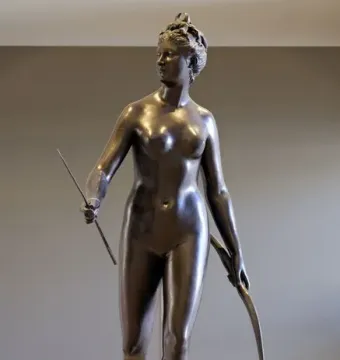
March 2025 © Shonagon · CC0
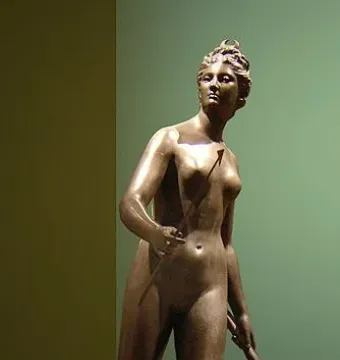
© Jean-Antoine Houdon (1741-1828) · CC BY-SA 3.0
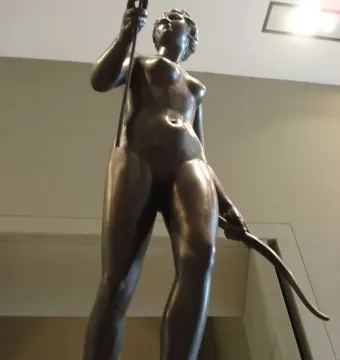
November 2006 © Vania Teofilo · CC BY-SA 3.0
© Jean-Antoine Houdon · CC BY-SA 3.0
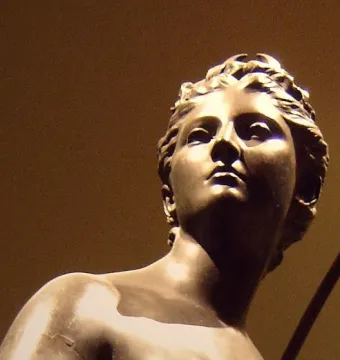
© Jean-Antoine Houdon · CC BY-SA 3.0
Identification | |
| Title | Diana |
| Original title | La Diana cacciatrice |
| French title | Diane chasseresse |
| Type | Sculpture |
Historical context | |
| Subject | Diana the Huntress |
| Creation date | Model dated 1776; plaster versions made in 1776 and 1777; terracotta version made in 1777; marble version made in 1780; lead version made in 1781; bronze versions made in 1782 and 1790; created between 1776 and 1790 |
| Relation to other works | Houdon's transformation of the theme distinguished it from Louis-Claude Vassé's Diana the Huntress (1769) and Christophe-Gabriel Allegrain's Diana (1778, marble, now in the Louvre) |
Creator | |
| Artist | Jean-Antoine Houdon |
Discovery and provenance | |
| Original commission | Commissioned by the Duke of Saxe-Gotha |
| Marble provenance | Purchased by Catherine II of Russia, then sold by the Soviet government in the early 1930s with other artworks, then acquired by Calouste Gulbenkian |
| Terracotta provenance | Acquired by the Frick Collection in New York in 1939 |
| Louvre bronze provenance | Made by the artist without a prior commission; later purchased by the Louvre after the sculptor's death and entered the museum's collections in 1829 |
Physical characteristics | |
| Versions | Several plaster versions were made before the marble version; three bronze versions were made |
| Current version locations | Marble version: Calouste Gulbenkian Museum, Lisbon; terracotta version: Frick Collection, New York; bronze versions: Louvre Museum, Paris and Huntington Art Gallery, San Marino |
Materials | |
| Materials | Plaster, terracotta, marble, lead, bronze |
| Version material | The initial version was plaster; later versions were made in terracotta, marble, lead, and bronze |
Appearance | |
| Scale and finish | The work is highly refined, with a simple overall aspect and linear contours |
| Pose | The figure is turned in a twisting pose and rests on one foot |
Iconography and meaning | |
| Nudity | Diana is depicted nude, which was controversial because the usual nude depiction is Diana at the bath rather than Diana the Huntress |
| Original anatomical detail | The original sculpture showed Diana's vulva |
| Louvre alteration | In the Louvre version, the vulva was covered and hammered over when the work entered the museum's collections in 1829 |
| Salon reception | The work was regularly shown at the Salon during the years of its creation and was criticized mainly for its iconography |
| Defenders | Melchior Grimm defended Houdon's choice of nudity |
| Houdon's justification | Houdon argued that the nudity of gods, whose bodies are perfect, is not immodest |
Style | |
| Stylistic influences | A crossroads of classicism and Mannerism |
| Classicist features | Nudity, passivity, regularity of features, pure and simple overall aspect, pure linear contours, serenity, fidelity of the face to Antiquity, and a noble, impassive, intimidating character |
| Mannerist features | An elongated body, twisting posture, and a single point of contact for the foot with the base |
| Neoclassical interpretation | Linked to Neoclassicism because of its impassivity, serenity, and fidelity to Antiquity |
| Possible inspiration | Giambologna's Mercury Flying was suggested as a possible source of inspiration |
History and restoration | |
| Bronze composition | The three bronze versions present the composition as the artist originally imagined it |
| Marble version difference | The marble version differs because it was technically impossible to make the goddess's body rest on one foot |
| Casting | Houdon personally handled the castings, which was uncommon and not always successful |
Location and ownership | |
| Museum locations | Calouste Gulbenkian Museum, Lisbon; Frick Collection, New York; Louvre Museum, Paris; Huntington Art Gallery, San Marino |