
Standing Mercury
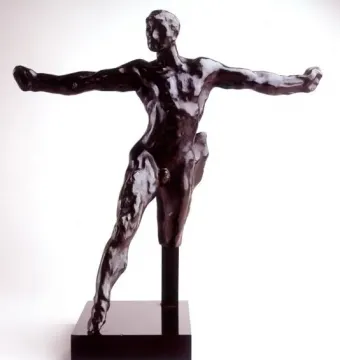
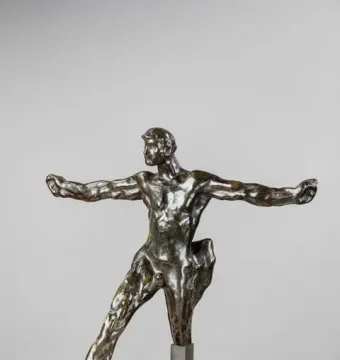
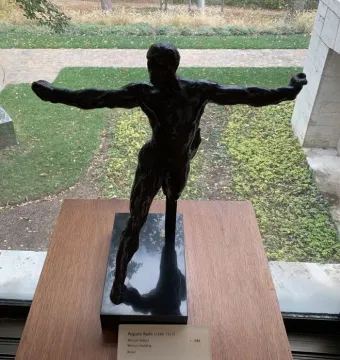
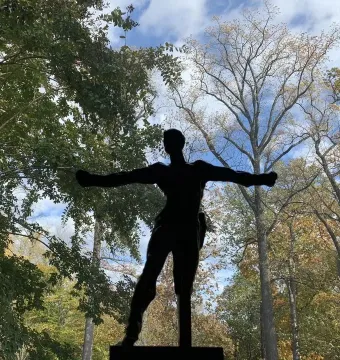
Standing Mercury is an Auguste Rodin sculpture first presented in 1888. Inspired by humanism, Rodin depicts Mercury, the son of Jupiter and Maia, as a strong, youthful god rather than the mature figure of Greek tradition. The body touches the ground lightly at the toes, with the arms extended and the muscles clearly emphasized. The lower part blends into cloud-like or mound-like forms, and the work originated from La Faune, placed on the upper right of the model for The Gates of Hell. Rodin also removed the winged sandals usually associated with Mercury, making him appear closer to an ordinary human being. The sculpture later inspired Rodin’s Study of Apollo.
March 2005 © Museo Soumaya · Public domain
June 2016 © Museo Soumaya · Public domain
November 2019 © AgnosticPreachersKid · Public domain
November 2019 © AgnosticPreachersKid · Public domain
Identification | |
| Title | Standing Mercury |
| Type | Bronze sculpture |
Creator | |
| Artist | Auguste Rodin |
| Artist nationality | French |
Historical context | |
| Related work | Study of Apollo |
| Influence on other work | Standing Mercury inspired Rodin's Study of Apollo |
| Placement in The Gates of Hell | Placed on the central jamb of The Gates of Hell, on the right side, hanging upside down |
| Early version | According to curator John L. Tancock, in the first sketches for The Gates of Hell, Mercury emerged from rocks |
| Source work | Derived from La Fauna, at the upper right of the maquette for The Gates of Hell |
| Inspiration | Inspired by the humanism of the Renaissance |
| First exhibited | 1888 |
Iconography and meaning | |
| Pose | Descending from above, touching the ground with the tip of one foot and resting lightly on it, with arms extended |
| Depiction | A strong young man representing eloquence and reason, shown more as a mortal man than as the mature god of traditional Greek depictions |
| Depicted figure | Mercury, son of Jupiter and Maia, messenger of the gods and guide of souls to the underworld |
| Role in The Gates of Hell | In The Gates of Hell, Mercury is no longer a messenger god but one soul among the multitude waiting to be cast into the abyss of hell |
Physical characteristics | |
| Build | Vigorous musculature |
| Missing body part treatment | The missing part of the body merges into clouds or mounds |
Other | |
| Movement and composition | The Gates of Hell allowed Rodin to deploy figures with unprecedented freedom of movement |
History and restoration | |
| Critical assessment by Camille Claudel | Camille Claudel said its graceful ease made it one of the sculptor's best, or happiest, works |
Location and ownership | |
| Later placement of related work | At the base of the monument to Domingo Faustino Sarmiento |
| Associated monument person | Domingo Faustino Sarmiento, former Argentine president |