
Disk of Mictlāntēcutli
Disk of Mictlāntēcutli is an emblematic sculpture from the National Museum of Anthropology in Mexico City, where it inaugurates the Teotihuacan Gallery. Carved in andesite and decorated with red pigment, it dates to the Classic period (1–650 CE) and measures 126 x 102 x 25 cm. The stone disk shows a flayed human face surrounded by a halo that may represent folded paper. It was found in 1964 in front of the Pyramid of the Sun at Teotihuacan. Scholars have linked it to the sunrise, human sacrifice, and possible Teotihuacan or Mexica cultural origins.
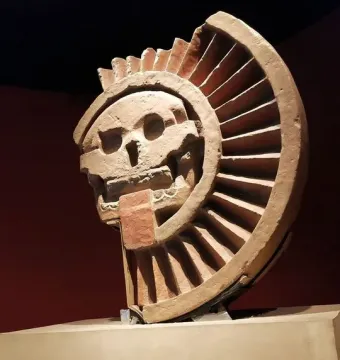
September 2023 © Ferfive · CC BY 4.0
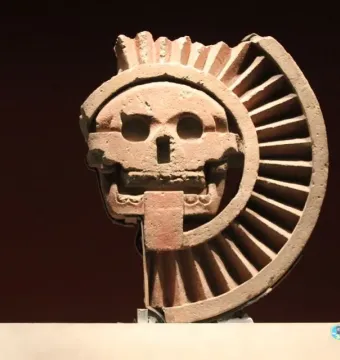
July 2012 © Gary Todd · CC0
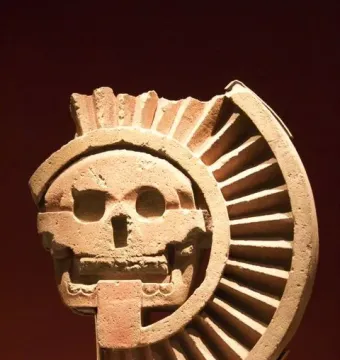
July 2015 © Mike Peel · CC BY-SA 4.0
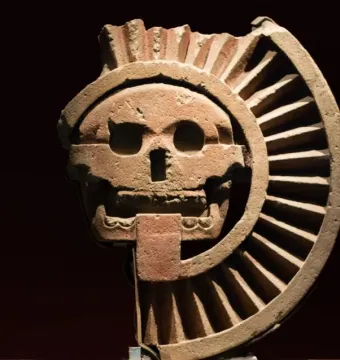
© Luis Ezcurdia · CC BY-SA 3.0
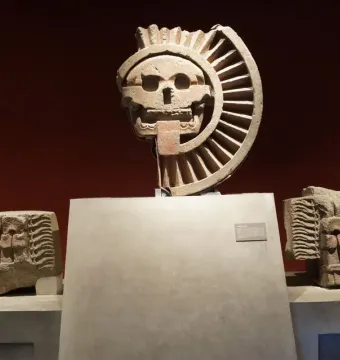
© Manoj Karingamadathil · CC BY-SA 4.0
Identification | |
| Title | Disk of Mictlāntēcutli |
| Alternative names | Escultura con rostro de la muerte; Disco de la Muerte; Disk of Death |
| Type | Pre-Hispanic stone disk sculpture |
Historical context | |
| Date created | Classic period, 1–650 CE |
| Associated practice | Aztecs conducted pilgrimages from Tenochtitlan to honor Teotihuacan and leave gifts, including the disk |
| Cultural/historical context | For the Aztecs, Teotihuacan was the place where the Fifth Sun was born |
Creator | |
| Creator | Unknown |
Discovery and provenance | |
| Discovery location | Teotihuacan, in front of the Pyramid of the Sun |
| Discovery date | 1964 |
| Found by | Archaeologists |
Physical characteristics | |
| Dimensions | 126 × 102 × 25 cm |
| Condition | Partly destroyed |
| Surface decoration | Red pigment |
Materials | |
| Material | Andesite (also described as basaltic rock) |
Appearance | |
| Surrounding motif | A halo or pleated-paper headdress, possibly representing folded paper |
| Visual features | Flayed face with tongue emerging from the mouth, surrounded by a pleated-paper halo |
| Depicted motif | A skull with the tongue out |
| Depicted figure | A flayed human face; interpreted as Mictlāntēcutli, the Aztec god of death and ruler of Mictlān |
Iconography and meaning | |
| Interpretation | The meaning of the sculpture is uncertain |
| Possible interpretation | It may allude to the sun’s birth in the east and decline in the west, or to sun death or human sacrifice |
| Interpretation by Felipe Solís Olguín | Because it was found in front of the pyramid, he suggested it was related to human sacrifice |
| Scholarly debate | Eduardo Matos Moctezuma notes that it has been speculated the piece may not be Teotihuacan and could belong to the Mexica culture |
| Evidence cited for Mexica attribution | The tongue emerging from the mouth and the folded-paper halo are said to be characteristic of Mexica culture |
| Matos Moctezuma's position | He maintains that the element is originally Teotihuacan and was later adopted by other cultures, as was common in Mesoamerica |
Location and ownership | |
| Current location | National Museum of Anthropology, Mexico City |
| Gallery | Teotihuacan Hall |
| Exhibition | Teotihuacan exhibition |
Significance | |
| Cultural significance | An emblematic piece of the National Museum of Anthropology |
| Exhibition significance | It inaugurates the Teotihuacan Hall of the museum |