
Door of the Apostles
Door of the Apostles is one of the two bronze doors Donatello made for the Old Sacristy of the Basilica of San Lorenzo in Florence. Measuring 235 x 109 cm, it is arranged in two leaves with five panels on each leaf, and its execution dates to 1434–1443. The Old Sacristy was the private funeral chapel of the Medici family, built by Filippo Brunelleschi between 1421 and 1428 and decorated by Donatello from 1428–29 onward. The doors were not appreciated by their contemporaries, who found them too expressive. Donatello’s composition has been linked to the doors of the Baptistery of Pisa and other earlier models.
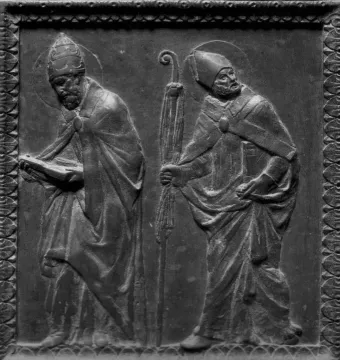
1439 © Donatello · Public domain
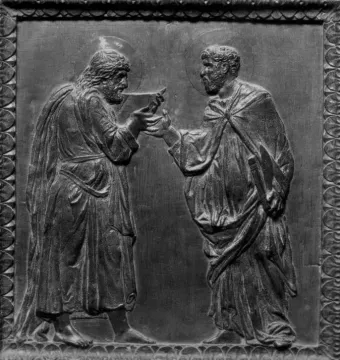
1439 © Donatello · Public domain
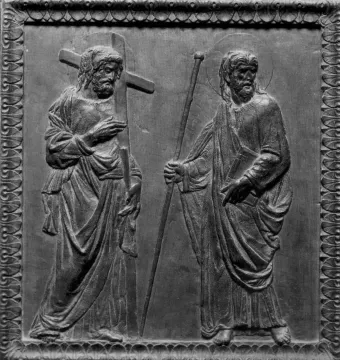
1439 © Donatello · Public domain
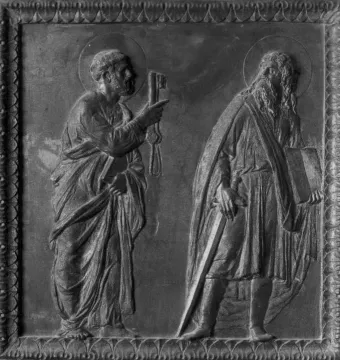
1439 © Donatello · Public domain
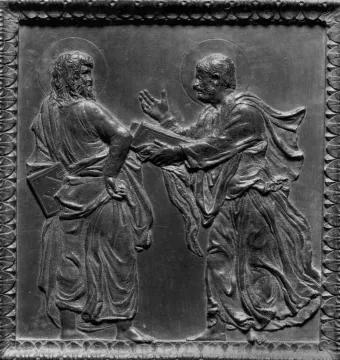
1439 © Donatello · Public domain
Identification | |
| Title | Door of the Apostles |
| Original title | La Porta degli Apostoli |
| Alternative title | Door of the Doctrine |
| Type | Right bronze door of a pair |
Creator | |
| Artist | Donatello |
Historical context | |
| Date | 1434–1443 |
| Commissioned for | the Medici family’s private funerary chapel in the Old Sacristy of San Lorenzo, Florence |
| Construction context | made after the Sagrestia Vecchia was built by Filippo Brunelleschi between 1421 and 1428 |
Discovery and provenance | |
| Commissioners | private citizens of the Medici family |
Location and ownership | |
| Current location | Old Sacristy (Sagrestia Vecchia), Basilica of San Lorenzo, Florence |
| Architectural setting | entrance to two small service rooms, one for the lavabo and one for storing candles |
| Relation to chapel decoration | part of a decorative program that also included enormous stuccoes and numerous saints, completing the chapel’s religious cycle |
Physical characteristics | |
| Dimensions | 235 × 109 cm |
| Structure | two leaves with five panels on each leaf |
| Decorative scheme | ten square panels separated by a border of festoons, rosettes, and palmette friezes |
| Handles | two intertwined ropes |
Materials | |
| Frame material | stone frames in pietra di macigno |
| Material | bronze |
Appearance | |
| Depicted figures | Apostles, Church Fathers, and saints |
| Figure treatment | figures shown without a background |
| Stylistic character | highly expressive and strongly three-dimensional |
| Spatial treatment | figures often project from the relief frame, leaning on it, embracing it, or disappearing behind it |
| Visual comparison | their isolated monumentality recalls the stucco lunette of Saints Cosmas and Damian |
Iconography and meaning | |
| Main theme | the multiplicity of forms of human interaction in intellectual and religious dispute |
| Identification of figures | the attributes generally allow the figures to be identified correctly |
History and restoration | |
| Contemporary reception | not appreciated by contemporaries because they were judged too expressive |
| Filarete’s comment | in his Treatise on Architecture (1461–1464), Filarete advised readers not to make apostles like Donatello’s in the sacristy door of San Lorenzo, saying they “seem like pullers” |
Significance | |
| Art-historical significance | prestigious and costly objects normally reserved for elite patrons; commission by private citizens was highly unusual |
| Number of bronze doors by Donatello | the only bronze doors Donatello created in his long career, though he was commissioned for others he never had time to make |
| Stylistic influence | Kaufmann and Janson proposed influence from the apostles in the Pisa Baptistery door, the doors by Bonanno in Pisa Cathedral, and perhaps early Christian ivory diptychs |
| Scholarly dating | Janson dated the doors to before 1492, before Agostino di Duccio’s signed Scenes from the Life of Saint Geminianus in Modena Cathedral, which appears derived from Donatello’s doors |
| Scholarly hypothesis | Kaufmann hypothesized, on stylistic grounds, that the Door of the Apostles was created first |