
Female Figure
Female Figure is a marble sculpture by the Flemish artist Giambologna, made between 1571 and 1573 early in his career. Measuring 114.9 cm, it depicts an unidentified woman who may be Bathsheba, Venus, or another mythological figure. The figure is seated on a cloth-covered column, holding a jar in one hand and drying her left foot with the other. Except for a bracelet on her upper left arm and a draped garment over her lap, she is nude. The work has been in the collection of the J. Paul Getty Museum since 1982 and has been restored twice.
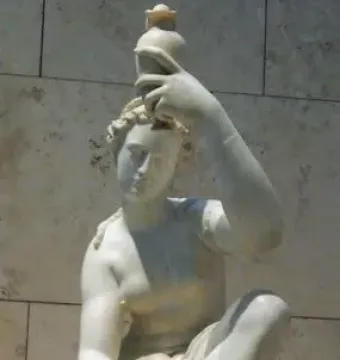
1571 © Taromsky · CC BY-SA 4.0
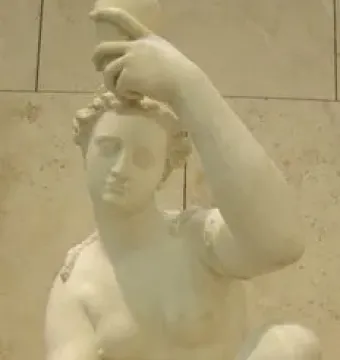
October 2010 © sailko · CC BY-SA 3.0
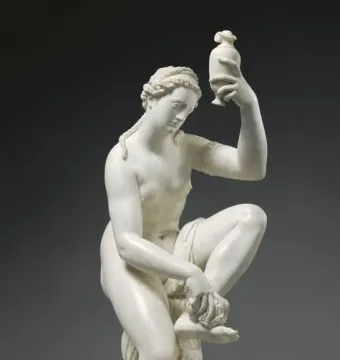
© Giambologna · Public domain
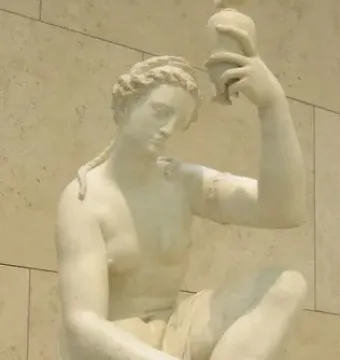
October 2010 © sailko · CC BY-SA 3.0
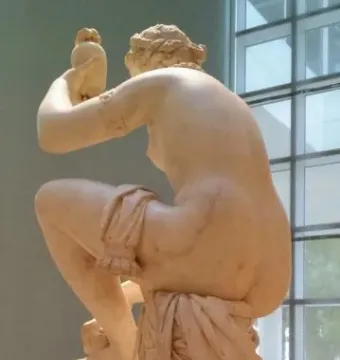
1571 © Taromsky · CC BY-SA 4.0
Identification | |
| Title | Female Figure |
| Original title | Figura femenina |
| Type | Sculpture |
Historical context | |
| Period in artist's career | Early in Giambologna's career |
| Date | c. 1571–1573 |
| Century | 16th century |
Creator | |
| Artist | Giambologna |
| Artist nationality | Flemish |
| Attribution history | Attribution was debated for centuries but is now generally accepted as Giambologna's work |
| Attribution basis | Stylistic comparison with other known works by Giambologna, including Triumph of Florence over Pisa |
Discovery and provenance | |
| Accession number | 82.SA.37 |
| Ownership in 1703 | Owned in 1703 by the Swedish court grand master, identified by Charles Avery as Johann-Gabriel Stenbock (1640–1705) |
| Museum acquisition | Acquired by the J. Paul Getty Museum in 1982 from Daniel Katz of London |
| Rediscovery | It was published by Gunnar W. Lundberg in 1970 after being forgotten for some time |
| Later location | It remained at Akerö under various owners until the late 1970s, and later moved to England |
| Auction record | It appeared in the 1770 auction catalogue for the contents of Akerö but remained unsold |
| Akerö association | It was recorded in inventories of Akerö, the Swedish estate of the Stenbock family, in 1757 and again in 1770 |
| Later ownership | By descent it passed to Carl Gustaf Tessin, then remained in the Stenbock family for several generations |
| Ownership in 1715 | Recorded in the possession of Eric Sparre in 1715 |
| Museum collection since | 1982 |
| Early Swedish record | Nicodemus Tessin the Younger mentioned it in 1688 as being in Sweden without giving its precise location |
| Swedish inventory record | Listed in a 1715 inventory by Nicodemus Tessin the Younger as a Bathsheba in the bath by Jean de Bologne |
| Historical mention | Mentioned in 1635 among artworks plundered from the Munich Residenz, in connection with inquiries by Maximilian I, Elector of Bavaria |
| Possible wartime provenance | One source says it was plundered from the Munich Residenz by Swedish troops in 1632; another says it came from Prague as Swedish war booty in 1648 |
| German provenance | It was at some point in Germany before later being in Sweden |
| Transfer documentation | No documents concerning the statue's transfer to Germany have yet been found |
| Patron or recipient | Sent as a diplomatic gift to a Duke of Bavaria, though the specific recipient is unknown |
| Borghini description | Raffaello Borghini described it in 1584 as a marble seated figure the size of a sixteen-year-old girl, sent to the Duke of Bavaria |
| Early documentation | No Florentine documents are known relating to its manufacture, and no surviving record exists of its owner or function |
| Original commission | Probably a Medici commission, either for Cosimo I de' Medici or more likely for Francesco I de' Medici |
| Reported transport to Sweden | A magistrate reported that a life-size marble statue of Bathsheba was brought to Stockholm on the orders of King Gustavus Adolphus |
Physical characteristics | |
| Facial features | Straight nose, center-parted wavy and curly hair, inscrutable expression |
| Other object held | Small cloth |
| Object held | Jar or vessel for water |
| Support | Truncated or round column with drapery hanging from it |
| Nudity | Nude except for a bracelet on the upper left arm and a discarded chemise or garment covering part of the lap |
| Pose | Seated on a column draped with cloth, with most of her weight on the left buttock; left leg raised and sharply bent; head inclined downward; eyes blank |
| Body type | Voluptuous and fleshy, in a typical Mannerist manner |
| Size | Almost life-size |
| Height | 114.9 cm (45 1/4 in.) |
| Action | She is washing herself, holding a jar above her head and using a small cloth to clean her left foot |
| Subject | An unidentified female figure, generally understood as a bathing Venus |
| Possible identification | Bathsheba, Venus, Psyche, or another mythological figure |
Materials | |
| Material | Single block of white Carrara marble |
| Medium rarity | A rare medium for Giambologna |
Technique | |
| Surface treatment | Highly finished and repolished, with some drill and rasp marks |
| Internal structure | A channel system inside the figure was probably intended to bring in a metal structure to stabilize the marble |
| Condition-related material loss | The hair is heavily weathered, while the rest of the figure is repolished |
Appearance | |
| Stylistic description | Mannerist elegance with a serpentine pose and an unusual, tense body position |
| Viewing orientation | Possibly intended to be viewed diagonally from the left rather than frontally |
| Head and expression | The head is inclined downward and the expression is described as inscrutable or anxious in its grace |
Iconography and meaning | |
| Artist's iconographic approach | Giambologna was more interested in form than iconography and rarely titled his works |
| Comparative model | A red wax model attributed to Giambologna, close in pose especially at the left shoulder and neck angle, may be related |
| Other possible sources | Figures from Michelangelo's tomb in Santa Croce, Raphael's Psyche being carried by Cupid, and Michelangelo's Ignudi have also been proposed |
| Possible source | An ancient Roman or Greek bathing Venus, known through a drawing by Maarten van Heemskerck made around 1535, may have been a source |
| Interpretive comment | Fogelman suggested that the Bathsheba title was used to justify the nudity with biblical symbolism |
| Subject rarity | Bathsheba was a rare subject in sculpture |
| Bathsheba interpretation | The title Bathsheba appears in a Bavarian document of 1635 and later museum usage, but the identification is considered non-original and disputed |
| Bathing Venus interpretation | Generally treated as a bathing Venus |
| Iconographic uncertainty | The sculpture's iconography is uncertain, partly because the original attribute in the left hand is missing and may have been a shell, coral, or another vessel |
Location and ownership | |
| Current location | J. Paul Getty Museum |
| Owner | J. Paul Getty Museum |
History and restoration | |
| Condition | Relatively good condition |
| Restoration count | Restored twice |
| First restoration | Probably in Sweden in the late 18th century, with reconstruction of damage to the hands and feet |
| Second restoration | Around 1980 in London; missing parts including the left hand, vessel, left foot toes, and nose were replaced in marble, iron stains removed, and cracks along the body repaired |
| Damage before second restoration | The statue was already described as damaged in 1757 |
| Later conservation issue | The reconstructed vessel was based on the jar of Adriaen de Vries' later Mercury and Psyche group and is considered incorrect in shape and proportion |
| Surface history | The figure was exposed to the elements for a long time in Sweden; only the hair preserves the original surface |
| Base | A base was designed in 1703 |
| Aftercasts | Five aftercasts survive in the bathroom of Ericsberg Palace in Sweden, and another lead cast survives in Fredensborg Palace, Denmark |