
Dona i Ocell
Dona i Ocell, also known as Mujer y pájaro, was the last large-scale work by Joan Miró. It was inaugurated in 1983 without the artist present because of his serious health problems; he died a few months later at the age of 90. The sculpture is one of the first public art works of democratic Barcelona. Located in Parc de Joan Miró, formerly the Escorxador, it stands beside a large artificial lake. Made of concrete and 22 meters tall, it depicts a female form with a hat and a bird above it. The surface combines black ceramic with exterior trencadís in red, yellow, green, and blue, created by ceramist Joan Gardy Artigas.
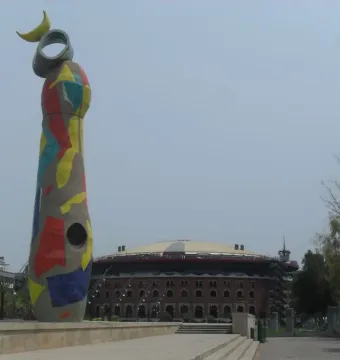
© Gerardo nuñez · CC BY 3.0
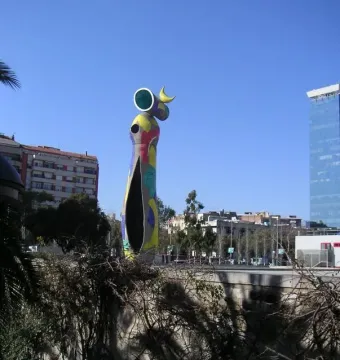
2010 © Slastic · Public domain
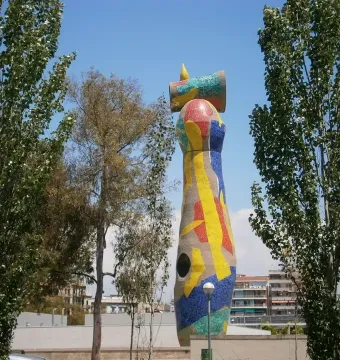
July 2011 © Image tube · CC BY-SA 4.0
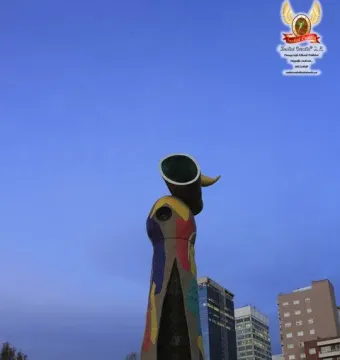
November 2017 © Ferran Madueño Noguer · CC BY-SA 3.0 es
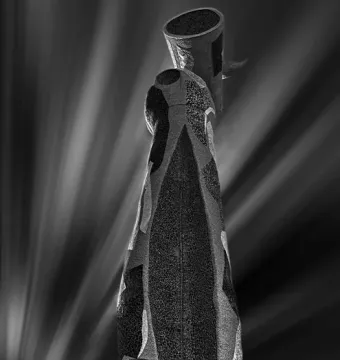
March 2020 © Jose Ramirez · CC BY-SA 2.0
Identification | |
| Title | Dona i Ocell |
| Type | Public sculpture |
| Work type | Large-scale sculpture |
| Translated title | Woman and Bird |
| Other titles | Mujer y pájaro; Femme et oiseau; Mulher e Pássaro |
Creator | |
| Collaborator | Joan Gardy Artigas |
| Artist | Joan Miró |
| Artist description | Spanish-Catalan polymath artist |
Historical context | |
| Artist's death | He died a few months later, at age 90 |
| Commission context | Public commission; the last of three works commissioned by Barcelona to welcome visitors arriving by sea, air, or land |
| Historical significance | One of the first expressions of public art in democratic-era Barcelona |
| Artist present at inauguration | No; Miró was absent because of serious health problems |
| Inauguration date | 1982 or 1983; sources vary |
| Date made | 1983 |
| Status in Miró's oeuvre | His last large-scale work |
Location and ownership | |
| Location | Parc de Joan Miró, Barcelona, Catalonia, Spain |
| Site setting | At the foot of a large artificial lake; the lake reflects the sculpture and prevents close physical approach |
| Urban role | A reference point that gives character to the park and is visible from Gran Via de les Corts Catalanes when arriving by car |
Physical characteristics | |
| Height | 22 meters |
| Form | A vertical, elongated, figurative composition with a hollow cylindrical body, a black incision, and an upper crescent-like element |
| Appearance | The sculpture is phallic in overall form, with a vulva-like incision and a bird-like top element |
| Silhouette | The woman's silhouette is described as an elongated, stretched leaf |
| Composition | Vertical composition governed by a diagonal axis |
Materials | |
| Mosaic material | Broken ceramic tile fragments |
| Structure material | Concrete |
| Surface material | Ceramic tiles |
Technique | |
| Fabrication | Realized in situ; its large size required cranes and masons |
| Surface technique | Trencadís mosaic |
Appearance | |
| Surface colors | Red, yellow, green, and blue |
| Decorative effect | The colors reflect light and contrast strongly with the gray concrete background |
| Surface treatment | The ceramic pieces are arranged in a mosaic-like manner |
| Accent material | Black fragments emphasize the openings and incision |
| Upper element | A hollow cylindrical attachment topped by a curved, yellow form |
| Lower body | The main body has an elongated opening and a round opening at the top |
Iconography and meaning | |
| Artistic synthesis | Considered a synthesis of Miró's iconography |
| Related ancient site | Miró mentioned Empúries as an example of this custom |
| Historical reference | Miró linked the monument to the Roman custom of carving an erect sex at city gates to wish health and strength to arrivals |
| Dedication or homage | Seen as a tribute to Antoni Gaudí, because of its forms and the use of trencadís |
| Interpretation | The sculpture combines woman and bird imagery with phallic and vulva symbolism |
| Recurring theme | Woman and birds are a recurring theme in Miró's work |
| Title symbolism | In Catalan, ocell can also be a figurative term for the penis |
| Symbolic meaning | It links rooting in the earth with the free flight of a bird through the female body |
| Depicted subject | A female figure with a hat topped by a bird |
Significance | |
| Public image | Used frequently as a symbol of Barcelona in tourist and representational items during the second half of the 1980s |
Other | |
| Related project context | It grew out of an earlier 1968 Barcelona proposal for a ceramic wall for El Prat Airport, expanded into a trilogy including works for the airport, La Rambla, and Parc de Joan Miró |
| Related work by collaborator | Joan Gardy Artigas had previously added tiles to Miró's mural on the Wall of Miró in Ludwigshafen am Rhein |