
Oscar Wilde's Tomb
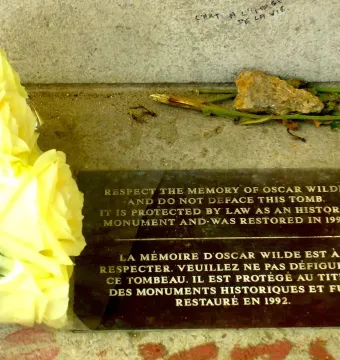
Oscar Wilde's Tomb is a funerary monument in Père-Lachaise Cemetery in Paris. Sculpted by Jacob Epstein, an American-born sculptor, it was carved from a twenty-ton block of Hopton stone and financed by Helen Carew, an admirer of the Irish writer. The monument draws inspiration from an Assyrian winged bull and also contains the ashes of Robert Ross, Wilde’s lover and literary executor. Its exposed genitalia caused scandal at the time. The tomb was later restored with support from Wilde’s family and the Irish government, and protective glass panels were added to prevent visitors from kissing the monument.
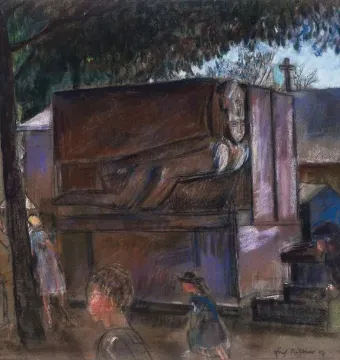
© Erich Büttner · Public domain
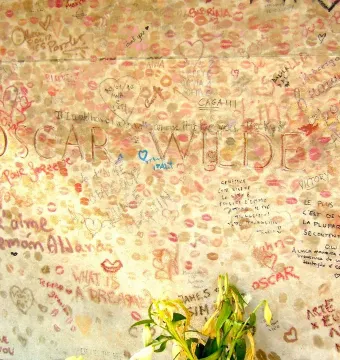
September 2010 © Cat Dam · CC BY-SA 3.0
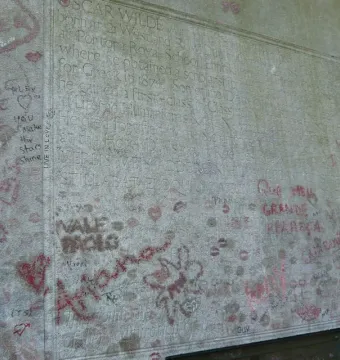
November 2007 © Jane023 · CC BY-SA 3.0
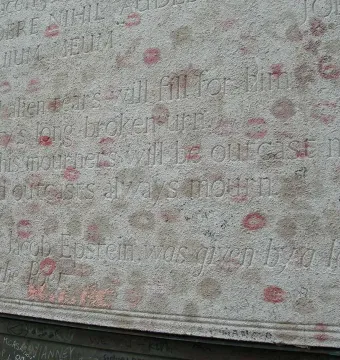
October 2009 © elizabeyth · CC BY 2.0
September 2010 © Cat Dam · CC BY-SA 3.0
Identification | |
| Type | Funerary monument / tomb |
| Title | Oscar Wilde's tomb |
Historical context | |
| Commissioned date | 1908 |
| Created | 1909–1912 |
Creator | |
| Sculptor | Jacob Epstein |
| Nationality | American-born sculptor |
| Associated architect / plinth designer | Charles Holden |
| Inscription carved by | Joseph Cribb |
Discovery and provenance | |
| Transported to | Père Lachaise Cemetery, Paris, France |
| Material source | Hopton Wood Stone (limestone) from Derbyshire, England |
| Commissioned by | Robert Ross, Oscar Wilde's literary executor |
| Original workshop | Cheyne Walk, London |
| Commission cost | £2,000 |
| Financed by | An anonymous donation, later revealed as Helen Carew; with financial assistance from Sydney Schiff (Stephen Hudson) |
Physical characteristics | |
| Weight | 20 tons |
| Dimensions / weight | Twenty-ton block |
Materials | |
| Material | Hopton stone |
Appearance | |
| Original design features | Originally included five figures on the headdress, including one with a crucifix; sketches also included a small angel behind the sphinx's ear and a phallic sphinx |
| Depicts | A large winged figure, conceived as a messenger; a sphinx is also present |
Iconography and meaning | |
| Possible meaning | The crucified figure may allude to Wilde's martyrdom or to his sexually transgressive life veiled by Catholicism |
| Inspiration | Wilde's works, especially The Young King and The Sphinx; also Assyrian winged bulls (lamassu) from the British Museum |
| Artistic influences | Eric Gill and the perceived primal sexuality of Indian and Egyptian art, contrasted with British art |
| Symbolism | Intended as a purely symbolic figure of the poet as messenger; many viewers interpreted it as a portrait of Oscar Wilde |
Location and ownership | |
| Current location | Père Lachaise Cemetery, Paris, France |
| Burial concession | Perpetual concession |
| Contains ashes of | Robert Ross, Wilde's lover, literary executor, and great friend; placed in the tomb in 1950 |
History and restoration | |
| Restoration | Restored in 2011, except for the amputated sex of the sphinx |
| Public reaction | Wilde's grandson Merlin Holland condemned the defacement; Marc Overton found the kisses disgusting, while Lisa Marie described the kissing as devotion |
| Protective measures | Two-meter-high plastic sheets were added to the stone walls to prevent visitors from approaching and kissing the monument |
| Cleaning and wear | The monument had been covered in lipstick since the early 2000s; lipstick caused permanent damage by making the stone more porous, and cleaning made it even harder to clean later |
| Public reception | Visitors traditionally kiss the tomb after applying lipstick, leaving kiss marks; graffiti is almost entirely love letters to Wilde |
| Surviving preparatory sketches | A number of Epstein's sketches survive in private collections and galleries; one profile sketch is in the Garman Ryan Collection at The New Art Gallery Walsall |
| Funding for conservation | Ireland's Office of Public Works paid for cleaning and the barrier, regarding the tomb as an Irish monument overseas |
| Historic status | Listed as a historic monument by decree |
| Completion time | Nine to ten months |
| Current popularity | Seen by thousands of visitors every year |
| Protective barrier | A glass barrier was erected in 2011 and completed in 2014 to make the monument kiss-proof; it covers only the lower half of the tomb |
| Initial unveiling | Shown to the London press in June 1912 |
| Replacement part | A silver prosthesis replaced the missing testicles in 2000, suggested by Leon Johnson |
| Aftermath of vandalism | They are missing; a cemetery director is said to have used them as paperweights |
| Vandalism | The testicles were removed in 1961 |
| Epstein's reaction | He was furious that the work had been altered without his consent and refused to attend the unveiling |
| Unveiling compromise | A bronze butterfly-shaped plaque was placed over the genitals under Robert Ross's instructions |
| Artist's response | Epstein reportedly bribed a police officer to continue working |
| Police surveillance | The monument was under police surveillance during work on it |
| Censorship and alteration | It was covered with tarpaulins and the genitals were covered with plaster before unveiling |
| Transport and customs issues | Police and French customs objected to the monument as a work of art; French customs imposed a heavy import duty of £120 |
| Controversy | Outraged public reaction to the nudity, especially the prominent genitalia of the angel/figure |
| Unveiled by | Aleister Crowley |
| Unveiled | Early August 1914 |
Other | |
| Associated people | Oscar Wilde, Helen Carew, Robert Ross, Jacob Epstein, Leon Johnson, Charles Holden, Joseph Cribb, Sydney Schiff (Stephen Hudson), William Rothenstein, Aleister Crowley |
| Associated place mentioned in inspiration source | British Museum |
| Title / subtitle in French source fragment | "angel-demon flying" (incomplete wording) |