
The Face of Barcelona
The Face of Barcelona, also known as El Cap de Barcelona or Barcelona Head, is a Pop sculpture by American artist Roy Lichtenstein created in 1991–1992 for the 1992 Summer Olympics in Barcelona, Spain. It was Lichtenstein’s first outdoor work using glazed ceramic tile and references Antoni Gaudí and Josep Maria Jujol’s trencadís mosaic technique. Made of concrete, glazed ceramic tile, and stainless steel, the sculpture is an abstract rendition of a woman’s head with bold red, yellow, blue, black, and white mosaic surfaces. It stands on the waterfront in the heart of Barcelona and reflects Lichtenstein’s signature pop-art style in three dimensions.
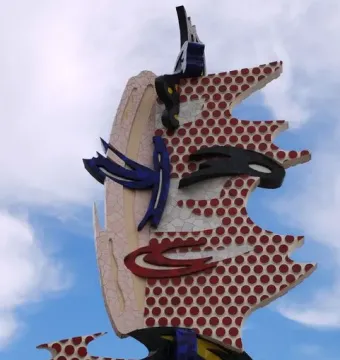
May 2013 © HitchHikersHandbook.com · CC BY-SA 3.0 es
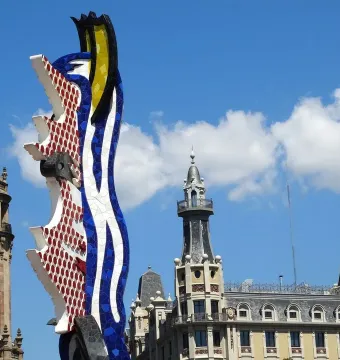
June 2014 © Adam Jones · CC BY-SA 2.0
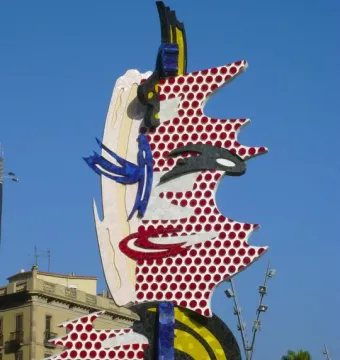
October 2007 © Andy Mitchell · CC BY-SA 2.0
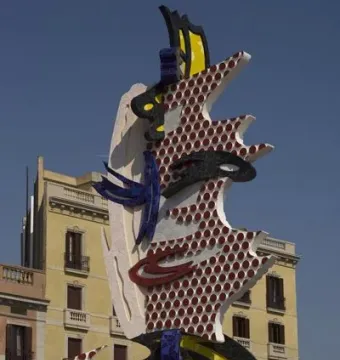
September 2008 © PMRMaeyaert · CC BY-SA 3.0
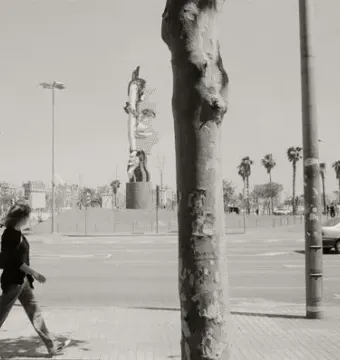
2006 © PMRMaeyaert · CC BY-SA 4.0
Identification | |
| Title | The Face of Barcelona |
| Original title | El Cap de Barcelona |
| Alternative names | Barcelona Head; Brushstroke Head IV; La Cara de Barcelona |
Creator | |
| Artist | Roy Lichtenstein |
| Artist nationality | American |
| Artist life dates | 1923–1997 |
| Executed by | Diego Delgado Rajado |
Historical context | |
| Date created | 1991–1992 |
| Created for | The 1992 Summer Olympics in Barcelona, Catalonia, Spain |
| Historical context | Created during Barcelona's urban transformation before the 1992 Summer Olympic Games, as the city sought to present itself as a modern metropolis |
| Series | Brushstrokes |
| Preliminary version | Small-format first version dated 1987, held in the collections of MACBA in the Raval district |
Discovery and provenance | |
| Wooden model | Wood model dated 1985 |
Physical characteristics | |
| Type | Sculpture |
| Style | Pop art; monumental sculpture |
| Subject | Highly abstracted face of a woman |
| Form | A face formed by large brushstrokes |
| Height | About 15 meters |
| Width | 6 meters |
| Base height | About 5 meters |
| Weight | 90 tonnes |
Materials | |
| Primary materials | Reinforced concrete, stainless steel staples, colored ceramic tiles |
| Model material | Wood |
Technique | |
| Artistic technique reference | Trencadís mosaic technique |
| Surface treatment | Covered in colored mosaic tiles, including red, yellow, blue, black, and white; the right side has a grid of red dots in relief |
| Construction | Made of eight prefabricated pieces with a ceramic coating |
Appearance | |
| Visual effect | From a distance it can look like a painting, as if it were made with a few quick brushstrokes |
| Eye depiction | The eyes look like thick blue and black brushstrokes |
| Nose depiction | The nose looks like a thick blue and black brushstroke |
| Lip depiction | The lips look like a quick stroke of bright red paint |
| Additional elements | A tall blue-and-white stroke beneath the head resembles a neck and extends through the face; a perpendicular yellow-and-black stroke begins at the bottom and reappears at the top of the head |
| Left side of face | The left third of the face, including the blue nose and eye, is covered with white tiles |
| Right side of face | The right two thirds of the face are covered in a grid of red dots |
Iconography and meaning | |
| Formal effect | Intended to create a two-dimensional impression and to resemble an image known from painting rather than a normally three-dimensional sculpture |
| Relation to earlier works | Similar to Lichtenstein's early-1980s Brushstrokes sculptures, but those earlier works were made of painted aluminum |
| Earliest cited painting | Look Mickey (1961) |
| Visual references | Reminiscences of Joan Miró's visual language |
| Artistic background | Lichtenstein began experimenting with three-dimensional art in the late 1970s; before that, his main focus was pop art and comic-strip-like imagery with bold primary colors, thick dark lines, thought bubbles, and dots |
| Reason for material choice | The ceramic tiles were used as a sign of respect for Gaudí and other Catalan Modernisme artists, and to reflect Barcelona's association with organic lines and mosaic tiles |
| Homage to | Antoni Gaudí and Catalan Modernisme, including the trencadís technique widely used in Barcelona |
| Stylistic inspiration | Built to resemble the style of Antoni Gaudí |
Location and ownership | |
| Current location | Passeig de Colom at the entrance to Port Vell, Barcelona, Spain, on the waterfront near the border with La Barceloneta |
| Specific site | At the intersection of Passeig de Colom and Pas de Sota Muralla streets, near Moll de la Fusta, opposite Plaça d'Antonio López |
| Nearby landmarks | The area includes the Palau de Mar and the Museum of the History of Catalonia |
| Visibility | Clearly visible because of its size |
History and restoration | |
| Date of unveiling | 7 April 1992 |
| Installation occasion | Installed for the 1992 Summer Olympics |
Significance | |
| Significance | A vivid landmark of the Barcelona waterfront that attracts tourists |