
Statue of Joseph Stalin
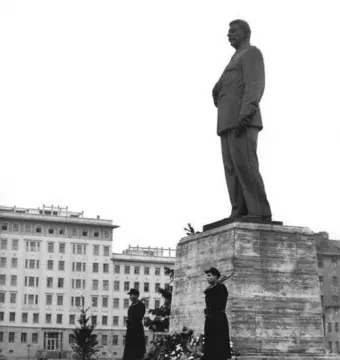
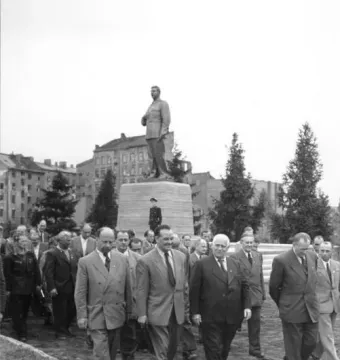
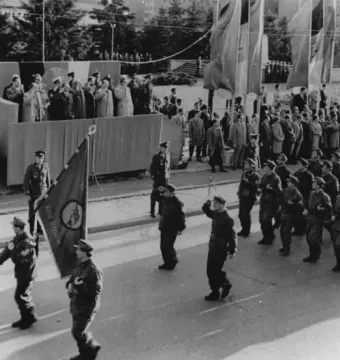
The Statue of Joseph Stalin was a 4.8-meter bronze monument by Soviet sculptor Nikolai Tomsky. It stood on Stalinallee, now Karl-Marx-Allee, in the Soviet sector of Berlin from 1951 to 1961. Unveiled by Walter Ulbricht in Friedrichshain, it faced the Deutsche Sporthalle and became a site for official ceremonies. After the start of de-Stalinization, East German authorities secretly dismantled it on the night of 13 to 14 November 1961 and replaced the site with green space. The sculpture’s fate is uncertain, though a legend says its bronze was melted down to make figures for the Berlin Zoo.
© Günter Weiß · CC BY-SA 3.0 de
© Walter Heilig · CC BY-SA 3.0 de
© Unknown authorUnknown author · CC BY-SA 3.0 de
© Schaar-Junge · CC BY-SA 3.0 de
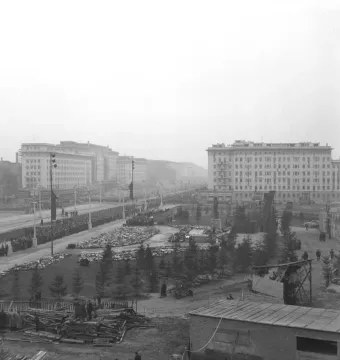
© Klein · CC BY-SA 3.0 de
Identification | |
| Title | Statue of Joseph Stalin |
| Type | bronze statue |
| Subject | Joseph Stalin |
| Alternative title | Berliner Stalindenkmal |
Creator | |
| Artist | Nikolai Tomsky; attribution is disputed, with Grigory Postnikov and Sergey Merkurov also proposed |
| Signature | Unsigned |
Discovery and provenance | |
| Presented by | A Komsomol delegation |
| Presented to | The East Berlin government |
| Presentation occasion | The Third World Festival of Youth and Students |
| Paid for by | The DDR government |
| Transport | Transported to East Germany by air |
| Acquired | Acquired in the Soviet Union in July 1951 by Walter Ulbricht with Rudolf Appelt |
History and restoration | |
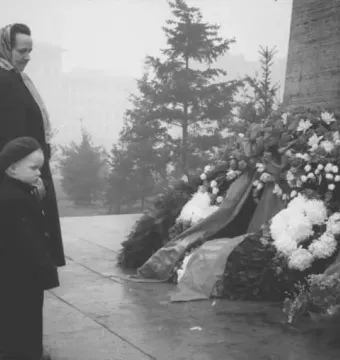
| Use at site | Became a site for official ceremonies, rallies, demonstrations, and a funeral march in 1953 |
| Unveiled | 3 August 1951 by Walter Ulbricht |
| Attendees at unveiling | Wilhelm Pieck and Otto Grotewohl |
| Historical context | It formed part of the Stalin cult in East Germany; Stalin monuments were generally removed during de-Stalinization, and in 1961 all other Stalin monuments in the GDR were also removed |
| Reuse of material | The bronze was reportedly used to make bronze figures for the Berlin Zoo |
| Fate | The statue was destroyed; reports say the bronze was smashed or melted down and recycled |
| Street renaming after removal | The section of Stalinallee from Alexanderplatz to Frankfurter Tor was renamed Karl-Marx-Allee |
| After removal | The site was turned into a green area |
| Removal | Discreetly removed by East German authorities in a clandestine overnight operation on the night of 14 November 1961, along with street signs for Stalinallee |
| Damage during 1953 unrest | During the 17 June 1953 uprising it was pelted with stones but was not damaged |
| Mourning after Stalin's death | On 9 March 1953, flowers were laid, flags were draped with black crepe or flown at half-mast, and minutes of silence were held in schools |
Physical characteristics | |
| Uniform and insignia | Wearing a uniform with medals and the Order of the Hero of Socialist Labour |
| Depicted rank | Marshal of the Soviet Union |
| Pose | Typical military pose, with the right hand tucked under the button placket and the left hand holding a scroll |
| Pedestal base | Masonry platform |
| Pedestal material | Disputed: marble, concrete, or sandstone |
| Pedestal shape | Slightly conical |
| Pedestal height | About 3 meters |
| Height | 4.8 meters |
Materials | |
| Material | Bronze |
Iconography and meaning | |
| Scroll meaning | Interpreted as identifying Stalin as a planner of large-scale communist construction projects or as a constitution maker |
Location and ownership | |
| Original location | Stalinallee in East Berlin, Friedrichshain district, between Andreasstraße and Koppenstraße, opposite the German Sports Hall |
| Street context | Stalinallee, formerly Große Frankfurter Straße, later renamed Karl-Marx-Allee |
| City | Berlin |
| Country | German Democratic Republic |
| Placement context | Set on a newly designed boulevard under construction, in an open area between the B-Süd and C-Süd apartment blocks with a sparse pine grove nearby |
| Intended relocation | Planned to be moved to Strausberger Platz once that square was ready, but it remained at its original location |
Significance | |
| Significance | A symbol of Stalinist state propaganda and of Stalinallee as a showcase avenue for the 1951 World Festival of Youth and Students |