
Pi-Chacán
Pi-Chacán, also known as Chacán-Pi, is a sculpture by Peruvian artist Fernando de la Jara, installed in 2011 in front of the Institutes of Microbiology and Virology at the University of Tübingen. Carved in red Verona marble, it weighs 32 tons and measures 4.2 x 1.7 x 1.7 meters. The work depicts a human vulva and was intended by the artist to celebrate the body. Its name combines the Quechua term chacán, which de la Jara says means both a water-carved cavity in rock and "to make love," with the Greek letter Pi. The sculpture was originally planned to include a pool at its base, but budget limits prevented this.
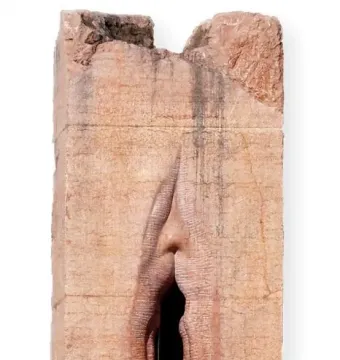
March 2010 © Skulptur_tuebingen_vulva.jpg · Public domain

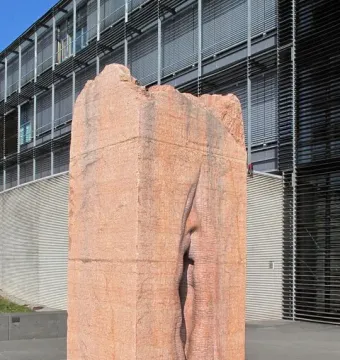
March 2011 © Kamahele · CC BY-SA 3.0 de
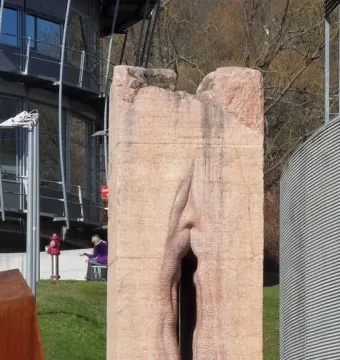
March 2010 © Skulptur_tuebingen_vulva.jpg · Public domain
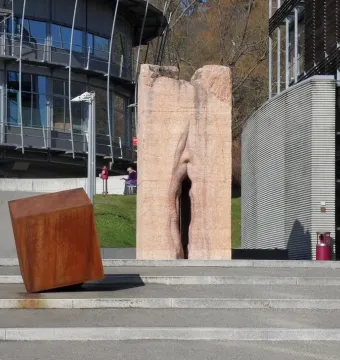
© 134.2.247.214 · Public domain
Identification | |
| Title | Pi-Chacán |
| Alternative name | Chacán-Pi; "Steinerne Vulva" ("Stone Vulva") |
| Type | Sculpture |
Creator | |
| Artist | Fernando de la Jara |
| Artist nationality | Peruvian |
Historical context | |
| Installation date | 2001 |
Discovery and provenance | |
| Cost | €120,000 |
Physical characteristics | |
| Weight | 32 tonnes |
| Dimensions | 4.2 × 1.7 × 1.7 metres |
Materials | |
| Material | Red Verona marble |
Appearance | |
| Depicted subject | A human vulva |
| Form and surface | Prominent and recessed forms with surfaces of different textures; a narrow slit in the back lets light into the interior |
| Feature | A water basin/pool at the base was planned but not realized because of budget constraints |
Iconography and meaning | |
| Intended interaction | It should be entered / penetrated |
| Artistic approach | Participatory art |
| Artist's view of the work | The main part of the work is not the exterior |
| Artist's intention | To celebrate the body |
| Tactile design | Intended to be tactile and appreciable by blind people through different textures and forms |
| Meaning of Pi | The Greek letter π, used as the mathematical symbol for pi; its shape evokes a stylized door or vulva |
| Meaning of chacán | According to de la Jara, it means a cavity carved by water in rock and also to make love |
| Name origin | Named by the artist from the Quechua term chacán and the Greek letter Pi |
Location and ownership | |
| Location | At the end of the Weg der Künste (Path of the Arts), in front of the Institutes of Microbiology and Virology of the University of Tübingen, Tübingen, Germany |
| Context of location | Placed in a setting dedicated to the study and care of the human body |
History and restoration | |
| Incident date | 20 June 2014 |
| Incident description | An unnamed American exchange student climbed into the sculpture, became trapped inside after trying to pose for an unusual photo, and had to be rescued by firefighters |
| Public attention | The sculpture attracted international media attention after the 2014 trapping incident |
| Emergency response | Tübingen police received an emergency call reporting that a person was stuck inside a stone vulva and sent 5 fire engines and 22 firefighters |
| Rescue duration | About 30 minutes |
| Rescue method | The victim was pulled out with bare hands; forceps were not necessary |
| Condition after incident | Neither the student nor the sculpture was damaged |
| Artist's reaction | De la Jara said he was amused by the incident and attributed it to the student's lack of coordination or sensibility; he said the student would not have had a problem if he had gone in carefully instead of jumping in |
| Mayor's reaction | Mayor Boris Palmer said he could not imagine how the accident happened, even considering extreme adolescent fantasies, and that deploying 22 firefighters for the rescue almost pained his soul |
| Witness reaction | A witness said the fire department was not really amused and that the student was really embarrassed |