
Minerva d'Arezzo
Minerva d'Arezzo is a Roman bronze statue found in 1541 in Arezzo during the digging of a well. The exact circumstances of its discovery are not well known, and its original condition is unclear. Early restorations in bronze, plaster, and wood were probably carried out as early as the 16th century, and may have been more accurate than the present ones, which date from the 18th century. Its dating is debated, with proposed dates ranging from around 280/270 BC to the first decades of the Empire, at the end of the 1st century BC. The statue is now part of the collections of the National Archaeological Museum of Florence.
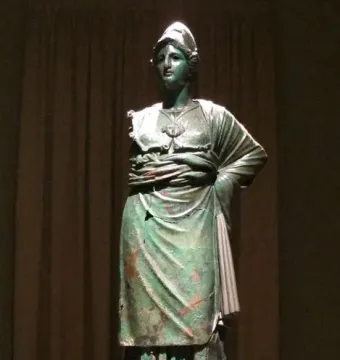
June 2012 © sailko · CC BY-SA 3.0
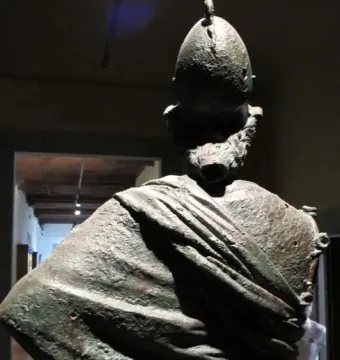
June 2012 © sailko · CC BY-SA 3.0
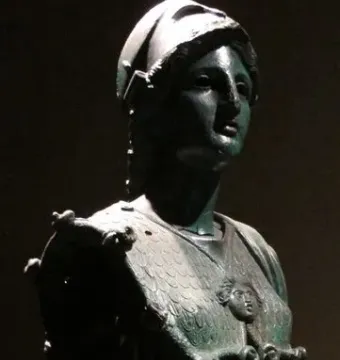
June 2012 © sailko · CC BY-SA 3.0
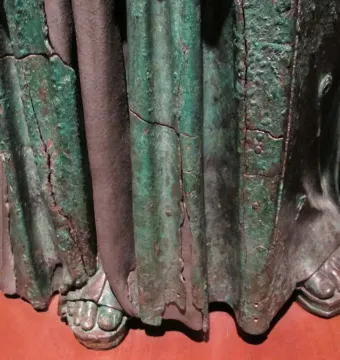
June 2012 © sailko · CC BY-SA 3.0
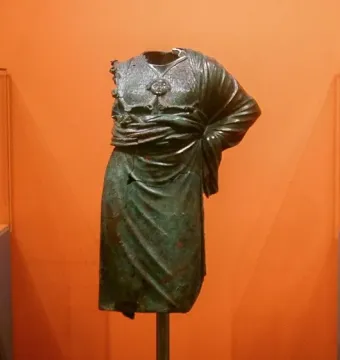
December 2006 © sailko · CC BY 2.5
Identification | |
| Title | Minerva d'Arezzo |
| Type | Roman bronze statue |
Historical context | |
| Dating | Opinions differ: around 280–270 BC, or the first decades of the Roman Empire (late 1st century BC) |
| Discovery date | 1541 |
Discovery and provenance | |
| Early ownership | In the collection of antiquities of Cosimo I de' Medici about ten years after its discovery; by 1559 it decorated the duke's office |
| Exhibited in Florence | In 1782, Luigi Lanzi exhibited it with the Chimera, the Arringatore, and the Idolino in the Corridore di Mezzogiorno of the Uffizi Gallery |
| Associated archaeological context | Later excavations in the same area, at the beginning of the 20th century, revealed notable remains of a large Roman house |
| Discovery circumstances | Little is known about the discovery circumstances |
| Discovery place | Arezzo, near the church of San Lorenzo, during the digging of a well |
Location and ownership | |
| Current location | National Archaeological Museum of Florence, Floor I, Room XIV, no. 248 |
History and restoration | |
| Original state at discovery | Unclear |
| Early restorations | Probably carried out already in the 16th century; used bronze, plaster, and wood |
| Early restorations assessment | Probably more philologically correct than the current restorations |
| Current restorations date | 18th century |
| Right arm reconstruction | The right arm, from the shoulder, is a bronze reconstruction dated 1785 |
| Restoration display | The separated elements were presented during the 2006 restoration |
Physical characteristics | |
| Height | Not specified |
Materials | |
| Type materials | Monumental statues of this type could be made of marble or bronze |
| Material | Bronze |
Appearance | |
| Garment | Thickly folded chiton and a large himation |
| Gesture | The oratorical gesture resembles that of the Arringatore |
| Headgear | Corinthian helmet, raised to reveal the face |
| Chest attribute | Aegis with gorgoneion on the chest |
| Original pose | The right arm was extended along the torso and the forearm raised and bent at the elbow to hold a spear |
| Weapon attribute | Spear |
Iconography and meaning | |
| Ancient source | Pausanias, 8.9.3 |
| Ancient worship areas | Worshipped almost everywhere in antiquity, including Greece, Etruria (as Menrva), and Rome |
| Domain and attributes | Goddess of wisdom, intelligence, human work, and war |
| Divine parentage in myth | Daughter of Jupiter (Zeus), born from his head |
| Interpretive significance | For Minerva, such statues especially recalled her protective role over intelligence and the arts |
| Function in antiquity | Cult statue in temples; in the Hellenistic and especially Roman periods, such statues were also used to decorate public or private buildings |
| Copy type date | Hellenistic variant dated to about 280–270 BC |
| Number of known exemplars | At least twenty-five exemplars are known |
| Prototype source | A statue from the Praxitelean school dated to 340–330 BC |
| Derivation | Derived from a Praxitelean model |
| Type name | The so-called Athena Vescovali type |
| Identification certainty | Probably not an original Greek work of the Classical age; possibly the original, or more probably a Roman copy, of a Hellenistic variant |
| Subject | Minerva (Athena), goddess of wisdom and war |
| Possible model | Possibly Athena of Mantineia by Praxiteles |