
Karasu Relief
The Karasu relief, also called the Süpürgüç relief, is a Neo-Hittite rock relief located on a tributary of the Euphrates. It measures 1.98 m high and 1.6 m wide and depicts a warrior or protective god standing on a deer. The deer faces left with its head held high, while the male figure wears a short kilt, shoes, and a tall, round-topped god’s hat, and carries a spear and bow. A sun symbol hovers above him. Much of the upper part of the figure was destroyed in 1976 by treasure hunters. The relief is generally identified as a representation of the protective god of the wild, Kurunta or Tuntija, and has been dated either to the traditional style period or to Late Hittite II.
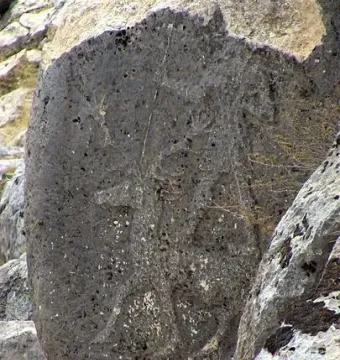
September 2014 © Klaus-Peter Simon · CC BY-SA 3.0
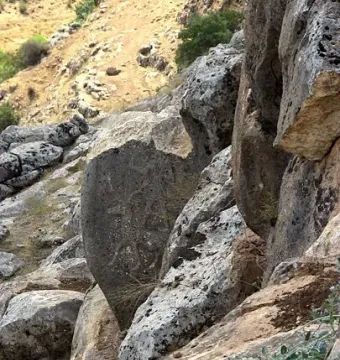
September 2014 © Klaus-Peter Simon · CC BY-SA 3.0
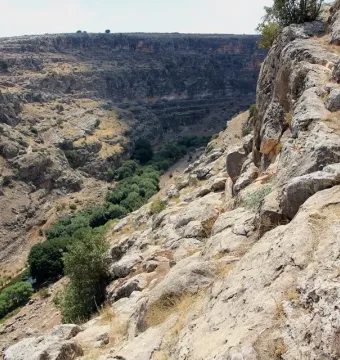
September 2014 © Klaus-Peter Simon · CC BY-SA 3.0
Identification | |
| Title | Karasu relief |
| Alternative name in German | Felsrelief von Süpürgüç |
| Type | rock relief |
| Alternative name | Süpürgüç relief |
Historical context | |
| Ancient territorial attribution | Based on the inscription of the destroyed Neo-Assyrian relief at Kenk Boğazı, both reliefs appear to have been within the kingdom of Kummuh |
| Ancient political boundary | In the early 1st millennium BC the area lay on the border between the Iron Age kingdoms of Kummuh (later Commagene) and Carchemish |
| Period | Late Hittite period; also dated by Winfried Orthmann to Late Hittite II (950–850 BC) and by Hansgerd Hellenkemper and Jörg Wagner to the "traditional style" (1050–850 BC) |
Creator | |
| Discoverers | the geologists Krummenacher and Wilson |
Discovery and provenance | |
| Discovered | 1956 |
| First described | 1958 by Charles Burney and G. R. Lawson |
| Nearby related monument | The destroyed late Assyrian relief at Kenk Boğazı was about 10 km away |
Physical characteristics | |
| Dimensions | 1.98 m high and 1.60 m wide |
| Relief type | raised relief |
| Support | rock block |
Location and ownership | |
| Nearby bridge | The remains of the Roman bridge Karasu Köprüsü are about 2 km upstream along the Karasu |
| Access | The plateau above the relief can be reached from the bridge by an approximately 45-minute ascent |
| Associated road | a military road from Zeugma to Samosata |
| Nearby monuments | the monumental tombs at Elif, Hisar, and Hasanoğlu lie south of the road |
| Elevation above river | About 200 m above the Karasu |
| Distance to Euphrates confluence | About 3 km before the Karasu flows into the Euphrates |
| River setting | In a deep gorge cut by the Karasu, a right tributary of the Euphrates |
| Position on rock | A few metres below the upper edge of the rock |
| Setting | On the east side of a rock block on a steep cliff-face / rocky ridge in the limestone mountains of the Kartal Dağı |
| Location | Near Gümüşpınar, by Akbudak, in Araban district, Gaziantep Province, Turkey |
Appearance | |
| Animal direction | Facing left |
| Above-figure symbol | winged sun disc |
| Headgear | high, round-topped divine cap |
| Animal antlers | finely carved and shown frontally, with two tines on each side |
| Animal pose | head held high on a slender neck, shown in profile with a slightly open mouth |
| Figure attribute | bow over the left shoulder |
| Animal back height | 52 cm |
| Figure clothing | short kilt and shoes |
| Animal height | 1.20 m |
| Animal identification | According to Frank Starke, an adult red deer (Cervus elaphus) |
| Animal | deer |
| Figure weapon | spear in the right hand |
| Animal body length | 68 cm |
| Main subject | a male guardian or warrior standing on a deer |
| Figure height | 1.2 m |
| Figure direction | Facing left |
Iconography and meaning | |
| Inscriptions | No inscription survives on the relief |
| Interpretation | The figure has been identified as a protective god, possibly the wild god Kurunta or Tuntija; because of the deer and bow it has also been interpreted as Runtiya |
| Motif | "god on a deer" |
| Motif history | Attested already in the Assyrian trading colonies at the beginning of the 2nd millennium BC and in the Hittite Empire; a later parallel is the Hacıbebekli stele |
| Possible function | The relief may have depicted the protective deity of that settlement |
Archaeology and context | |
| Settlement context | Traces of a late Hittite settlement were found in the surrounding area |
History and restoration | |
| Earlier condition | Older images show facial details and hair tied at the nape of the neck |
| Current condition of head | Since 1976 only the beard under the chin is visible |
| Damage | In 1976 treasure hunters blew away the upper part of the rock block with dynamite |
Significance | |
| Art historical context | Rock reliefs are a prominent aspect of Hittite art |
| Stylistic attribution | Hansgerd Hellenkemper and Jörg Wagner assign the work to the "traditional style" (1050–850 BC); Winfried Orthmann dates it to Late Hittite II (950–850 BC) |