
Dancing Maenad
Dancing or Furious Maenad is a sculpture made of Parian marble by the Greek sculptor Scopas. Created around 330 BC, it belongs to the late Classical period of Greek sculpture and reflects the emotional, pathos-driven style typical of its author. The work seen today is a Roman copy of the original Greek piece. It is preserved in the State Art Collections of Dresden, in the Albertinum Museum. The sculpture is significant for its move away from the classical ideal of perfect balance toward a more subjective and expressive representation of movement and emotion.
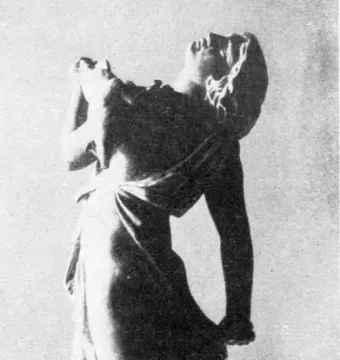
1909 © Paul Schumann (1855–1927) · Public domain
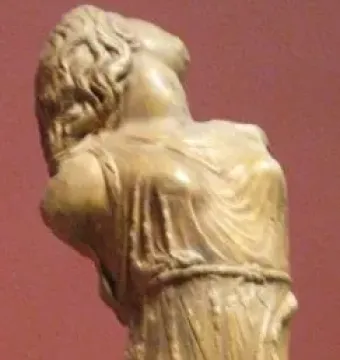
November 2007 © shakko · CC BY-SA 3.0
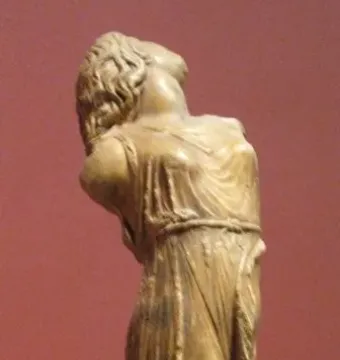
November 2007 © shakko · CC BY-SA 3.0
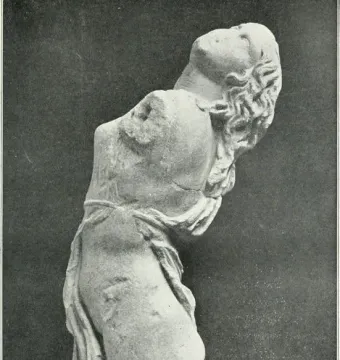
1907 © Internet Archive Book Images · No restrictions
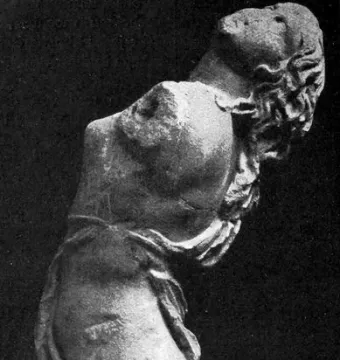
1909 © Paul Schumann (1855–1927) · Public domain
Identification | |
| Title | Dancing or Furious Maenad |
| Type | Roman copy of a sculpture by Scopas |
| Alternative names | Bacchante; The Furious Maenad; The Dancing Maenad |
Historical context | |
| Art period | Late Classical Greek art, in the transition from the Classical period to the Hellenistic era |
| Date | circa 330 BC |
Creator | |
| Style | Pathos style |
| Stylistic features | Emotion placed above physical form; torsion, convulsive movement, and expressive faces |
| Artist birth date | around 380 BC |
| Artist birthplace | Paros, Cyclades |
| Artist nationality | Greek |
| Artist | Scopas |
Discovery and provenance | |
| Known from | A small fragmentary marble copy |
| Extant version | The surviving piece is a Roman copy |
Physical characteristics | |
| Head position | Head thrown backward and turned to the left |
| Light and shadow effect | Strong chiaroscuro created by the varying depths of the folds and hair |
| Hair | Disordered mass of hair with curled locks |
| Expression | Full face with parted lips and a lost gaze toward the sky |
| Clothing | An airy chiton or dress clinging to the body, cinched just above the waist, opening upward and leaving the left side uncovered |
| Pose | Strong swirling torsion from the left leg through the torso and neck to the head; designed to be viewed from the side or in diagonal view |
| Condition | Incomplete and badly damaged, but preserving its fundamental features |
| Subject | A female maenad, originally full-length |
| Form | Free-standing round sculpture |
| Preserved parts/status | The arms are lost; the legs are mutilated; the knife and sacrificed goat once carried on the shoulders are missing |
Materials | |
| Material | Marble, specifically Parian marble |
Technique | |
| Technique | Carved by subtraction; wet drapery technique; undercutting and trepanation for the hair curls |
Iconography and meaning | |
| Associated term | Sparagmos, the tearing apart of animals or even human beings |
| Interpretation | A transgressive figure of womanhood, shown in a state of Bacchic ecstasy and surrender |
| Symbolic meaning | Represents Dionysian frenzy, irrationality, instinctuality, and opposition to civic order and moderation |
| Ritual practice | Orgiastic ceremonies, frenzied dances to flutes and tambourines, and ritual sacrifice of a kid or roe deer torn apart with knives and eaten raw |
| Mythological theme | Associated with Dionysus (Bacchus) and the cult of Dionysus |
| Depicted scene | A maenad in ecstatic Dionysian ritual |
Location and ownership | |
| Current location | Albertinum Museum, State Art Collections Dresden, Dresden |
| Current museum | Albertinum Museum |
| Current collection | State Art Collections Dresden |
History and restoration | |
| Historical context | Placed in the Classical and post-Classical transition of Greek history, amid political, economic, social, philosophical, and aesthetic change after the crisis of the polis system and Athens' loss of preeminence |
| Historical background | Between the Ionian Revolt of 499 BC and the conquest of Greece by Alexander the Great around 336 BC; marked by the Persian Wars, the Peloponnesian War, rivalry between Athens and Sparta, the decline of the polis system, and the rise of Macedon under Philip II and Alexander the Great |
| Artistic significance | A transition from Classical art to Hellenistic art, based on expressiveness, drama, and movement |
Significance | |
| Art-historical significance | Considered one of the three major figures of late or post-classical Greek art, alongside Praxiteles and Lysippos |
| Ancient sources | Known from classical authors such as Pausanias, Pliny the Elder, and Calistratus |
| Quoted interpretation by Calistratus | The figure, though hard, softened into femininity while retaining vigor and abandoning itself to Bacchic delirium |