
Bronze Ram
Bronze Ram is a bronze sculpture from Syracuse, dated to the first decades of the 3rd century BC and attributed to the circle of Lysippus. It was cast using the lost-wax technique and depicts a crouching ram, apparently ready to spring forward. The work is the sole surviving piece of a pair and is kept in the “hall of bronzes” at the Salinas Archaeological Museum in Palermo. Its history is marked by a long series of movements and restorations, including transfers between Sicilian residences and later conservation work in 2005. Since 27 June 2013, it has been listed among the immovable heritage of the Sicilian Region, and it returned to the Salinas Museum in 2016.
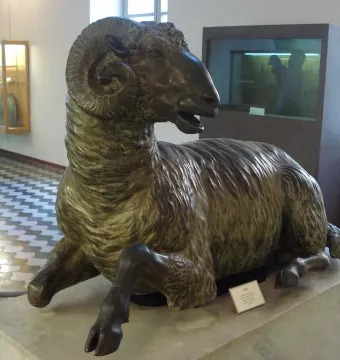
September 2006 © Giovanni Dall'Orto · Attribution
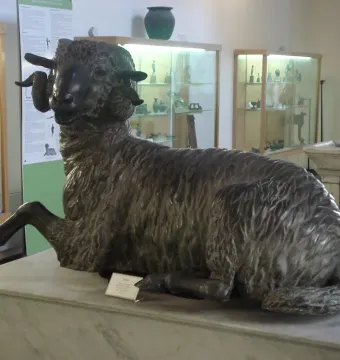
September 2006 © Giovanni Dall'Orto · Attribution
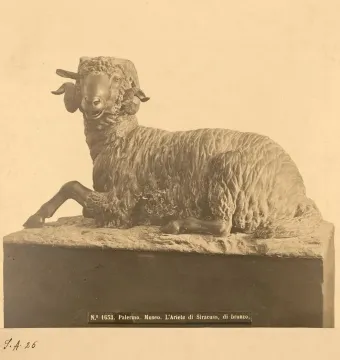
© Fratelli Tagliarini · Public domain
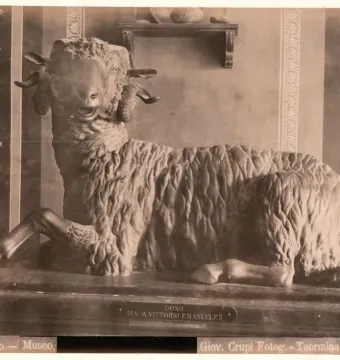
© Giovanni Crupi · Public domain
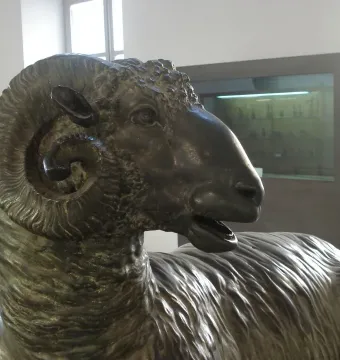
September 2006 © Giovanni Dall'Orto · Attribution
Identification | |
| Title | Bronze Ram |
| Alternative name | Ram of Castello Maniace |
| Type | Ancient bronze sculpture |
| Subject | Ram |
| Original title | L'Ariete in bronzo |
Historical context | |
| Dating | Probably the first decades of the 3rd century BC; disputed, with dates proposed from the Hellenistic period to the Roman Imperial period |
| Style | Greek school |
Creator | |
| Attribution | Attributed to the circle of Lysippos |
Discovery and provenance | |
| Number of figures | Two rams originally; one survives |
| Associated fortress | Castello Maniace, Syracuse |
| Placement at Castello Maniace | The two rams flanked the main portal of the fortress at a height of seven meters |
| Initial location in the 13th century | Castello Maniace, Syracuse |
| Documented history begins | Around the middle of the 13th century |
| Original function | Unknown |
| Original composition | Part of a pair of mirror-image ram statues |
| Surviving counterpart | The counterpart is lost |
| Place of manufacture | Disputed / controversial |
| Another hypothesis about origin | The rams may have been found during occasional excavations in Syracuse |
| Alternative origin tradition | According to another tradition, the two bronze rams were brought from Constantinople to Syracuse by the Byzantine admiral George Maniakes and placed on the fortress he built there; this tradition is considered doubtful |
| Possible original location | The palace of Agathocles in Syracuse |
| Origin | From Syracuse |
Physical characteristics | |
| Height | 79 cm |
| Base appearance | The base may have imitated a natural landscape such as a meadow or a rock |
| Base | The irregular underside suggests the ram was mounted on an intentionally uneven base |
| Scale | Approximately life-size |
| Length | 138 cm |
| Fur on the body | Long and wavy |
| Detailing | Richly detailed |
| Fur on the head | Finely curled |
| Horns | Twisted |
| Mouth | Slightly open |
| Head position | Head turned to the left |
| Pose | Lying down with the left front leg raised |
Materials | |
| Material | Bronze |
Technique | |
| Technique | Hollow cast using the lost-wax casting method |
| Eye technique | The eyes were cast together with the statue |
Location and ownership | |
| Date of inclusion in Beni Inamovibili | 27 June 2013 |
| Current location | Museo Archeologico Regionale Antonino Salinas, Palermo, Italy |
| Included in | Beni Inamovibili of the Region of Sicily |
| Inventory number | 8365 |
History and restoration | |
| Other source tradition | According to other sources, in 1820 during the unrest in Palermo they were thrown out of a window, and only one was saved |
| Donation to museum | In 1866, by order of King Victor Emmanuel II, the surviving restored statue was donated to the Royal Archaeological Museum of Palermo |
| Current museum | Salinas Archaeological Museum, Palermo |
| Restoration campaign start | 2005 |
| Restoration concern | The ram was threatened by corrosion from atmospheric humidity; the left hind leg had already detached |
| Return to museum | On 6 April 2016 the original ram returned to the Salinas Archaeological Museum in Palermo |
| Restoration by | Anna Maria Carruba, under the direction of museum director Agata Villa |
| Restoration methods | Cleaning with a microsandblaster using glass microspheres to remove atacamite; finishing with scalpels and bristle brushes mounted on a dental microdrill; stabilization of corrosion products with 5% benzotriazole applied by brush; surface coating with a thin acrylic resin film (Paraloid B72); reattachment and fixing of the detached leg using a mechanical support in steel and epoxy resin |
| Use of historical mold matrix | A mold matrix made by the Fonderia Storica Chiurazzi of Naples in the 19th century, still unused, was employed during the restoration |
| Loan to Castelbuono | In 2011 the bronze ram was loaned to the city of Castelbuono for a cycle of studies dedicated to the artifact |
| Exhibition | From 15 September to 9 December 2012 it was one of 160 works selected by the Royal Academy of Arts in London for the exhibition Bronze |
| Goethe's account | He saw them in 1787 and reported it in Italian Journey |
| Salinas statement | In 1875 Salinas wrote that two of these rams were preserved in the Royal Palace; during the Sicilian revolution of 1848 one was smashed and melted down, and the other had projecting parts broken off, including the tail, the right knee, the right hind leg, and one ear |
| Later placement on tomb | In 1475 Antonio, son of Giovanni Ventimiglia, placed the two relics on his tomb |
| Houël's legend | A popular legend said the pair was part of a quartet of bronze rams on tall columns facing the four main winds; when the wind blew, the statues supposedly produced a sound like bleating, and this work was said to have been made by Archimedes |
| Subsequent location | Ventimiglia's castle in Castelbuono |
| Date seen by Houël | 18th century |
| Removal | Taken away by Queen Maria, wife of Alfonso V of Aragon |
| Gift to Giovanni Ventimiglia | 1443 |
| Reason for gift | As a reward for his loyalty after suppressing the Syracusan revolt |
| Gift recipient | Giovanni Ventimiglia, Marquess of Geraci |
| Confiscation | In 1485 the Ventimiglia, Marquesses of Geraci, rebelled against the rulers of the kingdom and were exiled, and the rams were confiscated by the viceroy Gaspare de Spes |
| Location after confiscation | Palazzo Steri, Palermo |
| Later decorative location | Castello a Mare, Palermo |
| Transfer to Naples of viceregal residence | 1556 |
| Return to Palermo | The two statues later returned to Palermo |
| Seen by | Jean-Pierre Houël, Richard Payne Knight, and Johann Wolfgang von Goethe |
Significance | |
| Sicilian provenance view | The statue has often been treated as an example of Greek art from Sicily |
| Reception in scholarship | The re-dating to the Middle Imperial period has partly been accepted, while the statue is still sometimes treated as an example of Sicilian Hellenistic art |
| Bronze art of Sicily | Not sufficiently known to allow stylistic comparison |
| Iconographic interpretation | According to Gans, the iconographic context may have changed and the image may have acquired a new meaning |
| Possible earlier origin | Gans discussed a possible origin from Byzantium |
| Possible later transfer | It may have been brought to Sicily only in medieval times |
| Reason against long-term local survival | Gans considered it unlikely that such valuable statues would have remained on the island for so long because of repeated plundering of Sicily, including by the Roman governor Gaius Verres |
| Sicilian production disputed | Gans argued it need not have been produced in Sicily |
| Alternative dating proposed | Antonine period |
| Contrast with Greek large bronzes | In Greek large bronzes, the eyes were usually left open in the casting and inserted later from another material |
| Basis for Antonine dating | The form of the eyes, especially the pupils, which Gans considered comparable to imperial-period statues |
| Proposed by | Art historian Henning Gans |
| Alternative attribution source | Gisela M. A. Richter |
| Alternative attribution | Sometimes described as a Roman work based on a Hellenistic model |
| Art-historical period proposed | Hellenistic period, based on the subject and execution |
| Initial attribution | Generally regarded as a Greek work of art |
| Uniqueness | The only surviving example of a pair |
Iconography and meaning | |
| Subject interpretation | A crouching ram, probably ready to spring |
| Possible mythological interpretation | Possibly a depiction of the encounter between Odysseus and the Cyclops Polyphemus, because sheep play a role in that myth |
| Alternative interpretation | Possibly an idyllic shepherd scene |
| Possible setting | May have been placed in a garden or villa complex as part of a locus amoenus composition |
| Function | Uncertain; Heinrich Heydemann thought it was a fountain figure from whose mouth water gushed |
| Interpretation by Gans | The ram and its counterpart may have been part of a sculptural group |
Other | |
| Original title language | German |