
Head of a Princess from Amarna
Head of a Princess from Amarna is an ancient Egyptian bust from the Amarna period, inventory no. 21223, in the Egyptian Museum Berlin. It depicts an unnamed princess and dates to around 1350 BCE. The 21 cm high head is made of silicified sandstone. It was found in 1920 during excavations by the German Oriental Society in house P 47,1, the sculptor Thutmose’s workshop at Tell el Amarna, and was acquired by James Simon for the museum. The portrait shows the characteristic Amarna style with an elongated face, prominent chin, long curved neck, and broad skull, while still preserving youthful features. It was part of a composite statue and was intended to be attached with a tenon; the eye and eyebrow inlays are missing.
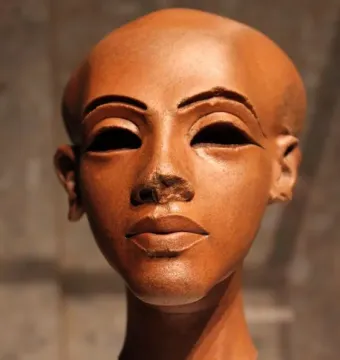
February 2014 © Anagoria · CC BY 3.0
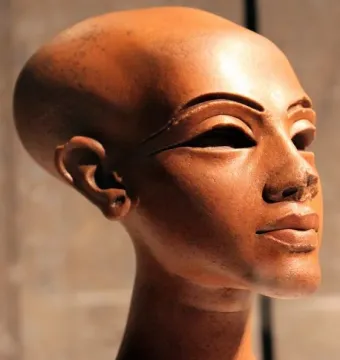
February 2014 © Anagoria · CC BY 3.0
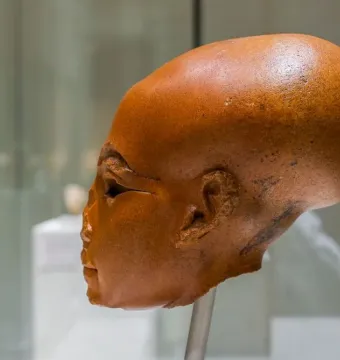
December 2014 © ArchaiOptix · CC BY-SA 4.0
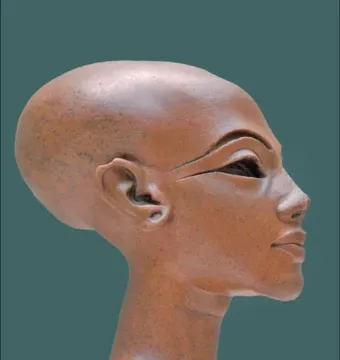
August 2011 © dalbera · CC BY 2.0
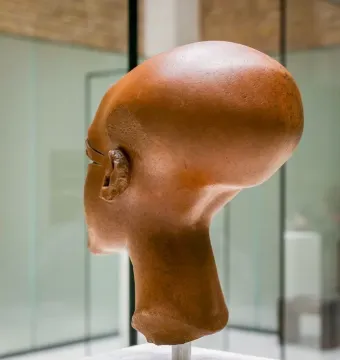
December 2014 © ArchaiOptix · CC BY-SA 4.0
Identification | |
| Title | Head of a princess from Amarna |
| Inventory number | 21223 |
| Object type | Sculpture head of a princess; part of a composite statue |
Historical context | |
| Culture | Ancient Egyptian |
| Period | Amarna Period, early phase |
| Date | c. 1350 BCE |
Creator | |
| Workshop | Thutmose's workshop, House P 47.1, Tell el-Amarna |
Discovery and provenance | |
| Discovery date | 1920 |
| Excavated by | German Oriental Society |
| Findspot | House P 47.1, the workshop of the sculptor Thutmose, Tell el-Amarna |
| Acquired by | James Simon |
| Acquired for | Egyptian Museum, Berlin |
Location and ownership | |
| Current location | Egyptian Museum Berlin |
Physical characteristics | |
| Attachment method | The head was attached to the statue with a mounting tenon; remains of the tenon survive |
| Anatomical treatment | The neck, nape vertebrae, and bone structure of the back of the head are rendered with anatomical precision |
| Height | 21 cm |
| Condition | The head is complete, but the inlays for the eyes and eyebrows are missing |
Materials | |
| Material | Silicified sandstone |
Appearance | |
| Style | Amarna style modeled on the portrait style of Pharaoh Akhenaten |
| Stylistic features | Elongated face, oversized chin, long bent neck, and expansive skull |
| Portrait character | The portrait combines a precocious, mature expression with childlike features |
Iconography and meaning | |
| Subject | An unnamed princess, probably one of the daughters of Akhenaten and Nefertiti |
| Identification certainty | The exact daughter cannot be identified because there are no inscriptions |
| Royal family | Akhenaten and Nefertiti had six daughters |
| Interpretation | An idealized portrait image |
Significance | |
| Art historical significance | Represents a new depiction of the royal daughters, independent of their actual age, and influenced later portrait art |