
Serpent Labret with Articulated Tongue
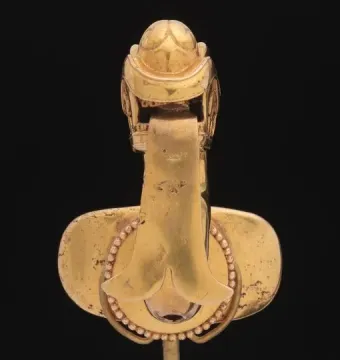
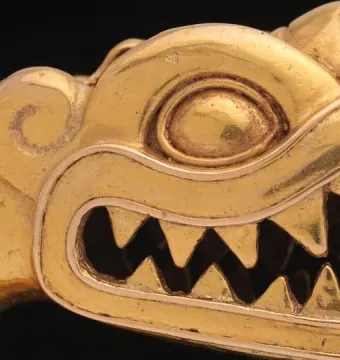
The serpent labret with articulated tongue is an Aztec gold-alloy body ornament dating to 1300–1521, when the Aztecs flourished. Made to be worn in a piercing below the lower lip, it shows a fanged serpent poised to strike, with a bifurcated tongue that could move and retract. The ornament was cast in a gold, copper, and silver alloy using the lost-wax method. Labrets were associated with nobility and elite status, and the serpent may represent Xiuhcoatl, the fire serpent linked to the sun god Huītzilōpōchtli. Known by 1937, it was later acquired by the Metropolitan Museum of Art in 2016.
April 2016 © Anna-Marie Kellen for the Metropolitan Museum of Art · CC0
April 2016 © Anna-Marie Kellen for the Metropolitan Museum of Art · Public domain
April 2016 © Anna-Marie Kellen for the Metropolitan Museum of Art · CC0
April 2016 © Anna-Marie Kellen for the Metropolitan Museum of Art · Public domain
April 2016 © Anna-Marie Kellen for the Metropolitan Museum of Art · Public domain
Identification | |
| Title | Serpent labret with articulated tongue |
| Original-language title | Le labret serpent à langue articulée |
| Type | labret (lip plug) |
Historical context | |
| Culture | Aztec |
| Date | mid-2nd millennium CE, between 1300 and 1520 |
| Period | Aztec period |
Creator | |
| Possible makers | Aztec or Mixtec makers |
Materials | |
| Material | gold alloy containing approximately 59.3 to 64.3% gold, 26.8 to 33.1% copper, and 7.5 to 8.8% silver |
Technique | |
| Surface treatment | tongue filed and polished after casting; wavy lines and comma-shaped marks are present on the surface |
| Casting sequence | cast in three pieces: the tongue first, then the head and neck, and finally the flanged base |
| Casting details | head and neck were modeled in wax; the tongue was inserted into the core before casting; a thin charcoal paste lined the mold; three support holes show where wood or thorns may have held the core; the tongue appears to have shifted during the second casting and displaced wax from the top of the maxillary arch |
| Manufacturing technique | lost-wax casting |
Physical characteristics | |
| Construction | Hollow |
| Weight | 51 grams |
| Dimensions | 6.6 cm high, 4.45 cm wide, 6.6 cm deep |
Appearance | |
| Depicted subject | serpent poised to strike |
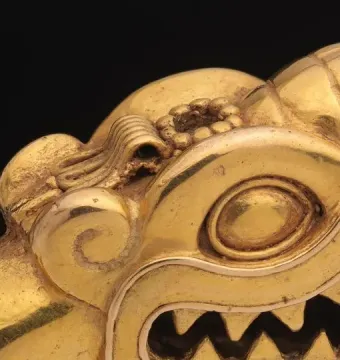
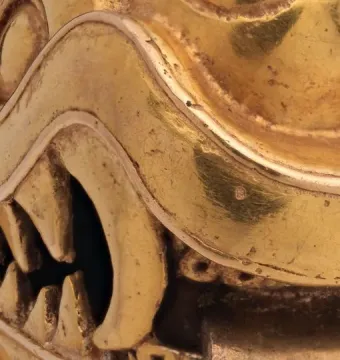
| Head features | arched brow and snout, pointed teeth, two fangs, rounded nostrils, and eyes set under a prominent brow |
| Tongue | articulated, cast separately, and able to retract, extend, and swing from side to side with the wearer's movement |
| Body details | scales shown beneath the lower jaw |
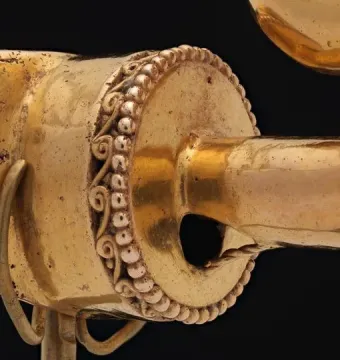
| Headdress | feathered and beaded headdress represented in false filigree, with a circle of ten spheres, three loops, and a small central recess that may once have held an inlay |
| Mounting | attached to a cylindrical plug with a wide plain flange and a decoration of small spheres and spirals |
Function | |
| Body placement | worn in a piercing below the lower lip |
Iconography and meaning | |
| Interpretation | possibly represents Xiuhcoatl, the fire serpent associated with the sun god Huītzilōpōchtli |
| Social significance | associated with nobility, elite status, and power; gold was linked to divinity in Aztec belief and eloquence was a hallmark of nobility |
| Symbolic meaning | probably symbolised the wearer's status and eloquence, and possibly divine right to rule |
| Broader motif context | serpents were a longstanding Mesoamerican motif, especially associated with rulers because they were believed to transcend earth, water, and sky |
Location and ownership | |
| Current location | New York |
| Funding for purchase | 2015 Benefit Fund and the Lila Acheson Wallace Gift |
| Current owner | Metropolitan Museum of Art |
| Acquisition date | 2016 |
| Accession number | 2016.64 |
Discovery and provenance | |
| Ownership period | 1981 to 2004 |
| Ownership period | 2016 |
| Owner | private New York collection |
| Ownership period | 2004 to 2016 |
| Early provenance | history before 1937 is unknown |
| Owner | Herbert L. Lucas |
| Owner | Judith Small Nash and Peter G. Wray |
| Ownership period | 1978 to 1981 |
| Owner | Jay C. Leff |
| Sale | sold at Sotheby's, New York, on 22 November 1978 for US$101,000 |
| Ownership period | 1949 to 1978 |
| Loan location | American Museum of Natural History |
| Owner | Heath McClung Steele |
| Ownership period | by 1937 to 1949 |
History and restoration | |
| Scholarly assessment | described as an ingenious example of Aztec metalworking, a tour de force of Aztec art, and among the finest surviving Aztec gold objects |
| Curator comment | According to Joanne Pillsbury, the labret opens a window into Aztec culture at the very highest level and would have been terrifying to behold on ritual occasions and the battlefield |
| Wear frequency | probably worn only on particularly important occasions because of its size and weight |
| Alternative interpretation | may have been intended as a funerary or votive offering |