
Statue of Ashurnasirpal II
The Statue of Ashurnasirpal II is a magnesite sculpture of the Assyrian king Ashurnasirpal II (883–859 BCE). It was discovered in May 1850 by A.H. Layard during excavations at Nimrud, ancient Kalhu, in the ruins of the temple of Šarrat-nipḫi, likely its original setting. The figure stands with uncovered head, long styled hair, and an elaborate braided beard, wearing a long robe and decorated shawl. He holds a ceremonial sickle-like weapon in his right hand and a mace in his left. A short cuneiform inscription on the chest lists the king’s titles and ancestry. The statue is now in the British Museum (BM 118871).
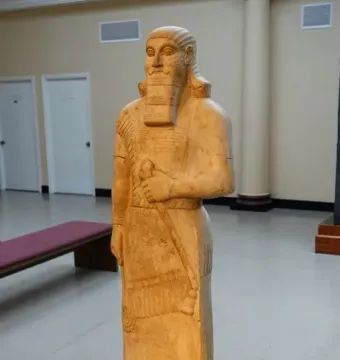
April 2016 © Daderot · Public domain
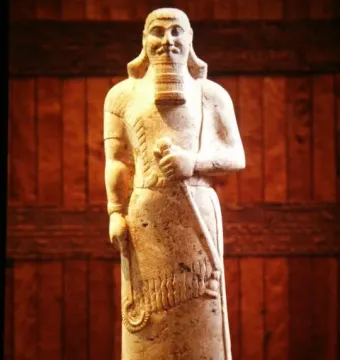
August 1993 © Gary Todd · CC0
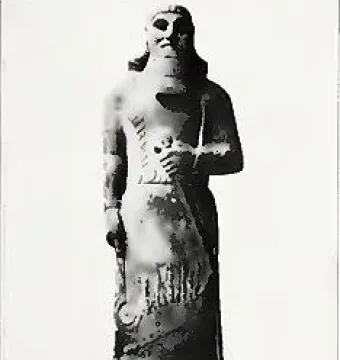
June 2014 © Encyclopædia Britannica, 1911 · Public domain
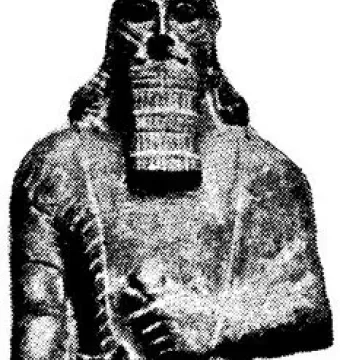
· Public domain
Identification | |
| Title | Statue of Ashurnasirpal II |
| Type | Statue |
| Subject | Ashurnasirpal II, Assyrian king |
| Original-language title | Posąg Aszurnasirpala II |
Historical context | |
| Date | 883–859 BC |
Creator | |
| Discoverer | Austen Henry Layard |
Discovery and provenance | |
| Museum inventory number | BM 118871 |
| In collection since | 1851 |
| Current location | British Museum |
| Original purpose | Placed in the Temple of Ishtar to remind the deity of the king's piety |
| Original location | Temple of Šarrat-nipḫi (Temple of Ishtar), probably standing there originally |
| Discovery location | Nimrud (ancient Kalhu), in the ruins of the temple of Šarrat-nipḫi / Temple of Ishtar |
| Discovery date | May 1850 |
Physical characteristics | |
| Height | 113 cm |
| Width | 32 cm |
| Thickness | 15 cm |
| Condition | Flawless condition |
| Craftsmanship | High quality |
| Pose | Standing |
Appearance | |
| Right hand object | Ceremonial sickle-like weapon held in the lowered right hand |
| Left hand object | Ceremonial mace |
| Head covering | Bare-headed, without a royal crown |
| Clothing | Long, short-sleeved robe reaching the feet with a richly decorated fringed shawl draped over it |
| Hair | Long, carefully arranged hair |
| Beard | Long, intricately braided beard |
Materials | |
| Pedestal height | 77.5 cm |
| Pedestal thickness | 37 cm |
| Pedestal width | 56.5 cm |
| Associated pedestal | A pedestal found near the statue on which it originally stood |
| Material origin | Both the magnesite and the red stone were not found locally and were probably transported to Nimrud after a military campaign abroad |
| Pedestal material | Red dolomite |
| Statue material | Magnesite |
Iconography and meaning | |
| Mace symbolism | Symbol of the authority exercised by the king as vice-regent of the supreme god Ashur |
| Sickle symbolism | A weapon sometimes used by gods in Assyrian iconography to fight mythical monsters and demons |
| Religious and political significance | Represents the king as vice-regent of the supreme god Ashur |
Inscription | |
| Inscription location | Across the king's chest at chest height |
| Inscription type | Eight-line cuneiform inscription |
| Inscription content | Lists the king's titles and genealogy, including Ashurnasirpal as great king, mighty king, king of the universe, and king of Assyria; son of Tukulti-Ninurta; grandson of Adad-nirari; and mentions a military campaign from the Tigris to the Lebanon Mountains and the Great Sea, assumed to be the Mediterranean Sea |
History and restoration | |
| Date of dispatch to London | Within a year of its discovery |