
Appeal to the Great Spirit
Appeal to the Great Spirit is a 1908 equestrian statue by Cyrus Dallin, located in front of the Museum of Fine Arts, Boston. It depicts a Native American on horseback facing skyward, with his arms spread wide in a spiritual request to the Great Spirit. The work was the last of Dallin’s four major sculptures of Indigenous people known as The Epic of the Indian, alongside A Signal of Peace (1890), The Medicine Man (1899), and Protest of the Sioux (1904). A statuette of the sculpture is held in the permanent collection of the White House and was displayed in President Bill Clinton’s Oval Office. Another statuette was owned by British Prime Minister David Lloyd George following a 1923 meeting with Sioux Chief Two Eagle.
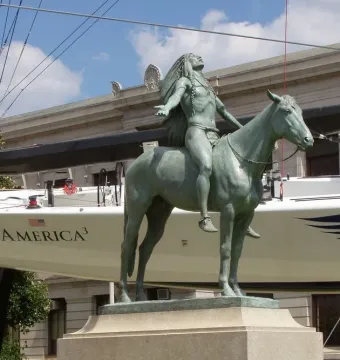
© Daderot · CC BY-SA 3.0
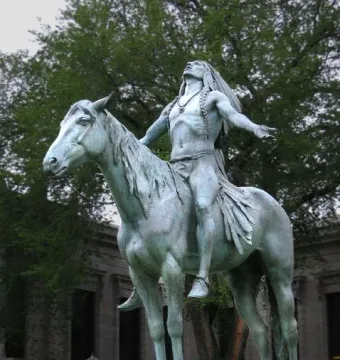
© Dpbsmith · CC BY-SA 3.0
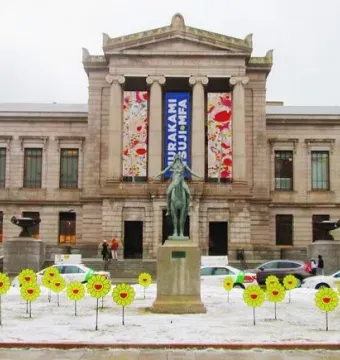
January 2018 © Beyond My Ken · CC BY-SA 4.0
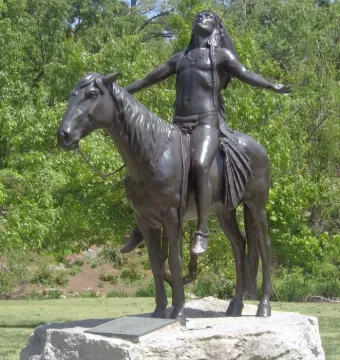
2008 © Caleb Long · CC BY-SA 2.5
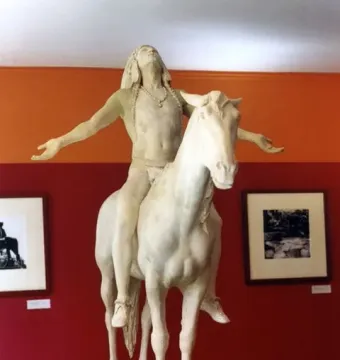
January 1908 © Nancy White · CC BY-SA 4.0
Identification | |
| Title | Appeal to the Great Spirit |
| Type | Equestrian statue |
Creator | |
| Artist | Cyrus Dallin |
| Model | Antonio Corsi |
Historical context | |
| Artist's background | Born in Utah; as a child, Dallin spent much time with Native American and Ute children, and later developed the Indian theme in his work after moving to Boston in 1880 and studying in Paris |
| Artist's interpretation | According to Dallin, the work shows a chief's final appeal to the Great Spirit for peace with the white man after his signals of peace were rejected |
| Artist's activism | He used his art and status to protest the oppression of Indigenous peoples and defend their rights |
| Artist's views on Native Americans | He expressed sympathy for Native Americans, deep respect for Indigenous peoples, and anger at their mistreatment by white pioneers and the U.S. government |
| Subject | A Native American man on horseback, often described as a Ute or Sioux chief or warrior |
| Related works in the series | A Signal of Peace (1890), The Medicine Man (1899), Protest of the Sioux (1904) |
| Position in series | The fourth and final sculpture in the series |
| Series | The Epic of the Indians |
| Date | 1908-1909 |
| Series period | 1890–1909 |
Iconography and meaning | |
| Theme | The oppression and vulnerability of Indigenous peoples under Euro-American colonization |
| Symbolism | Represents a people who are spiritually intact but overwhelmed |
| Meaning | A spiritual appeal to the Great Spirit in despair after betrayal, broken promises, military defeat, and the threatened extinction of Indigenous life |
| Pose and gesture | Seated on a motionless horse, head thrown back toward the sky, arms outstretched with open palms in prayer |
Location and ownership | |
| Other notable statuette owner | British Prime Minister David Lloyd George |
| Lloyd George example context | He received a statuette in connection with a meeting with Sioux Chief Two Eagle during an October 1923 tour of the United States and Canada |
| Miniature edition | A miniature bronze edition was made by Gorham Manufacturing Company in 1913 |
| Edition size | Nine bronzes were cast around 1922 |
| Cast copy size | 40 inches |
| Cast copy locations | Dartmouth College, the Cyrus Dallin Museum in Arlington, Massachusetts, Corning, New York, Tulsa, Oklahoma, and Muncie, Indiana |
| Dartmouth copy | A cast copy was formerly displayed in the Tower Room of Dartmouth College's Baker Tower and has since been removed |
| Tulsa copy | A bronze copy was cast in 1985 from the Central High School plaster example, under the supervision of Howard R. Kirsch, and is now at Woodward Park at 21st Street and Peoria in Tulsa, Oklahoma |
| Current location | In front of the main entrance of the Museum of Fine Arts, Boston, Massachusetts |
| Installation in Muncie | A full-size bronze version was installed in 1929 at the intersection of Walnut and Granville streets in the Wysor Heights Historic District, Muncie, Indiana, approved by Cyrus Dallin and dedicated in memory of Edmund Burke Ball by his wife and children |
| Plaster examples | One-third-scale plaster examples are at the Cyrus Dallin Museum in Arlington, Massachusetts, the Rockwell Museum in Corning, New York, and Central High School in Tulsa, Oklahoma |
| Status | An iconic symbol of the Museum of Fine Arts, Boston |
| Intended installation duration | Temporary, but it was never removed |
| Installation date | 23 January 1912 |
| Ownership | Purchased by the Museum of Fine Arts, Boston |
| Statuette and replica editions | Bronze statuette and small replica editions exist; examples are in the White House, the U.S. Department of State, and many American museums, and one statuette was exhibited in President Bill Clinton's Oval Office |
| White House example | A statuette is in the permanent collection of the White House |
Materials | |
| Preliminary version material | Plaster |
| Material | Bronze |
Technique | |
| Casting location | Paris |
| Casting method | Lost-wax casting |
| Foundry | Jaboeuf and Rouard |
History and restoration | |
| Reception | Shown to the public with great success and described as one of Dallin's greatest successes |
| Patina restoration | The original Boston version was restored at Dallin's request to reverse a conservator-applied brown patina in favor of the aged light green tones that had developed over time |
| Award | Gold medal at the Paris Salon |
| Plaster version exhibition | Shown with great success at the 1908 exhibition of the National Society of Sculptors in Baltimore |
| Modeling period | 1907–1908 |
| Working location | Dallin's studio in Boston |
| Related museum and public programs | On 3 March 2019, the Museum of Fine Arts held a discussion with five art historians and museum curators, including two Native American panelists; in October 2019 it surrounded the statue with community-submitted placards for Indigenous Peoples' Day; in 2020 it posted two brief essays by Native Americans on the sculpture's cultural meanings |
| Related temporary installations | In 2021, Raven Reshapes Boston: A Native Corn Garden at the MFA surrounded the statue with corn, beans, and sedges, and Radiant Community by Ekua Holmes placed sunflowers nearby |
Significance | |
| Sculpture history contribution | In the 1900s, he was among those who helped American equestrian sculpture reach its peak |
| Influence | His depictions of Native Americans are said to have influenced attitudes toward public art in the United States |
| Art-historical significance | Dallin is described as a pioneer of the artist's role as an agent of social change and as helping open the way for more inclusive public art in America |
| Historical significance | The work gave Dallin a reputation as perhaps the best sculptor of Native American subjects and is described as one of the most deeply moving sculptures of its time |
| Public interpretation in Muncie | Many residents consider the Muncie example a symbol of the city |