
Head of a Philosopher
Head of a Philosopher is the surviving part of a bronze sculpture, probably of Magna Graecia origin and dated to the second half of the 5th century BC. It was found in 1969 in a shipwreck off Porticello, near Cannitello, north of Villa San Giovanni in Calabria. The work is now kept at the National Museum of Magna Graecia in Reggio Calabria. The sculpture is damaged, with the left eye and part of the hair at the nape missing, and there are traces of a cord that once bound the head. Associated bronze fragments of a hand and mantle suggest a philosopher or man of letters. More recent studies identify the figure as Pythagoras, while another interpretation sees it as the lawgiver Charondas.
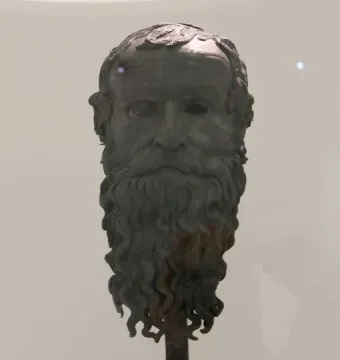
October 2016 © Giovanni Dall'Orto · Attribution
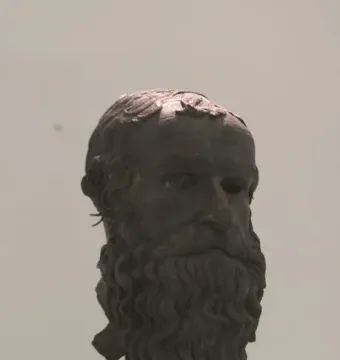
October 2016 © Giovanni Dall'Orto · Attribution
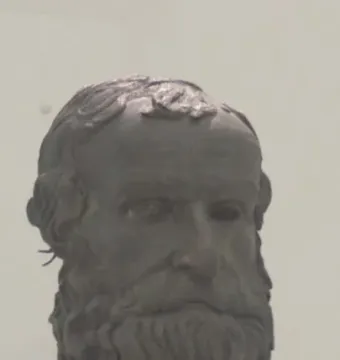
September 2016 © Effems · CC BY-SA 4.0
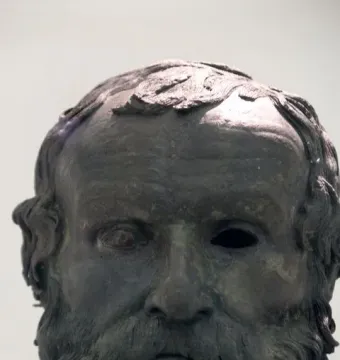
October 2016 © Giovanni Dall'Orto · Attribution
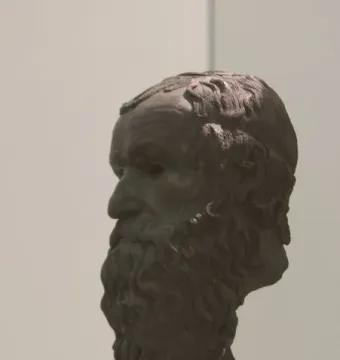
October 2016 © Giovanni Dall'Orto · Attribution
Identification | |
| Title | Head of a Philosopher |
| Artifact name | Porticello bronze head |
| Object type | Bronze sculpture fragment |
| Original name | Testa del Filosofo |
Historical context | |
| Culture | Greek |
| Cultural context | Magna Graecia |
| Date | Second half of the 5th century BC; shipwreck study dates the recovered sculptures to around 415–385 BC |
| Wreck date | End of the fifth century BC |
Creator | |
| Scholarly attributions | Believed to portray a philosopher; alternatively identified as Pythagoras of Samos, Charondas, or a poet such as Hesiod |
Discovery and provenance | |
| Discovery date | 1969 |
| Discovery location | A shipwreck off Porticello beach near Cannitello, north of Villa San Giovanni, Calabria, Italy; also described as in the Straits of Messina |
| Probable origin | Probably Magna Graecia |
Location and ownership | |
| Current location | National Museum of Magna Graecia, Reggio Calabria, Italy |
Physical characteristics | |
| Preserved damage | The left eye and part of the hair on the nape are missing; traces indicate that a cord once encircled the head at the nape; the statue also lacked its laurel wreath |
| Type | Large-scale statuary |
| Condition | Partially damaged; recently restored |
Materials | |
| Material | Bronze |
Appearance | |
| Associated fragments | Fragments of a hand and a mantle/cloak made of the same casting material were found with the statue |
Iconography and meaning | |
| Interpretation | The associated hand and mantle fragments led scholars to identify the head as a philosopher or literatus from Ancient Greece |
| Iconographic evidence | The head appears to have worn a turban, a recurring feature in traditional depictions of Pythagoras |
| Related surviving parts | Other parts of the statue, also kept in the Reggio museum, attest to the typical pose used to depict Pythagoras |
| Alternative scholarly view | Brunilde Ridgway rejected the two-wreck hypothesis proposed to reconcile a later dating with the shipwreck context |
History and restoration | |
| Dating proposals | Alain Pasquier proposed c. 460–440 BC; Enrico Paribeni proposed the late fourth or early third century BC; another study suggested the recovered sculptures date to around 415–385 BC |
| Proposed historical context | It may have been part of the booty with which Dionysius of Syracuse paid mercenaries after the capture of Reggio in 386 BC |
| Later-date reconciliation hypothesis | It has been suggested that there were two wrecks, one earlier and one later, to reconcile the later date with the late-fifth-century shipwreck context |
Significance | |
| Historical significance | Seen as a symbol for Reggio of regained independence and cultural ferment |
Other | |
| Scholarly reference | K. A. Dafas, 2019, Greek Large-Scale Bronze Statuary: The Late Archaic and Classical Periods, BICS Supplement 138, pp. 130–133, plates 146–149 |