
Heureka
Heureka is a sculpture by Jean Tinguely, completed in 1964 for the Swiss National Exhibition in Lausanne. It is an 8-metre-high machine sculpture built from reclaimed materials, mainly metals. After the exhibition, it was placed in Zürichhorn park in Zurich, where it remained in 2016. The Centre national d'art et de culture Georges-Pompidou holds a preparatory sketch for this machine. In Zurich, the sculpture is written as Heureka.
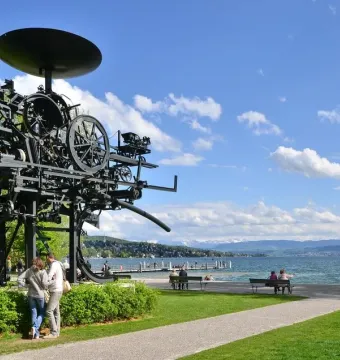
May 2015 © Roland zh · CC BY-SA 3.0
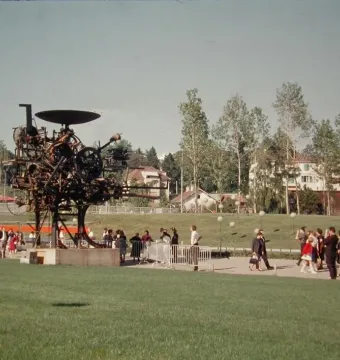
September 1964 © Anidaat · CC BY-SA 4.0
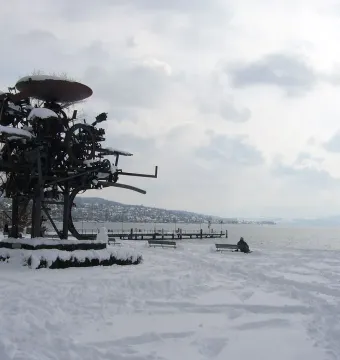
March 2006 © Peter Berger · CC BY-SA 3.0
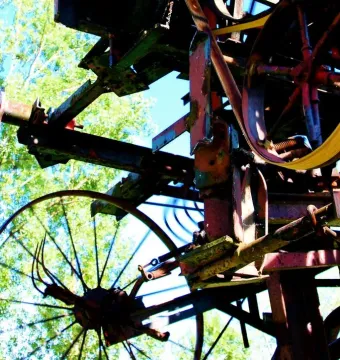
June 2007 © Todd Huffman · CC BY 2.0
March 2012 © Roland zh · CC BY-SA 3.0
Identification | |
| Title | Heureka |
| Alternative title | Euréka |
| Original-language title | «Еврика» |
Creator | |
| Artist | Jean Tinguely |
| Artist nationality | Swiss |
Historical context | |
| Creation date | 1963–1964 |
| Commissioned for | the Swiss National Exhibition 1964 (Expo 64) in Lausanne |
| Commissioned by | Alberto Camenzind, chief architect of Expo 64 |
| Commission purpose | to serve as a signal tower |
| First public work | Yes |
Physical characteristics | |
| Color | Matte black |
| Power supply | 220 V |
| Appearance | Painted matte black |
| Structure | Five blocks, each with its own motor |
| Height | 8 m |
| Dimensions | 780 × 660 × 410 cm |
| Type | kinetic large-scale sculpture-machine |
| Movement | Moves without any apparent purpose; its parts move up and down, swing back and forth, and move forward and backward |
Materials | |
| Materials | Scrap metal and industrial machine parts, including iron bars, steel wheels, metal tubes, rails, rods, transmission wheels, sheet metal, mine carts, agricultural machinery parts, electric motors, and an old hay tedder |
| Material source | Collected from scrap heaps of factories |
Technique | |
| Construction method | Designed first in numerous sketches on paper and built on site at the exhibition |
Location and ownership | |
| Current location | Zürichhorn park, Zurich, Switzerland |
| Installed there since | 1967 |
| Temporary installation | Mounted provisionally at Zürichhorn, Zurich |
| Exhibition loan | Loaned by the city of Zurich to ARTZUID in Amsterdam in summer 2011 |
Discovery and provenance | |
| After-exhibition purchaser | Industrialist and patron Walter Bechtler, for the city of Zurich |
| Post-exhibition storage | Dismantled and stored on the grounds of Bechtler's factory |
| Planned relocation | ETH Zurich wanted it installed on the new Hönggerberg campus, but this did not happen |
History and restoration | |
| Artist residence during creation | Initially in Paris in early 1963; after the Impasse Ronsin studios were demolished, he moved with Niki de Saint Phalle to Lutry near Lausanne, and later back to Auberge au Cheval Blanc in Soisy-sur-École near Fontainebleau |
| Placement history | After the exhibition it was placed in Zürichhorn park |
| Construction duration | Six months |
Other | |
| Preparatory drawing | A preparatory sketch of this machine held by the Centre national d'art et de culture Georges-Pompidou |
Iconography and meaning | |
| Wheel symbolism | The many wheels symbolize wisdom and madness at the same time |
| Relation to death | The sculpture's predetermined paths are linked to Osiris as god of the dead |
| Relation to growth | The sculpture's liveliness is linked to the growth-enabling aspect of Osiris |
| Osiris interpretation | Osiris is understood both as a vegetation god associated with growth and as a god of the dead before whom every person must account at the end of life |
| Mythological reference | Compared to the iconography of Osiris |
| Psychoanalytic interpretation | A complex structure of moving beams and tubes that smoothly follows predetermined paths, possibly representing collective repression and the idea that each person follows a predetermined path in life |
| Literary interpretation | An allusion to Edgar Allan Poe's The Pit and the Pendulum through expansion and contraction movements |
| Interpretation by Michel Conil-Lacoste | Three interpretations were proposed: sociological, literary, and psychoanalytic |
| Sociological interpretation | A celebration or glorification of the industrial age |
| Artist's view of machine | The machine embodies humor and poetry and was intended as a free and cheerful machine |
| Artist comment on title | Jean Tinguely said the title was a joke |
| Symbolic interpretation | A symbol of superfluous actions, non-development, and non-productivity |
| Concept | A useless machine that performs unnecessary actions |
| Irony in title | The title is meant ironically for an entirely useless machine; Tinguely said it was a joke and that the positive-sounding title was meant to deceive |
| Title interpretation | A fitting expression for inventors or researchers after a groundbreaking discovery |
| Title explanation | According to the account, Archimedes supposedly shouted it with joy when he discovered the principle of buoyancy while bathing |
| Title source | A quotation attributed to Archimedes of Syracuse |
| Title meaning | "I have found!" |
Significance | |
| Public work status | Jean Tinguely's first public work |
| Reception in 1964 | Opinions were divided: some considered it a bad joke, some saw it as a satire on the tyranny of technology in civilization, and others found it imaginative and beautiful |
| Reception in Zurich | The installation was reportedly approved mainly by people under 50, while older people tended to react negatively |
| Regional reception | French-speaking Swiss reportedly never fully accepted the title but understood the sculpture's idea better than German-speaking Swiss |
| Film context | Shown as an example of Swiss cultural life in the final part, Creation, of Ernst A. Heiniger's three-part film Switzerland for Expo 67 |
| Historical context of reception | In 1964, Swiss people reportedly began to doubt progress and capitalism |