
Johan Ludvig Runeberg Statue
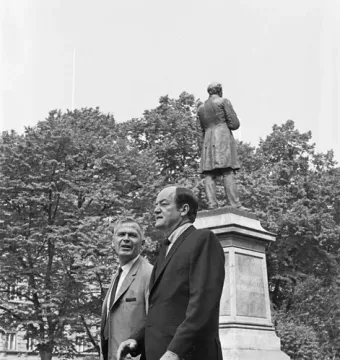
The Johan Ludvig Runeberg statue is a monument to the Finland-Swedish author, national poet, and priest Johan Ludvig Runeberg (1804–1877). It was designed and sculpted by his son, Walter Runeberg, and stands in Esplanadi park in Helsinki. The commission was awarded without competition, and Walter Runeberg completed the draft in 1881. The statue was approved in 1882, cast twice in bronze in Paris, and unveiled on 6 May 1885 before a large public crowd. Its pose was inspired by an ancient sculpture of Sophocles, while the position of the hand was modelled by Hjalmar Munsterhjelm. A female pedestal figure was completed separately in 1883.
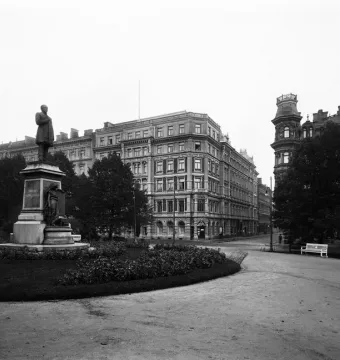
© Eric Sundström · Public domain
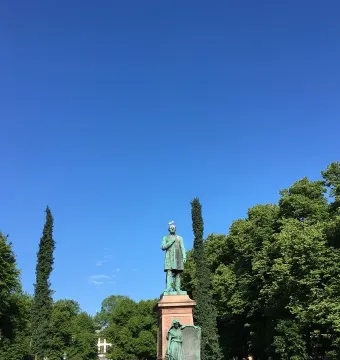
June 2016 © Eteil · CC BY-SA 4.0
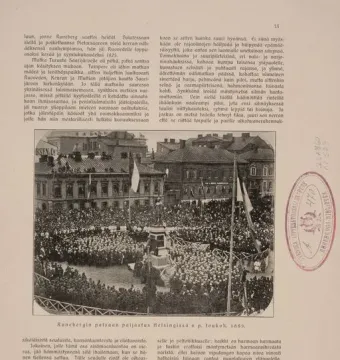
· No restrictions
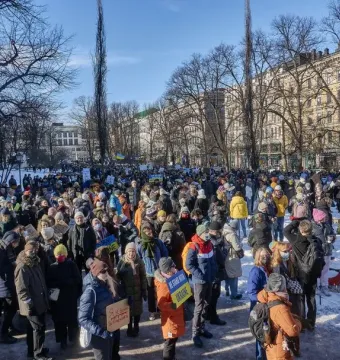
February 2022 © rajatonvimma /// VJ Group Random Doctors · CC BY 2.0
© Hans Paul · CC BY 4.0
Identification | |
| Title | Statue of Johan Ludvig Runeberg |
| Subject | Johan Ludvig Runeberg, the Finland-Swedish author, national poet, and priest |
| Type | Memorial statue with allegorical pedestal |
| Dedicated to | Johan Ludvig Runeberg |
Creator | |
| Artist relationship | Son of the subject |
| Artist | Walter Runeberg |
Historical context | |
| Committee treasurer | Merchant councillor Henrik Borgström |
| Commission method | Without competition |
| Commission awarded to | Walter Runeberg |
| Committee members | J. V. Snellman, Lorenz Lindelöf, Otto Donner, Robert Lagerborg, F. W. G. Hjelt |
| Committee chair | Senator Lars Theodor von Hellens |
| Committee established | Early 1878 |
| Public fundraising campaign launched | 31 May 1877 |
| First proposal | 1872, during Runeberg's lifetime |
| Commissioned by | The Finnish Diet |
| Committee secretary | Zacharias Topelius |
Discovery and provenance | |
| Artist residence at commission | Paris |
| Draft completed | 1881 |
| Draft approved | 1882, while on display in Finland |
| Pose inspiration | An ancient sculpture of Sophocles in the Lateran Museum in Rome |
| Hand model | Painter Hjalmar Munsterhjelm |
Physical characteristics | |
| Clothing | A priest's coat he wore while teaching at the Porvoo High School |
| Female figure | A young woman wrapped in a bearskin, holding a laurel wreath in her right hand and a large inscription tablet in her left, with a pile of books at her feet |
| Material | Bronze statue on a red granite pedestal |
| Depicted age | About 55 years old |
| Components | Bronze statue of Johan Ludvig Runeberg and allegorical pedestal with a female figure |
| Height | 8 meters |
| Pose | Standing upright with his right hand against his chest, thumb under the lapel of his coat, as if about to begin a speech |
Appearance | |
| Orientation | Faces east toward the Market Square |
Iconography and meaning | |
| Female figure name | Suomi / Vårt land |
| Female figure symbolism | Thought to represent Finland's allegorical muse or a mythological guardian spirit, rather than a national personification |
| Inscription tablet text | Three verses of Maamme in Swedish, reproducing the first and last two stanzas of the song |
| Name inscription | Runeberg's name does not appear on the monument |
Location and ownership | |
| Copy location | Porvoo |
| Location | Middle section of Esplanadi Park, Helsinki, Finland, on the central path between Kluuvikatu and Kasarmikatu, called Runeberg's Esplanade |
| Country | Finland |
History and restoration | |
| Castings | The statue was cast twice |
| Casting material | Bronze |
| Second statue size | Natural size |
| Casting location | Paris |
| Female figure completion | 1883 |
| Second statue form | Without the female pedestal figure |
| Second statue material | Bronze |
| Unveiling significance | Eighth anniversary of the poet's death |
| Second statue context | The city where Runeberg spent most of his life |
| Second statue location | Porvoo |
| Second statue unveiling date | 30 May 1885 |
| Unveiling events | Flags flew across the city, shops were closed, a 130-piece brass band played Björneborgarnas marsch, a choir of several hundred singers performed a cantata, Maamme was sung and conducted by Professor Fredrik Pacius, State Councillor Wilhelm Lagus spoke in Swedish, Dr Julius Krohn spoke in Finnish, and the city was festively illuminated in the evening |
| Estimated crowd at unveiling | Approximately 20,000 people |
| Unveiling date | 6 May 1885 |
| Date erected | 1885 |
Other | |
| Inscription on base | Suomen kansa maamme laulajalle ('From the people of Finland to the singer of Our Land') on the south side; Af Finlands folk ('From the people of Finland') on the north side; 1885 on the rear face |
| Historical note | The absence of a name inscription was considered self-evident at the time |