
Giraldillo
Giraldillo is the popular name for the female sculpture that crowns the Giralda of Seville. Cast by Bartolomé Morel in 1568, it has also been called Faith, Triumph of the Church, Colossus of Victorious Faith, and Allegory of the Fortitude of Faith. The likely designer was Luís de Vargas, with possible involvement by Hernán Ruiz the Younger and Morel himself. The figure stands on a large bronze sphere and was placed in position in August 1568. It was then gilded and painted by Antón Pérez in September, and a commemorative plaque was added to the tower in October of that year.
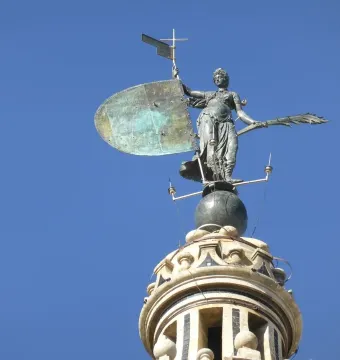
November 2015 © CARLOS TEIXIDOR CADENAS · CC BY-SA 4.0
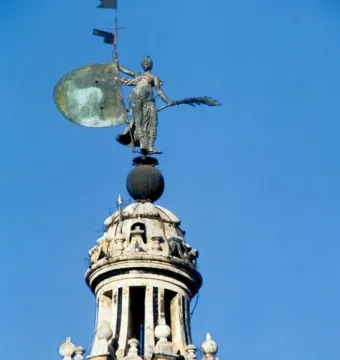
December 1986 © LBM1948 · CC BY-SA 4.0
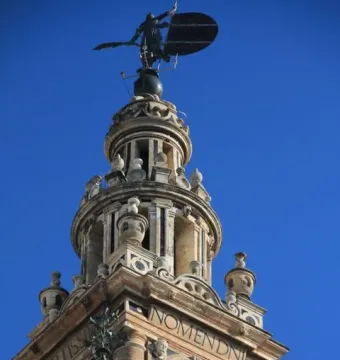
January 2018 © PEPE GADEIRAS · CC BY-SA 4.0
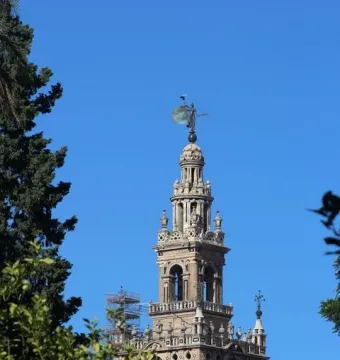
November 2017 © Martinvl · CC BY-SA 4.0
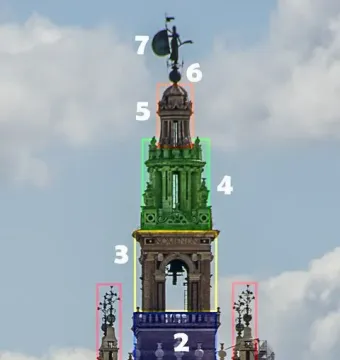
May 2018 © Anual · CC BY-SA 4.0
Identification | |
| Title | Giraldillo |
| Alternative names | Giralda; Faith; triumph of the church; Colossus of victorious faith; Allegory of the strength of Faith; Allegory of Faith |
| Type | Bronze female figure sculpture and weather vane |
Historical context | |
| Date made | 1568 |
| Historical role | Culminated the Renaissance architectural reforms applied to the Giralda minaret |
| Naming origin | Its ability to rotate with the wind originally led it to be called Giralda, a name that later came to refer to the entire tower |
Creator | |
| Artist | Bartolomé Morel |
| Probable designer | Luis de Vargas |
| Possible contributors | Hernán Ruiz el Joven; Bartolomé Morel |
| Related artistic movement | Roman Mannerism in Andalusia |
| Model inspiration | An engraving of Pallas Athena by Marco Antonio Raimondi, reproducing a drawing by Giulio Romano or Perin del Vaga |
Physical characteristics | |
| Height | 3.47 meters |
| Weight | 1.2 tons |
Materials | |
| Primary material | Bronze |
| Support structure | Large bronze sphere |
Technique | |
| Function | Weather vane |
| Movement | Can rotate according to the direction of the wind |
Appearance | |
| Depicted figure | Allegory of Faith |
| Right hand attribute | Large shield or labarum connected to a spear topped with a Christian cross |
| Left hand attribute | Palm |
| Headwear | Helmet surrounded by a crown with twelve fleur-de-lis |
| Jewelry on legs | Abstract representations of 16th-century Spanish jewelry |
| Crown style | Late medieval rather than Renaissance |
Iconography and meaning | |
| Subject | Faith |
| Shared feature with Daphne | An angel wing in the neckline/opening |
| Comparative references | Similar to Minerva in the Minerva Fountain in Hildesheim (c. 50 BC to 50 AD); the helmet resembles Minerva on Cellini's Perseus; the head resembles Juno in one of the Quattro Fontane in Rome; similar to a silver fountain by Wenzel Jamnitzer and a related wooden sculpture in Berlin; also compared with a Greco-Roman Minerva work |
Location and ownership | |
| Current location | Crowning the Giralda in Seville, Spain |
| Current replica location | In front of the Puerta del Príncipe of Seville Cathedral |
History and restoration | |
| Installation date | August 1568 |
| Controversy | There was disagreement over whether the bronze copy should have remained in the tower |
| Return to location | After being exhibited at the Royal Shipyards, the sculpture was returned to its place in July 2005 |
| 2003 completion | Restoration of the original was completed in 2003 |
| Cost of lowering and raising | 116,000 euros |
| Restoration cost | 600,000 euros for the original restoration; 720,000 euros total |
| Temporary replacement by bronze copy | From 1999, the bronze copy temporarily replaced the original during restoration |
| 1998 bronze copy | A bronze copy was made in 1998 by Codina foundry, Albarrán workshops, and Juan Alonso workshops, with work by José Antonio Márquez Pérez, Francisco Parra García, Rafael López Palanco, Vicente Puchol, Ángel Dilla Martínez, and Aniceto Mimbrero |
| 1997 removal of original | The original sculpture was lowered in 1997 |
| 1997-2003 restoration | Major restoration carried out by the Andalusian Regional Ministry of Culture through the Andalusian Institute of Historical Heritage, in the Astarté workshop of D. Ildefonso V. Cepeda Fuentes, supervised by Professor Jaime Gil Arévalo |
| 1981 documentation | Antonio García Romero, Rosario Martínez Lorente, Isaac Navarrete, and Blanca Guillén Arriaga made a 17-piece clay, plaster, and tow mold, followed by a silicone cast and a polyester copy at the University of Seville |
| 1980 restoration | Restored by the Ministry of Culture under Alfonso Jiménez Martín and José María Cabeza Méndez |
| 1886 repair | The vane shaft was repaired |
| 1842 repair | The dome containing the sculpture was repaired, probably after damage by a windstorm |
| 1770 restoration | Manuel Núñez erected a wooden scaffold, reinforced the interior with iron bars, replaced the original labarum with a lighter copper-sheet version, repaired cracks, and added Rococo elements that still survive |
| 1751 treatment | Basilio Cortés gilded the sphere beneath it; the sphere bears an inscription recording the work |
| 1684 treatment | Miguel Parrilla/Miguel Grelha gilded and varnished the sculpture; the patina no longer survives |
| 1592 restoration | After a strong wind twisted the pin, the shaft was removed on 18 September, the sculpture was lowered to the Colegio de San Miguel, and Juan Barba straightened it |
| Commemorative plaque | Placed in October 1568 by the canon Pacheco to commemorate completion of the tower works |
| Gilding and painting | Performed by Antón Pérez in September 1568 |
Other | |
| Related reproduction | Giraldilla of Cuba: made in 1632 by Jerónimo González, originally on the bell tower of the Castillo de la Real Fuerza in Havana, now in the Museum of Havana with a replica still in the castle; it represents Doña Isabel de Bobadilla and inspired the Havana Club rum brand logo |
| Architectural influence | The Giralda design has been reproduced or inspired numerous buildings in Spanish, American, Hispanic American, and European cities; the Giraldillo is most closely replicated by the Giralda of Kansas City, while other versions lack a Giraldillo and the Badajoz replica has sculptures with a different design |
| Related comparison notes | Joris Hoefnagel depicted the sculpture in his 1573 panorama of Seville with some liberties, apparently without having seen the finished statue; it was correctly represented in drawn panoramas of Seville during the Spanish Golden Age |
| Language of source | Spanish |