
Rearing Horse and Mounted Warrior
Rearing Horse and Mounted Warrior, also known as the Budapest Horse, is a bronze sculpture attributed to Leonardo da Vinci. It depicts Francis I of France mounted on a war horse. The work is said to have been made from a clay or wax model in the first half of the 16th century. Today, the sculpture is part of the permanent exhibition at the Museum of Fine Arts in Budapest.
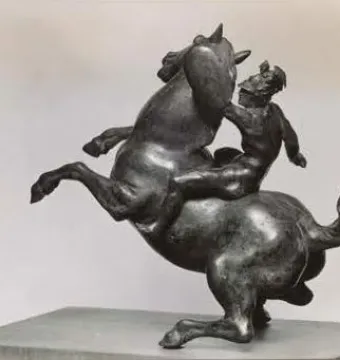
© Leonardo da Vinci · Public domain
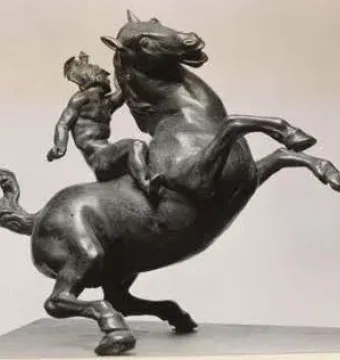
© Leonardo da Vinci · Public domain
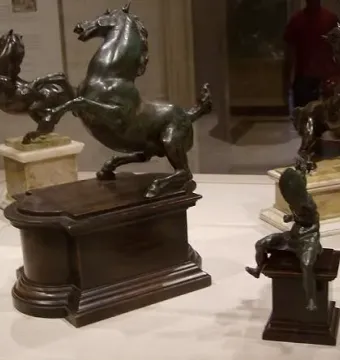
September 2009 © Pierreradulescu · CC BY-SA 4.0
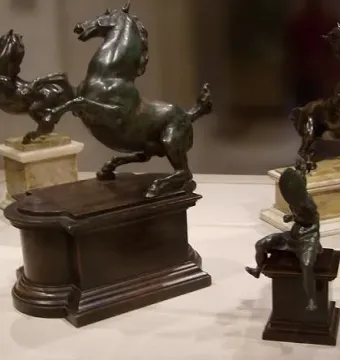
September 2009 © Pierreradulescu · CC BY-SA 4.0
Identification | |
| Title | Rearing Horse and Mounted Warrior |
| Type | Bronze equestrian statuette |
| Alternative names | Horse of Budapest; Budapest horse; Budapest Rider |
Historical context | |
| Date | First half of the 16th century; technical evidence suggests cast near or after Leonardo da Vinci's death in 1519 |
Creator | |
| Attribution | Attributed to Leonardo da Vinci |
| Design | Almost certainly by Leonardo da Vinci |
| Execution | Disputed; many Hungarian researchers believe Leonardo executed it himself, while most other scholars think it was executed after a model by Leonardo |
| Possible sculptors | Leonardo da Vinci; possibly a pupil of Leonardo; Giovanni Francesco Rustici has also been considered |
Discovery and provenance | |
| Former collection | Ferenczy's sculpture collection |
| Museum acquisition | The Museum of Fine Arts, Budapest acquired Ferenczy's collection from his heirs in 1914 |
| Provenance notes | The work was initially mistaken for a Greek or ancient work from Athens; its provenance was later discovered, leading to a dispute with the heirs after the sale to the museum |
| Acquisition period | Between 1818 and 1824 |
| Acquisition place | Rome |
| Acquired by | István Ferenczy |
| Probable origin | Believed to be one of several horse models Leonardo made for King Francis I of France |
Physical characteristics | |
| Scale relationship | The rider is smaller in scale than the horse |
| Weight | Not stated |
| Dimensions | 24 cm high, 15 cm wide, 28 cm long (assembled) |
| Construction | Both parts are hollow |
| Composition | A horse and a detachable rider |
| Depicted horse type | Destrier |
| Depicted person | Francis I of France, or possibly the young Francis I of France |
| Subject | A rearing horse with a mounted warrior, sometimes shown with and without the rider |
Materials | |
| Material | Bronze |
| Patina | Applied green patina over black paint patina |
| Metal alloy | The alloy composition is identical in all parts except the modern pin attaching the rider |
Technique | |
| Surface condition | Many holes and casting flaws on both horse and rider were left unchiseled and unfilled |
| Interpretation of finish | This suggests an intent to preserve a model rather than create a final cast |
| Casting method | Cast separately, including the horse's rump and tail section used to extract the core, but at the same time |
| Finish | Minimal finishing |
| Method of creation | Probably cast from a clay or wax model; the lost-wax technique was suggested by technical investigation |
Appearance | |
| Rider attire | Greek-style helmet with visor tipped up, encircled by a crown, with a serpent-tailed dragon on the back |
| Rider attributes | Holding a shield in the left hand; the right hand originally held a sword or lance, but only the hilt remains |
| Horse details | The horse lacks a saddle |
| Figural definition | The rider is less defined than the horse or Leonardo's other works |
| Surface modelling | The quality of the surface modelling has been taken to suggest the bronze cast may have been made by one of Leonardo's pupils from a wax model by Leonardo |
Iconography and meaning | |
| Comparative reference | Similar horses and riders appear in Leonardo's studies of horses owned by Galéas de Saint-Séverin |
| Related motif | Leonardo's lifelong interest in depicting horses in every possible movement |
| Related context | Francis I was Leonardo's patron in his later years and an avid participant in jousting tournaments; French jousts used less armor than Italian ones |
| Aggházy's interpretation | Mária Aggházy argued that the rider's light clothing, lack of armor or saddle, royal-style crown ornament, and association with French jousting support a portrait of Francis I and a display of chivalric bravery |
| Identification proposal | The rider may represent the young Francis I of France |
Location and ownership | |
| Current location | Museum of Fine Arts, Budapest, on permanent display |
| Former location | Shown in London in 1930; in New York, Washington, Atlanta, and Los Angeles in 2009–2010; in Paris, Mantova, Madrid, and Buenos Aires in 2016–2018 |
History and restoration | |
| Attribution history | Attributed to Leonardo da Vinci in the 17th century, then again by Simon Meller in 1916 |
| Reattribution | Simon Meller reattributed it to Leonardo da Vinci in 1916, based on similarities to Leonardo's drawings and other works such as The Battle of Anghiari and the Trivulzio monument |
| Scholarly reception | About a dozen scholars responded in the 1920s; about half agreed with Meller, while the rest thought it a later work by one of Leonardo's pupils |
| Conservation and wartime history | The museum evacuated artworks to lower floors and then to Veszprém in early 1943; after the German occupation in March 1944, most works were sent to Austria; Budapest was damaged in late 1944; the statuette was looted in the Nazi plunder and later returned by 1947 via the Munich Central Collecting Point and the Monuments, Fine Arts, and Archives program |
| Exhibition history | The statuette was displayed separately from the rider in the 2009 exhibition; related works were shown together in 1969 as 'Horses of Leonardo da Vinci' with reservation about attribution |
Significance | |
| Significance | Appears to reproduce one of Leonardo's last artistic ideas and has been cited as evidence of his capability in bronze casting |
Other | |
| Related works | The Metropolitan Museum of Art, Hunt Museum, London, and Speed Art Museum versions; the Hermitage Museum horseman titled Warrior; a mirror-image horse statuette in London |
| Related people and collections | Leone Leoni; Antoine Perrenot de Granvelle; Charles V; Louis XII; Bertel Thorvaldsen; Antonio Canova; Mária Aggházy; Simon Meller; Martin Kemp; L.H. Heydenreich; Kenneth Clark; Carlo Pedretti; Giovanni Paolo Lomazzo; Pierre Jeannerat |
| Related places and institutions | Royal Collection, Windsor Castle; Palace of Fontainebleau; Casa degli Omenoni; National Gallery of Art; Museum of Fine Arts, Budapest |