
Gayer-Anderson cat
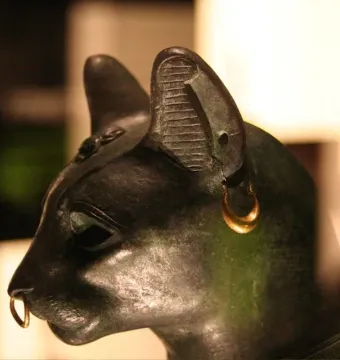
Gayer-Anderson cat is an ancient Egyptian bronze statue dating to the Late Period, around 664–332 BC. It depicts a cat representing the goddess Bast and is decorated with gold ornament, jewelry, a protective amulet, a scarab on the head, and a winged scarab on the chest. The statue is 42 cm high and 13 cm wide. It was presented to the British Museum by Major Robert Grenville Gayer-Anderson and Mary Stout Shaw, and a copy is kept in the Gayer-Anderson Museum in Cairo. X-rays show that the sculpture is more fragile than it appears, with a cracked body and a head supported by an internal frame.
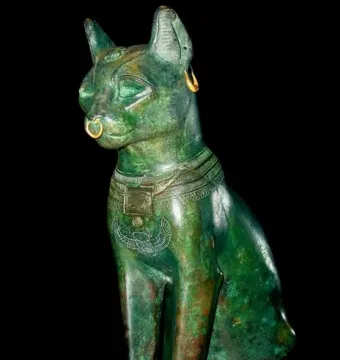
January 2008 © Peter D. Tillman · CC BY-SA 2.0
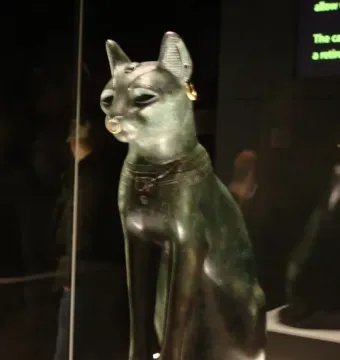
· CC BY 2.5
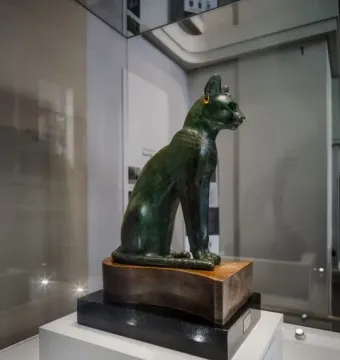
December 2023 © Dale Cruse · CC BY 2.0
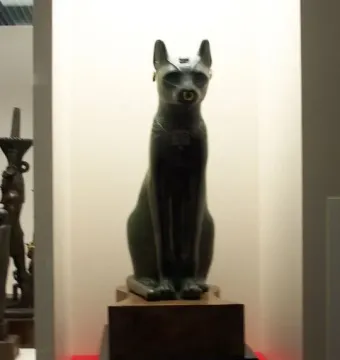
November 2003 © InSapphoWeTrust · CC BY-SA 2.0
· CC BY-SA 2.0
Identification | |
| Title | Gayer-Anderson cat |
| Type | Ancient Egyptian bronze statue of a cat |
| Alternative names | Кошка Гайер-Андерсона; Kot Gayera-Andersona; Gato de Gayer-Anderson |
Historical context | |
| Date | Late Period of ancient Egypt, about 664–332 BC |
| Culture | Ancient Egypt |
Creator | |
| Namesake | Major Robert Grenville Gayer-Anderson |
| Donors to the British Museum | Major Robert Grenville Gayer-Anderson and Mary Stout Shaw |
Discovery and provenance | |
| Provenance | Probably from Saqqara |
| Acquisition | Presented to the British Museum by Major Robert Grenville Gayer-Anderson in the 1930s |
| Inventory number | EA 64391 |
Physical characteristics | |
| Dimensions | 42 cm high, 13 cm wide |
Materials | |
| Material | Bronze with gold ornament |
| Alloy composition | 85% copper, 13% tin, 2% arsenic, and 0.2% lead |
Technique | |
| Possible alloy variation | Different alloys may have been used to create tonal variation on the body and stripes on the tail |
| Possible eye inlays | The eyes may originally have had stone or glass inlays |
| Casting process | A wax model was covered with clay; after firing, the hollow mold was filled with molten metal |
| X-ray evidence of manufacture | X-rays show remains of the pins that supported the wax core |
| Manufacturing technique | Lost-wax casting |
Appearance | |
| Depicted subject | A seated cat |
Iconography and meaning | |
| Associated deity | Probably Bastet |
| Decoration | Jewelry, a protective amulet with the Eye of Horus, a scarab on the head, and a winged scarab on the chest |
| Possible later additions | The earrings and nose ring may have been added later |
Location and ownership | |
| Current location | British Museum |
| Copy location | Gayer-Anderson Museum, Cairo |
History and restoration | |
| Condition | Not as well preserved as it appears; survives with losses and cracks |
| X-ray findings | X-rays reveal cracks almost completely around the middle of the body, and an internal reinforcement system holds the head in place |
| Restoration | Restored and cleaned by Major Gayer-Anderson in the 1930s |
| Condition when acquired | The surface was covered with a thick layer of crystalline verdigris and red patina |
Significance | |
| Name origin | Named after Major Robert Grenville Gayer-Anderson, who donated it to the British Museum |