
Young Archer
Young Archer is a marble statue in the collection of the Metropolitan Museum of Art in New York. The museum considers it a late Quattrocento work by Michelangelo, although this attribution is not widely accepted and has been disputed, including by William Wallace. Supporters of Michelangelo’s authorship have also identified the sculpture as the so-called “Manhattan Cupid,” connecting it with a long-lost life-size Cupid documented as a work made by Michelangelo for Jacopo Galli. The sculpture was purchased by architect Stanford White for the Payne Whitney Manhattan residence, where it was installed in the hall above a fountain designed by White. Since 2009, it has been on special loan from France to the Metropolitan Museum.
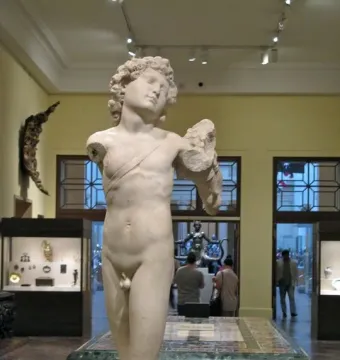
May 2012 © Yair Haklai · CC BY-SA 3.0
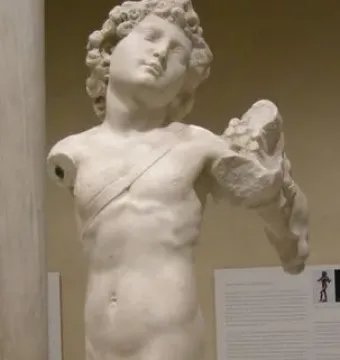
© sailko · CC BY-SA 3.0
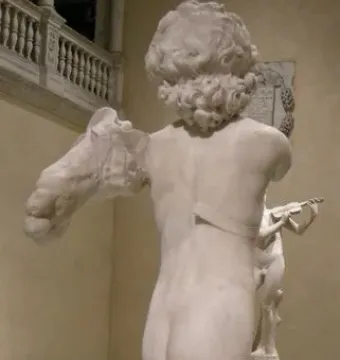
© sailko · CC BY-SA 3.0
Identification | |
| Title | Young Archer |
| Alternative name | Manhattan Cupid |
| Type | Marble sculpture |
| Original titles | Юный лучник; Ю́ний лу́чник; Le Jeune Archer; El Joven aquero; Il Giovane arciere |
Historical context | |
| Date | circa 1491–1492 |
| Period | Late Quattrocento |
Creator | |
| Attribution | Attributed to Michelangelo; disputed by William Wallace and other researchers |
| Attribution reaffirmed by | Kathleen Weil-Garris Brandt, 1997 |
| Related lost work identification | Sometimes identified by supporters with Michelangelo's lost life-size Cupid, also described as Cupid-Apollo |
| Commissioner of related lost work | Jacopo Galli |
Discovery and provenance | |
| Rediscovered by | James David Draper |
| Exhibition history | Shown in a 1999 exhibition on the young Michelangelo at Palazzo Vecchio, Florence, and at the Metropolitan Museum in 2009 |
| Later building use | The house later served as the New York office of the French Embassy's cultural department |
| Original installation | Installed in the lobby of the Payne Whitney mansion in Manhattan, above a fountain designed by Stanford White |
| Probable earlier owner/transfer | Probably brought to the house by Stanford White |
| Rediscovery location | Embassy of France on Fifth Avenue, New York |
| Museum loan | Held on a ten-year special loan from France to the Metropolitan Museum of Art, New York |
| Rediscovered in | 1990 |
| Post-auction status | Its whereabouts were lost after the 1902 auction; for a long time the auction-catalogue reproduction was the only visual record |
| Auction attribution | Attributed to Michelangelo |
| Auction date | 27 May 1902 |
| Auction house | Christie's |
| Sold through | Stefano Bardini |
| Original collection | Borghese collection |
Location and ownership | |
| Current location | Metropolitan Museum of Art, New York |
| Presence in the Americas | The only sculpture by Michelangelo in the American continent |
Physical characteristics | |
| Finished areas | The face and buttocks seem carefully smoothed |
| Unfinished areas | Small rough areas remain, especially in the hair and torso |
| Surface damage | Scratches and abrasions, with some fractures repaired by metal joints |
| Condition | Poorly preserved and unfinished |
| Anatomy | Notable anatomical precision, though the back has been questioned for an unusually long sacrum |
| Expression and hair | Calm, impassive face with curly hair |
| Attribute | A quiver shaped like a lion's paw is attached to the left arm |
| Head position | Head slightly tilted left, probably turned toward the quiver |
| Pose | The figure appears to be moving forward with a pronounced twist, lacking contrapposto |
| Missing parts | Arms and the lower legs below the knees are missing |
| Subject | A naked youth |
| Height | 97 cm |
Materials | |
| Material | Marble |
History and restoration | |
| Surface damage interpretation | The wear is compatible with outdoor display in a garden, possibly the Horti Borghese in Rome |
| Non-finito interpretation | The unfinished areas have been interpreted as a non-finito stage typical of Michelangelo's art |
Significance | |
| Stylistic assessment | Softly modeled with a delicate sentimental tone, still far from the terribilità of Michelangelo's mature works |
| Comparisons | Compared with Michelangelo's youthful works such as the Candleholder Angel, the Crucifix of Santo Spirito, the satyr in Bacchus, and figures from The Battle of the Centaurs |
| Facial comparison | The face resembles the angels in the Manchester Madonna panel |
| Attribution arguments | Supporters cite the curly hair, lack of contrapposto, unfinished details, and back anatomy; critics have questioned the hair treatment and other details |