
Venus of Moravany
Venus of Moravany is a Paleolithic Venus figurine from the Gravettian culture, discovered in Moravany nad Váhom in the Trnava Region of Slovakia. Made of mammoth bone, it measures 7.5 cm high, 2.0 cm wide, and 2.7 cm thick. Radiocarbon dating places it at about 22,800 BC. The figurine shows a schematically rendered female form with strongly emphasized sexual features, but without arms or a head. Found in the 1930s at a prehistoric mammoth-hunter camp, it was later taken during the German occupation, shown in Paris, and eventually returned to Slovakia in 1967. It is now held by the Department of Archaeology of the Slovak Academy of Sciences in Nitra.
July 2006 © Jankaka · CC BY-SA 3.0
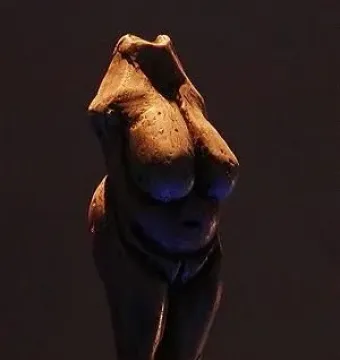
June 2005 © Martin Hlauka (Pescan) · Attribution
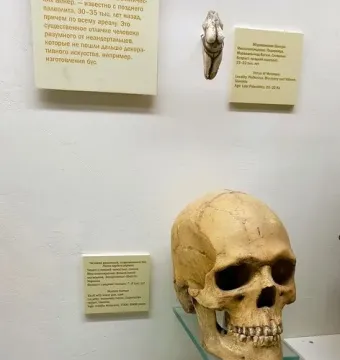
October 2022 © MikSed · CC BY-SA 4.0
Identification | |
| Title | Venus of Moravany |
| Alternative names | Wenus z Moravan; Wenus Morawiańska; Venus of Moravany nad Váhom |
| Type | Paleolithic Venus figurine |
Historical context | |
| Cultural period | Gravettian culture |
| Date | about 22,800 BC |
Discovery and provenance | |
| Discovery location | Near Moravany nad Váhom, Slovakia |
| Discovery context | Found in a prehistoric mammoth-hunters' campsite |
| Discovery date | Around 1930 |
| Discoverer | Farmer Štefan Gulman-Petrech |
| Later ownership and movement | Passed to the German archaeologist Lothar Zotz during World War II, shown in Paris and authenticated by Henri Breuil, with a cast taken to the Musée de l’Homme; returned to Slovakia in 1967 through the efforts of Czechoslovak scholars, including archaeologist Juraj Barta |
Location and ownership | |
| Current location | Slovak National Museum, Bratislava Castle |
| Replica | A cast is kept at the Musée de l’Homme in Paris |
Physical characteristics | |
| Height | 7.5–7.6 cm |
| Width | 2.0 cm |
| Thickness | 2.7 cm |
Materials | |
| Carved from | Mammoth tusk |
| Material | Mammoth ivory |
Technique | |
| Dating method | Radiocarbon dating |
Appearance | |
| Depicted figure | A standing naked female figure |
| Preserved features | Prominent breasts, wide hips, pronounced abdomen, clearly indicated navel and genitals |
| Missing parts | Head, arms, and lower legs |
| Stylistic features | Schematically outlined with clearly emphasized sexual characteristics |
Iconography and meaning | |
| Interpretation | A symbol of the preservation of the human race |
| Name origin | The term 'Venus' is a conventional label for Upper Paleolithic female figurines, derived from the Roman goddess Venus and originally popularized in the mid-nineteenth century by the Marquis de Vibraye's name La Vénus impudique |
| Scholarly criticism | Some scholars, including Vandewettering, argue that the naming reflects androcentric interpretations |
History and restoration | |
| Authenticity | Authentic, though Lothar Zotz initially doubted it; confirmed by Henri Breuil and later by a 1967 scientific study by Florian Heller |
| Scientific study | A 1967 study concluded that the ivory was carved before fossilization |
Significance | |
| Significance | Considered the oldest work of art in Slovakia |
Other | |
| Comparable finds | Venus of Willendorf; Venus of Dolní Věstonice |
| Associated categories | Archaeology of Slovakia; Paleolithic Venuses; Stone Age Europe; East Gravettian culture |