
Tuxtla Statuette
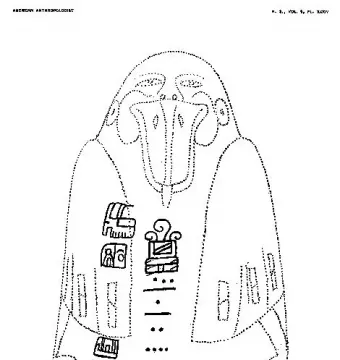
The Tuxtla Statuette is a small rounded nephrite figurine about 6.5 inches high, carved as a squat human figure with a duck-like bill, raised wings or a wing-like cape, and incised feet. It bears two columns of Epi-Olmec or Isthmian script on the front and two on the back, though the front is partly defaced and only partly readable. The glyphs include a Mesoamerican Long Count date, possibly March 162 CE, making it one of the oldest such dates known when discovered. Found in 1902 near Santiago Tuxtla in Veracruz by a farmer, it was later acquired by the Smithsonian Institution and is now in the National Museum of Natural History.
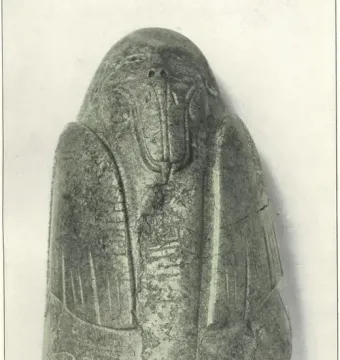
1907 © W. H. Holmes · Public domain
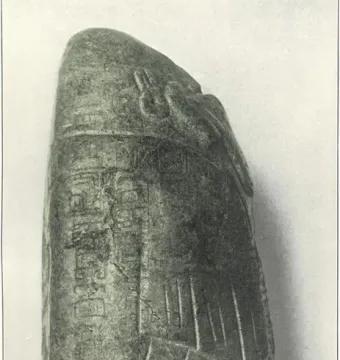
1907 © W. H. Holmes · Public domain
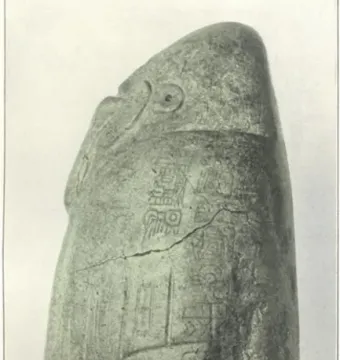
1907 © W. H. Holmes · Public domain
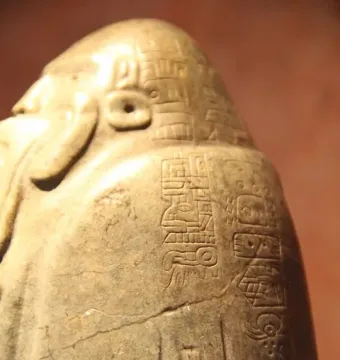
July 2012 © Gary Todd · CC0
1907 © W. H. Holmes · Public domain
Identification | |
| Title | Tuxtla Statuette |
| Original language name | Estatuilla de Tuxtla |
| Type | statuette |
Historical context | |
| Regional association | from the same region and period as La Mojarra Stela 1 |
| Period | final century of the Epi-Olmec culture |
| Culture | Epi-Olmec |
Creator | |
| Creator | unknown |
Discovery and provenance | |
| Discovery date | 1902 |
| Discoverer | a farmer named Pedro Mimendi |
| Discovery circumstance | found while plowing his field |
| Exact findspot | unknown |
| Acquisition | acquired by the Smithsonian Institution shortly after discovery |
| Provenance claim | reputedly smuggled into New York in a shipment of tobacco leaves |
| Catalog number | A222579-0 |
| Discovery location | west foothills of the Sierra de los Tuxtlas, Veracruz, Mexico, near Tres Zapotes |
Physical characteristics | |
| Material | green stone, probably nephrite |
| Height | about 16.5 cm |
| Shape | squat, rounded, bullet-shaped figure |
| Workmanship | shows traces of working on all sides |
Appearance | |
| Feet | feet carved at the base |
| Body features | raised wings or a wing-shaped cloak enveloping the body |
| Figure | crouching human figure with a human face and a long beak-like form extending to the chest |
| Head features | receding forehead and flat nose |
Iconography and meaning | |
| Script significance | one of the few extant examples of this very early Mesoamerican writing system |
| Possible reference | may refer to the same events or people as La Mojarra Stela 1 |
| Long Count date | 8.6.2.4.17, equivalent to 12 March 162 CE |
| Calendar content | includes a Long Count date |
| Dating uncertainty | some researchers suggested the date and text were carved much later than 162 CE |
| Interpretation | most researchers think it represents a shaman or shaman-priest wearing a bird mask and matching cloak |
| Bird context | a locally abundant bird along the Gulf Coast of Tabasco and southeastern Veracruz |
| Bird identification | the beak has been identified as that of a boat-billed heron |
Technique | |
| Inscription layout | two columns on the front and two on the back |
| Inscription | about 75 incised glyphs in the Epi-Olmec (Isthmian) script |
History and restoration | |
| Inscription condition | the front is somewhat defaced, so the front glyphs are only partially readable |
Significance | |
| Discovery significance | at the time of discovery in 1902, it was the oldest known Long Count date |
| Authenticity dispute | it was long discussed whether the sculpture might be a forgery |
| Later confirmation | later discoveries, including La Mojarra Stela 1 and Tres Zapotes Stela C, confirmed its antiquity |
| Related monument | Cerro de las Mesas Monument 5, a carved boulder showing a semi-nude figure with a duckbill-like mouth mask |
Location and ownership | |
| Current collection | Department of Anthropology, National Museum of Natural History, Smithsonian Institution, Washington, D.C. |
| Current owner | Smithsonian Institution |
| Current location | Washington, D.C., United States |
| Display status | on display at the museum in 2017–2019 |
Other | |
| Artistic importance | important for both its artistic quality and its calendrical information |