
Worshipper of Larsa
Worshipper of Larsa is a Mesopotamian statuette from the Paleo-Babylonian period, probably from the city of Larsa and dating to the first half of the second millennium BCE. It bears a Sumerian inscription and was dedicated to the god Amurru by Lu-Nanna for the life of the Paleo-Babylonian king Hammurabi. The figure, now in the Louvre (AO 15704), was acquired by the museum in 1931. Made of copper and gold, it shows a kneeling man with his hand before his mouth in a posture of prayer. The man is now generally identified as the dedicator Lu-Nanna rather than Hammurabi. The dedication highlights the growing importance of Amurru in Paleo-Babylonian religion.
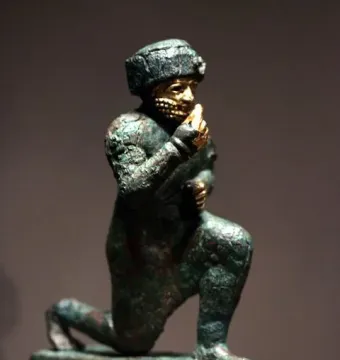
© Rama · CC BY-SA 3.0 fr
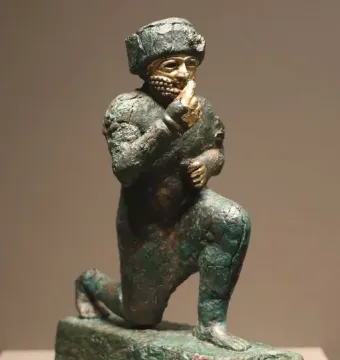
February 2024 © Francesco Bini · CC BY-SA 4.0
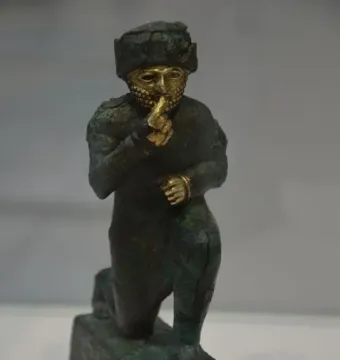
May 2016 © Carole Raddato · CC BY-SA 2.0
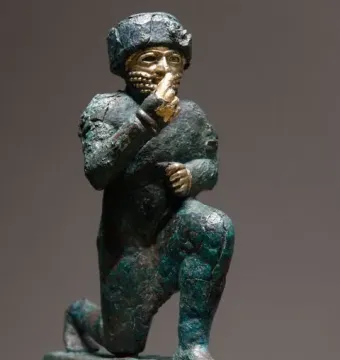
2014 © Marie-Lan Nguyen · Public domain
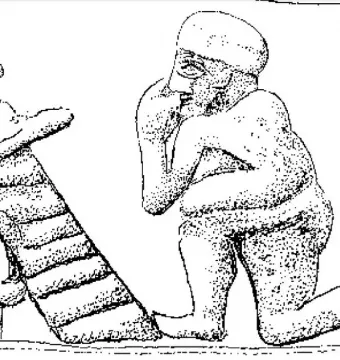
September 2008 © University of Zurich · Public domain
Identification | |
| Title | Worshipper of Larsa |
| Alternative title | So-called Adorante di Larsa |
| Original French title | L'Adorant de Larsa |
| Object type | Mesopotamian statuette |
Historical context | |
| Period | Old Babylonian period (Paleo-Babylonian period), first half of the 2nd millennium BCE (c. 2004–1595 BCE) |
Discovery and provenance | |
| Acquisition date | 1931 |
| Acquisition method | Purchased on the antiquities market after archaeological excavations at Larsa |
| Findspot | Larsa |
| Provenance | From clandestine excavations at Tell Senkereh, the ancient Larsa |
| Origin | Larsa, possibly Tell Senkereh (ancient Larsa) |
Creator | |
| Dedicator | A man named Lu-Nanna, believed to be an inhabitant of Larsa |
| Dedication | Dedicated to the god Amurru for the life of King Hammurabi |
| Inscription | Sumerian inscription |
| King referenced | Hammurabi (reigned c. 1792–1750 BC) |
Physical characteristics | |
| Height | 19.6 cm |
| Length | 14.8 cm |
| Width | 7 cm |
Materials | |
| Material | Copper with gold leaf gilding on the face, beard, and hands |
Appearance | |
| Headgear | A cap or hat similar to royal attire |
| Base decoration | One side shows the figure in front of a seated deity; the other side shows an ox or ram; the front has a small offering vase or projecting basin |
| Base inscription | Long inscription identifying Amurru as the patron god of the Amorrites |
| Figure details | A high-ranking man with a very finely depicted face |
| Condition | Exceptionally well preserved |
| Depicted figure | A bearded kneeling man, orant, with his hand raised to his mouth |
| Pose | Kneeling on his right knee in a prayer posture |
Significance | |
| Historical interpretation | The dedication attests to the growing importance of the god Amurru in Old Babylonian religion |
| Distinctive feature | Unique in its workmanship |
Location and ownership | |
| Current location | Room 227, Richelieu Wing, ground floor, Louvre Museum, Paris |
| Current owner | Musée du Louvre |
| Inventory number | AO 15704 |