
Venus of Tan-Tan
Venus of Tan-Tan is a possible anthropomorphic figure about six centimeters tall, made from a quartzite pebble with multiple fissures that give it a human-like form. It preserves traces of ochre and may also show intentional incisions and percussion marks, though its natural origin remains disputed. The piece was found in 1999 during an archaeological excavation led by Lutz Fiedler, 15 meters deep in fluvial sediments of the Drâa River near Tan-Tan, north of Tarfaya, Morocco. The associated context was a developed Acheulean industry with bifaces and flake tools. Some scholars accept it as a prehistoric human-modified object, while others argue it is only a naturally anthropomorphic stone.
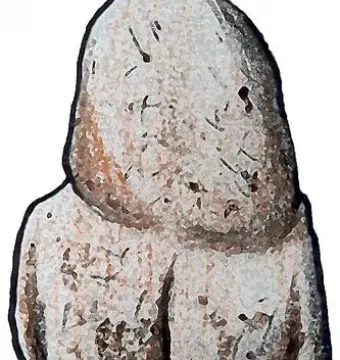
February 2006 © José-Manuel Benito · Public domain
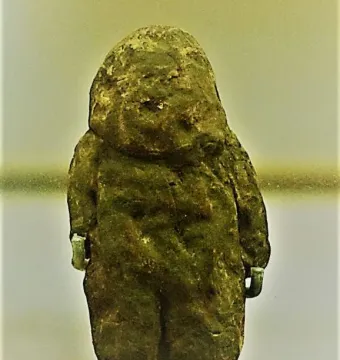
August 2018 © Museum of Human Evolution · CC BY-SA 4.0
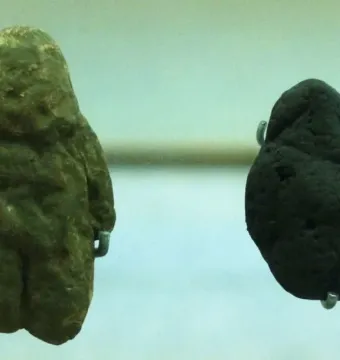
2018 © Own work · CC BY-SA 4.0
Identification | |
| Name | Venus of Tan-Tan |
| Type | Disputed prehistoric anthropomorphic figurine or proto-figurine |
| Original name | La Vénus de Tan-Tan |
Discovery and provenance | |
| Discovery year | 1999 |
| Discoverer | Lutz Fiedler, German archaeologist and state archaeologist of Hesse |
| Discovery context | Found during an archaeological survey/excavation |
| Discovery location | River terrace deposit on the north bank of the Draa River near Tan-Tan, Morocco |
| Discovery depth | 15 metres |
| Archaeological context | Attribution to the Lower Paleolithic / mid-Acheulean is disputed; some descriptions also place it in an Upper Paleolithic context |
| Associated industry | Acheulean assemblage with handaxes and flake tools |
| Associated human species | Homo heidelbergensis |
| Related find | Venus of Berekhat Ram |
| Comparison with related find | Sometimes proposed as contemporary with the Venus of Berekhat Ram and among the earliest known human-like figures |
| Dating | Uncertain; variously estimated at about 200,000–300,000 years ago, or 300,000–500,000 years ago, with some scholars proposing about 500,000 years ago |
Physical characteristics | |
| Surface features | Several cracks, fissures, grooves and indentations, some natural and some apparently artificial |
| Anthropomorphic appearance | Human-like, but extremely rough with generalized forms and no face |
| Sex depiction | Indeterminate; no clear sex characteristics |
| Dimensions | About 6 cm long, 2.6 cm wide, 1.2 cm thick; about 10 g |
| Head | No well-defined head |
Materials | |
| Material | Quartzite pebble |
| Pigment residue | Traces of ochre and other pigment residue; some descriptions mention a greasy substance with ochre |
Technique | |
| Surface treatment | Possible intentional incisions, percussion marks and carving; some grooves may be natural and others artificial |
| Pigment application | Possible later application of red ochre after carving |
Appearance | |
| Coloration | Traces of red ochre |
Historical context | |
| Contemporary species | Homo heidelbergensis |
| Possible age significance | If artificial, it could be among the earliest known representations of the human form |
Iconography and meaning | |
| Claims about meaning | Has been interpreted by some as evidence of primitive belief centered on the female figure and fertility |
| Interpretation | Disputed: some scholars see it as an intentional anthropomorphic sculpture, while others regard it as a naturally shaped pebble or geofact |
| Classification | Sometimes classed as a Venus figurine, but this interpretation is highly problematic |
| Symbolic meaning | Some scholars associate the ochre and human-like form with symbolic, possibly cultic or fertility-related significance |
Location and ownership | |
| Current location | Not stated |
History and restoration | |
| Controversy | Its nature, origin and use have been controversial since discovery |
| Scientific views | Stanley Ambrose argued it is a naturally eroded pebble and denied deliberate human enhancement; Robert Bednarik argued a natural pebble was intentionally modified by incisions, percussion and possibly ochre to make it more human-like |
| Natural origin hypothesis | Natural formation by erosion, weathering, wind or water is proposed by some researchers |
| Artificial modification hypothesis | Supporters argue a prehistoric hominid deliberately accentuated its human-like shape with stone-tool marks and possible pigment |
| Additional evidence | Percussion marks and a greasy substance with some ochre were noted; Bednarik considered the ochre to be manganese oxide and iron oxide, and it does not appear on other artifacts from the excavation |
Significance | |
| Significance claims | Sometimes presented as one of the oldest examples of a Paleolithic Venus and the earliest known monument of artistic creation |