
The Feast of Herod
The Feast of Herod, also known as Salome, is a work by Donatello conserved at the Palais des Beaux-Arts in Lille. It is a rectangular white Carrara marble bas-relief made around 1435 using the new relievo schiacciato technique invented by Donatello. The scene is taken from the Gospels and shows two moments in the story at once: Salome’s dance before Herod and the presentation of John the Baptist’s severed head. The composition places Salome at the center, while a second figure of her appears on the left in a gesture of repulsion. Around Herod, the guests react with horror and consternation.
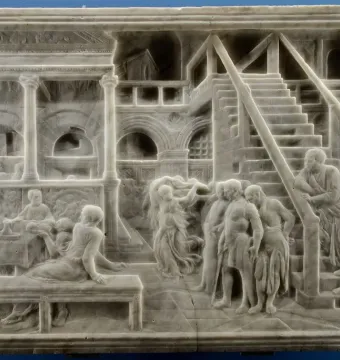
July 2022 © Velvet · CC BY-SA 4.0
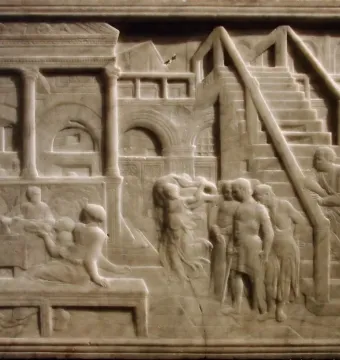
January 2008 © Vassil · Public domain
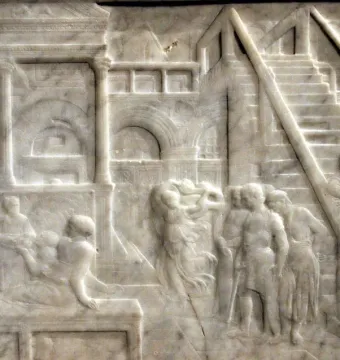
March 2007 © Remi Jouan · CC BY-SA 3.0
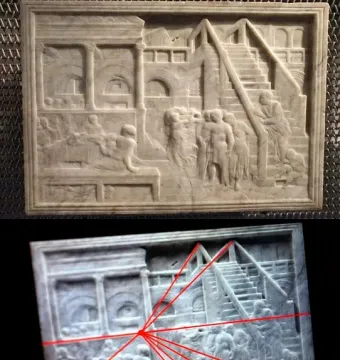
1435 © Sdegroisse · CC BY-SA 4.0
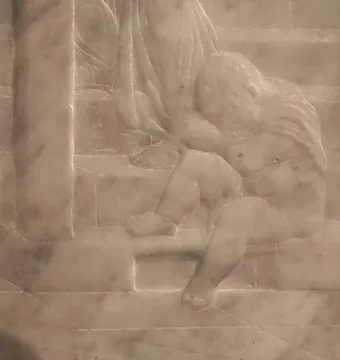
March 2017 © Sailko · CC BY 3.0
Identification | |
| Title | The Feast of Herod |
| Alternative titles | Salomé; Danza di Salomè; Il Banchetto di Erode; Le Festin d’Hérode |
| Type | Bas-relief |
| Shape | Rectangular |
Historical context | |
| Treatise | De pictura by Leon Battista Alberti, written in Florence in 1435 |
| Source | The Gospels |
| Date | circa 1435 |
| Date attribution | Mid-1430s, based on analogy with the stuccoes of the Old Sacristy, especially the Ascension of Saint John the Evangelist |
Creator | |
| Artist | Donatello |
| Technique attribution note | A new technique invented by Donatello |
| Attribution | Attributed to Donatello; generally accepted as probably by Donatello |
Materials | |
| Material | White Carrara marble |
Technique | |
| Technique | Relievo schiacciato (stiacciato relief) |
| Perspective | Uses rigorous perspective rules; described as the first bronze bas-relief to which Donatello applied such rules |
| Relation to Alberti | Applies principles defined by Leon Battista Alberti in De pictura |
Physical characteristics | |
| Dimensions | 43.5 × 65 cm |
| Composition depth | About 1 cm thick |
| Number of planes | About ten successive planes |
Location and ownership | |
| Current location | Musée des Beaux-Arts de Lille, Lille |
Discovery and provenance | |
| Bequest date | 1834 |
| Original placement | First floor of the Palazzo Medici, in the antechamber separating Lorenzo de' Medici's bedroom from his study |
| Bequest recipient | Society of Sciences, Agriculture and Arts of Lille |
| Acquirer | Jean-Baptiste Wicar |
| Provenance | Later lost track of; acquired by Jean-Baptiste Wicar at the beginning of the 19th century; bequeathed to the Society of Sciences, Agriculture and Arts of Lille in 1834 |
| Probable identification | Probably identifiable with the relief listed in the inventory of the possessions of Lorenzo de' Medici after his death in 1492 |
| Probable source document | Inventory of Palazzo Medici compiled in 1492 after the death of Lorenzo de' Medici |
Iconography and meaning | |
| Figure reactions | Salome turns away in repulsion; the guests express horror and consternation; one guest covers his eyes; the soldiers appear disturbed |
| Interpretation | The dancing Salome is interpreted as a spectral evocation of the stratagem used to have the saint killed |
| Background elements | The prison bars of John the Baptist are visible in the background |
| Salome depiction | Salome is shown in ancient-style dress and appears twice in the composition |
| Additional figures | An executioner carrying a sword and shield, a man on the staircase, a sleeping child, and a group of soldiers |
| Herod depiction | Herod receives the presentation of John the Baptist’s head |
| Left scene | A kneeling servant presents the severed head of Saint John the Baptist to Herod |
| Central scene | Salome’s dance of the seven veils |
| Narrative structure | A single composition combining two episodes: Salome’s dance and the presentation of Saint John the Baptist’s head to Herod |
| Subject | The banquet of Herod, where Salome dances and Herod orders the head of Saint John the Baptist to be presented |
Appearance | |
| Main artistic focus | Architecture, especially the virtuoso staircase on the right, foreshortened in perspective |
| Spatial treatment | Figures are placed effectively in space, with arches and openings revealing depth and an open space extending beyond the relief |
| Background feature | A foreshortened, obliquely seen pediment appears in the background |
| Style | Less dramatic than the Siena relief, with a more linear action and mildly grotesque accents |
Significance | |
| Comparative work | The analogous Banquet of Herod in Siena, cast in bronze by Donatello in 1423–1427 |
| Interpretation of autonomy | Generally interpreted as an independent work; no traces are known of it having belonged to a decorative complex |
| Certainty note | The identification and interpretation are presented as probable or generally accepted, not certain |
Other | |
| Comparative work material | Bronze cast |